DNI: Chinese hacking against U.S. companies is 'ongoing' but 'significantly reduced'
Full article728 words · extracted from cyberscoop.com · click to collapse
Get our latest cybersecurity news first on Google.
Dan Coats' assessment reports significant progress on the cyber front between the world's two biggest economies.

Chinese hacking against U.S. targets is ongoing but “at volumes significantly lower” than before the landmark agreement reached in 2015 between Beijing and Washington D.C., according to the Director of National Intelligence Dan Coats.
Former President Barack Obama and Chinese President Xi Jinping signed a deal in 2015 after cyberattacks that included widespread intellectual property theft for commercial gain, along with soft attribution that prompted threats of sanctions and other retaliation.
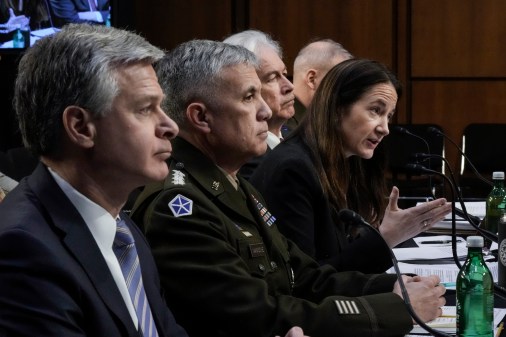
Coats’ comments came in front of the Senate Armed Services Committee Tuesday during a hearing on worldwide military threats faced by the United States. Almost two years after the agreement was signed, Coats’ assessment notes significant progress on the cybersecurity front between the world’s two biggest economies.
“We assess that Beijing will continue actively targeting the U.S. government, its allies, and U.S. companies for cyber espionage,” Coats said in his written testimony. “Private-sector security experts continue to identify ongoing cyber activity from China, although at volumes significantly lower than before the bilateral Chinese-U.S. cyber commitments of September 2015. Beijing has also selectively used offensive cyber operations against foreign targets that it probably believes threaten Chinese domestic stability or regime legitimacy.”
Gen. Vincent Stewart, director of the Defense Intelligence Agency, noted during his tesitmony that “attributing malicious cyberactivities is an enduring challenge, and the potential for unintended escalatory consequences from a cyberattack remains a concern.”
“Nations such as Russia and China will increasingly integrate cyberattack capabilities into their militaries, seeking to deny or disrupt our networked forces and infrastructure,” Stewart said testified.
China’s “long-term military modernization program” was one of several prioritized focuses in the hearing.
Coats also pointed to the late 2015 establishment of China’s PLA Strategic Support Force “probably to improve oversight and command of Beijing’s growing military interests in space and cyberspace.”
While addressing forward-looking threats, Coats asserted that a “blending” of electronic warfare and cyber-attack is expanding the threats in space.
Earlier this week, a former IBM developer and Chinese national pled guilty to stealing secrets from the American technology giant from 2010 to 2014 “to benefit the National Health and Family Planning Commission of the People’s Republic of China,” according to the U.S. Justice Department. The theft predated the Obama-Xi agreement.
More Scoops
US intel: Chinese influence operations are growing more aggressive, more similar to Russia’s
China is stepping up efforts to influence U.S. public opinion, which increasingly resemble Russian operations.
Accused Chinese hackers abandon techniques after U.S. indictments

Cyberthreats rise to the top at Senate hearing on worldwide dangers for U.S.
Latest Podcasts
Government
FBI officials say AI is bolstering adversaries, emphasizing need to focus on cyber basics, patching
Feds accuse China of ‘systematic’ distillation of U.S. AI models
CIA’s Michael Ellis says cyber intelligence is changing how the agency operates
The G7 tells industry to hurry up and prep for post-quantum encryption
Technology
Threats
Microsoft discloses two actively exploited zero-days among 974 vulnerabilities
Russian national extradited to US for alleged involvement in bank-account takeover scheme
Attackers exploit zero-days in consistently besieged SonicWall product
Jail time for Maine child in 764 marks turning point in federal law enforcement
Policy
Whistleblower says USPS deploying new, ‘untested’ IT systems governing mail-in ballots
‘Watershed 250’ test program in Texas looks to private sector for water cybersecurity help
Former sexual abuse victims say Grok used their images, videos to train deepfake capabilities
Cyber threats nudge Trump to sign executive order on foreign equipment in U.S. energy infrastructure
Text extracted automatically; images, tables and formatting may be missing. Original: https://cyberscoop.com/china-us-hacking-odni-dan-coats-2017/