Clop is back to wreak havoc via vulnerable file
Vulnerabilities mentionedAll →
| CVE | Vulnerability | CVSS | EPSS | Flags | Affected | Exposure | Published |
|---|---|---|---|---|---|---|---|
| CVE-2024-50623 | Unauthenticated RCE via Unrestricted File Upload in Cleo Harmony, VLTrader, LexiCom CVE-2024-50623 is an unrestricted file upload and download flaw (CWE-434) in Cleo's managed file transfer products — Harmony, VLTrader, and LexiCom — before version 5.8.0.21. It is reachable over the network with no authentication or user interaction (CVSS 9.8, AV:N/AC:L/PR:N), letting an attacker send crafted requests that upload arbitrary files to the server. The unrestricted upload leads to remote code execution, giving the attacker full control of the host for staging, data theft, or ransomware, while the download capability risks exposure of business files the server moves with trading partners. Any organization running these products is affected, and managed file transfer servers are typically internet-facing and handle sensitive B2B data. Exploitation is confirmed in the wild: CISA added it to the KEV catalog on 2024-12-13 with ransomware use noted, EPSS assigns a 98.6% probability of exploitation within 30 days, and the Clop ransomware gang has claimed dozens of breaches (some disputed), including a confirmed breach at WK Kellogg. Do: Upgrade Harmony, VLTrader, and LexiCom to 5.8.0.21 or later per vendor instructions; if upgrading is not possible, apply vendor mitigations or discontinue use of the product, as CISA's KEV entry requires. Prioritize internet-exposed instances, hunt for indicators of compromise (unexpected file writes and execution on the transfer host, new accounts, suspicious outbound connections), and restrict the service to trusted partner networks. Given known ransomware use by Clop, any suspected compromise should trigger checks for lateral movement and staged exfiltration of transferred files. | 9.8 | 99% | KEV ransomware |
| moderate≈1,000–3,000 internet-exposed Cleo servers (tens of thousands of enterprise deployments) | |
| CVE-2024-55956 | Unauthenticated File Upload RCE in Cleo Harmony, VLTrader, and LexiCom CVE-2024-55956 is an unauthenticated command-execution flaw (CWE-77) in Cleo's managed file transfer products: by default the Autorun directory automatically imports and runs files, so an unauthenticated attacker can import Bash or PowerShell commands that execute on the host. It is triggered over the network with no authentication and no user interaction (CVSS 3.1 score 9.8), by sending crafted import requests to a vulnerable Cleo server. Successful exploitation yields arbitrary command execution on the server, enabling data theft, lateral movement, and ransomware deployment. Any organization running Cleo Harmony, VLTrader, or LexiCom before 5.8.0.24 is affected — typically enterprises using these servers for EDI and partner file exchange. The flaw is actively exploited in the wild: it was added to CISA KEV on 2024-12-17 with known ransomware use (widely attributed to Cl0p), EPSS is 94% (top percentile), and confirmed downstream breaches such as WK Kellogg's have been tied to it. Do: Upgrade all Cleo Harmony, VLTrader, and LexiCom instances to 5.8.0.24 or later immediately, per the CISA KEV required action to apply vendor mitigations or discontinue use. If patching is delayed, restrict or remove internet exposure of the server. Because exploitation is confirmed and ransomware-linked, inspect the Autorun directory for unexpected imported files, review application logs for executed commands, and hunt for signs of data exfiltration or staging. | 9.8 | 94% | KEV ransomware PoC |
| largetens of thousands of installations (Cleo cites 100,000+ business customers; public internet scans showed roughly 1,000–2,000 exposed instances) |
Full article890 words · extracted from cyberscoop.com · click to collapse
Get our latest cybersecurity news first on Google.
Listen to this article
0:00
Learn more.

In what we can assure you is a new cybersecurity incident despite sounding incredibly similar to incidents of past notoriety: threat actors tied to a notorious ransomware and extortion group have exploited file-transfer software to carry out attacks.
Clop has claimed responsibility for attacks tied to vulnerabilities in software made by Cleo, an Illinois-based IT company that sells various types of enterprise software. The vulnerabilities, which affected Cleo’s LexiCom, VLTrader, and Harmony products, have led to worries that sensitive data across various industries could be swiped by the group in a repeat of some of the most damaging security incidents of the past few years.
The cybersecurity community was first alerted of the threat earlier this month when Huntress Labs identified that threat actors were exploiting Cleo’s software en masse. The flaw, catalogued as CVE-2024-50623, is an unrestricted file upload and download vulnerability that could lead to remote code execution. Cleo originally released fixes for CVE-2024-50623 in October, but the company issued another patch last week to further fix the issue.
Shortly thereafter, a new critical vulnerability was identified (CVE-2024-55956), allowing unauthenticated users to execute code through the Autorun directory. Cleo quickly issued another patch.
While the exact number of exploited systems remains unclear, cybersecurity firm Rapid7 cited a discernible uptick in compromised endpoints received via its customer telemetry..Huntress said in its initial research blog that approximately 10 businesses were attacked via the vulnerability, notably impacting sectors such as consumer products, food, and shipping.
According to Shodan, a search engine that scans IP addresses to find and access devices and systems connected to the internet, there were 390 exposed systems with the affected Cleo software as of this article’s publication. Cleo’s customer base spans around 4,200 organizations.
Last weekend, Clop published a blog post on its data leak site claiming responsibility for the attacks.
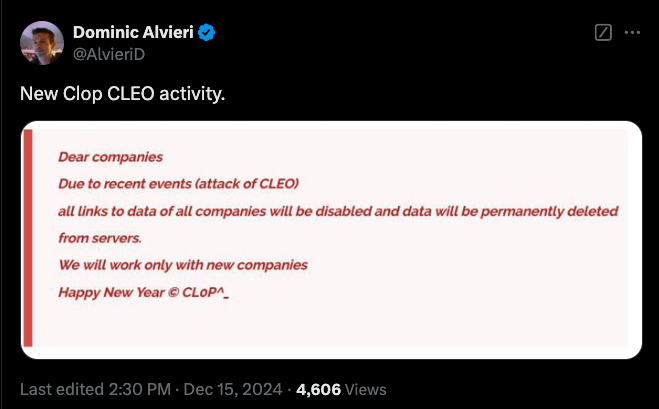
Clop has made a name for itself via vulnerabilities in this particular type of software, most notably related to the MoveIT breach in 2023. In May 2023, hackers with Clop exploited a previously undetected vulnerability in MOVEit software, which the group used to attack “hundreds of companies” as “part of exceptional exploit.” The exploit, which allowed the group to steal data via supply chain attacks, affected thousands of companies. Some risk management firms have stated that the attack is estimated to have cost companies a combined $12.15 billion.
The hacking group was also responsible for attacks related to similar software, including Fortra’s GoAnywhere MFT and Accelion’s file-transfer software.
Several cybersecurity experts told CyberScoop that the activity tied to Cleo’s software is the first time the group has surfaced since the MOVEit breach, indicating that Clop has been squarely focused on finding vulnerabilities in file-transfer software.
“It is plausible that Clop had prior knowledge of several vulnerabilities in the CLEO platform, enabling the group to breach and extract data from victim organizations systematically long before the vendor issued any public security advisory,” said a spokesperson for Intel471, a Texas-based threat intelligence company. “By timing their public disclosures and media engagement, the group likely intends to maximize the pressure on victims and amplify the overall impact of these attacks.”
Kimberly Goody, head of cyber crime analysis for Mandiant Google Cloud, told CyberScoop it is possible that the Cleo incidents show the threat actors, which the company tracks as FIN11, may have learned from the MOVEit breach and refined their techniques.
“Current evidence suggests that this may not have been a smash-and-grab as we observed with the MoveIt attack,” Goody said. “The targeting of these systems in the past has often not resulted in additional post-compromise activity other than the data theft and extortion; however, we have observed beacon deployment which could signal that the threat actors may have intended to also deploy ransomware.”
The Cybersecurity and Infrastructure Agency added one of the Cleo vulnerabilities to its Known Exploited Vulnerabilities list Tuesday, stating the addition is “based on evidence of active exploitation.”
Latest Podcasts
Government
FBI officials say AI is bolstering adversaries, emphasizing need to focus on cyber basics, patching
Feds accuse China of ‘systematic’ distillation of U.S. AI models
CIA’s Michael Ellis says cyber intelligence is changing how the agency operates
The G7 tells industry to hurry up and prep for post-quantum encryption
Technology
Threats
Microsoft discloses two actively exploited zero-days among 974 vulnerabilities
Russian national extradited to US for alleged involvement in bank-account takeover scheme
Jail time for Maine child in 764 marks turning point in federal law enforcement
Dogged Russia-based botnet dismantled after 23-year run
Policy
Whistleblower says USPS deploying new, ‘untested’ IT systems governing mail-in ballots
‘Watershed 250’ test program in Texas looks to private sector for water cybersecurity help
Former sexual abuse victims say Grok used their images, videos to train deepfake capabilities
Cyber threats nudge Trump to sign executive order on foreign equipment in U.S. energy infrastructure
Text extracted automatically; images, tables and formatting may be missing. Original: https://cyberscoop.com/clop-cleo-file-transfer-software-breach-fin11/