Player 3 Has Entered the Game: Say Hello to 'WannaCry'
Indicators of compromiseauto-extracted · verify before use · export allAll →
| Type | Indicator | Context |
|---|---|---|
| domain | iuqerfsodp9ifjaposdfjhgosurijfaewrwergwea.com | observed requests for one of WannaCry's killswitch domains (iuqerfsodp9ifjaposdfjhgosurijfaewrwergwea[.]com) starting at 07:24 UTC, then rising to a peak of just ove |
| sha256 | 055c7760512c98c8d51e4427227fe2a7ea3b34ee63178fe78631fa8aa6d15622 | 0548d8e6b87c83d50f4ab85c1debadb106d6a6a794c3e746f4fa b.wnry 055c7760512c98c8d51e4427227fe2a7ea3b34ee63178fe78631fa8aa6d15622 c.wnry 402751fa49e0cb68fe052cb3db87b05e71c1d950984d339940cf |
| sha256 | 09a46b3e1be080745a6d8d88d6b5bd351b1c7586ae0dc94d0c238ee36421cafa | daa345cfcaff3d629505572a484cff5221933d68e4a52130b8bb7badaf9 09a46b3e1be080745a6d8d88d6b5bd351b1c7586ae0dc94d0c238ee36421cafa 0a73291ab5607aef7db23863cf8e72f55bcb3c273bb47f00edf011515ae |
| sha256 | 0a73291ab5607aef7db23863cf8e72f55bcb3c273bb47f00edf011515aeb5894 | b3e1be080745a6d8d88d6b5bd351b1c7586ae0dc94d0c238ee36421cafa 0a73291ab5607aef7db23863cf8e72f55bcb3c273bb47f00edf011515aeb5894 428f22a9afd2797ede7c0583d34a052c32693cbb55f567a60298587b6e6 |
| sha256 | 24d004a104d4d54034dbcffc2a4b19a11f39008a575aa614ea04703480b1022c | d6a937221411bb8daf35900a9897fb234160087089a064066a65f42bcd4 24d004a104d4d54034dbcffc2a4b19a11f39008a575aa614ea04703480b1022c 2c2d8bc91564050cf073745f1b117f4ffdd6470e87166abdfcd10ecdff0 |
| sha256 | 2c2d8bc91564050cf073745f1b117f4ffdd6470e87166abdfcd10ecdff040a2e | 4a104d4d54034dbcffc2a4b19a11f39008a575aa614ea04703480b1022c 2c2d8bc91564050cf073745f1b117f4ffdd6470e87166abdfcd10ecdff040a2e 7a828afd2abf153d840938090d498072b7e507c7021e4cdd8c6baf727ca |
| sha256 | 2ca2d550e603d74dedda03156023135b38da3630cb014e3d00b1263358c5f00d | b5770705898cf9ef37aade532a7964642ecd705a74794b79 taskdl.exe 2ca2d550e603d74dedda03156023135b38da3630cb014e3d00b1263358c5f00d taskse.exe 97ebce49b14c46bebc9ec2448d00e1e397123b256e2be9eb |
| sha256 | 402751fa49e0cb68fe052cb3db87b05e71c1d950984d339940cf6b29409f2a7c | 98c8d51e4427227fe2a7ea3b34ee63178fe78631fa8aa6d15622 c.wnry 402751fa49e0cb68fe052cb3db87b05e71c1d950984d339940cf6b29409f2a7c r.wnry e18fdd912dfe5b45776e68d578c3af3547886cf1353d7086c8be |
| sha256 | 4186675cb6706f9d51167fb0f14cd3f8fcfb0065093f62b10a15f7d9a6c8d982 | 34012b8233b3df6adb7c0a3b2b13cc2354dd6de27e092873bf58af2693c 4186675cb6706f9d51167fb0f14cd3f8fcfb0065093f62b10a15f7d9a6c8d982 09a46b3e1be080745a6d8d88d6b5bd351b1c7586ae0dc94d0c238ee3642 |
| sha256 | 428f22a9afd2797ede7c0583d34a052c32693cbb55f567a60298587b6e675c6f | 91ab5607aef7db23863cf8e72f55bcb3c273bb47f00edf011515aeb5894 428f22a9afd2797ede7c0583d34a052c32693cbb55f567a60298587b6e675c6f 5c1f4f69c45cff9725d9969f9ffcf79d07bd0f624e06cfa5bcbacd22110 |
| sha256 | 4a468603fdcb7a2eb5770705898cf9ef37aade532a7964642ecd705a74794b79 | 5b45776e68d578c3af3547886cf1353d7086c8bee037436dff4b s.wnry 4a468603fdcb7a2eb5770705898cf9ef37aade532a7964642ecd705a74794b79 taskdl.exe 2ca2d550e603d74dedda03156023135b38da3630cb014e3d |
| sha256 | 5c1f4f69c45cff9725d9969f9ffcf79d07bd0f624e06cfa5bcbacd2211046ed6 | 2a9afd2797ede7c0583d34a052c32693cbb55f567a60298587b6e675c6f 5c1f4f69c45cff9725d9969f9ffcf79d07bd0f624e06cfa5bcbacd2211046ed6 62d828ee000e44f670ba322644c2351fe31af5b88a98f2b2ce27e423dcf |
| sha256 | 62d828ee000e44f670ba322644c2351fe31af5b88a98f2b2ce27e423dcf1d1b1 | f69c45cff9725d9969f9ffcf79d07bd0f624e06cfa5bcbacd2211046ed6 62d828ee000e44f670ba322644c2351fe31af5b88a98f2b2ce27e423dcf1d1b1 72af12d8139a80f317e851a60027fdf208871ed334c12637f49d819ab4b |
| sha256 | 72af12d8139a80f317e851a60027fdf208871ed334c12637f49d819ab4b033dd | 8ee000e44f670ba322644c2351fe31af5b88a98f2b2ce27e423dcf1d1b1 72af12d8139a80f317e851a60027fdf208871ed334c12637f49d819ab4b033dd 85ce324b8f78021ecfc9b811c748f19b82e61bb093ff64f2eab457f9ef1 |
| sha256 | 7a828afd2abf153d840938090d498072b7e507c7021e4cdd8c6baf727cafc545 | bc91564050cf073745f1b117f4ffdd6470e87166abdfcd10ecdff040a2e 7a828afd2abf153d840938090d498072b7e507c7021e4cdd8c6baf727cafc545 a897345b68191fd36f8cefb52e6a77acb2367432abb648b9ae0a9d70840 |
| sha256 | 85ce324b8f78021ecfc9b811c748f19b82e61bb093ff64f2eab457f9ef19b186 | 2d8139a80f317e851a60027fdf208871ed334c12637f49d819ab4b033dd 85ce324b8f78021ecfc9b811c748f19b82e61bb093ff64f2eab457f9ef19b186 a1d9cd6f189beff28a0a49b10f8fe4510128471f004b3e4283ddc7f7859 |
| sha256 | 9588f2ef06b7e1c8509f32d8eddfa18041a9cc15b1c90d6da484a39f8dcdf967 | 044347e972e21b6c376e37e1115dab494a2c6b9fb28b92b1e45b45d0ebc 9588f2ef06b7e1c8509f32d8eddfa18041a9cc15b1c90d6da484a39f8dcdf967 b43b234012b8233b3df6adb7c0a3b2b13cc2354dd6de27e092873bf58af |
| sha256 | 97ebce49b14c46bebc9ec2448d00e1e397123b256e2be9eba5140688e7bc0ae6 | edda03156023135b38da3630cb014e3d00b1263358c5f00d taskse.exe 97ebce49b14c46bebc9ec2448d00e1e397123b256e2be9eba5140688e7bc0ae6 t.wnry b9c5d4339809e0ad9a00d4d3dd26fdf44a32819a54abf846bb9b |
| sha256 | a1d9cd6f189beff28a0a49b10f8fe4510128471f004b3e4283ddc7f78594906b | 24b8f78021ecfc9b811c748f19b82e61bb093ff64f2eab457f9ef19b186 a1d9cd6f189beff28a0a49b10f8fe4510128471f004b3e4283ddc7f78594906b a93ee7ea13238bd038bcbec635f39619db566145498fe6e0ea60e6e76d6 |
| sha256 | a897345b68191fd36f8cefb52e6a77acb2367432abb648b9ae0a9d708406de5b | afd2abf153d840938090d498072b7e507c7021e4cdd8c6baf727cafc545 a897345b68191fd36f8cefb52e6a77acb2367432abb648b9ae0a9d708406de5b fb0b6044347e972e21b6c376e37e1115dab494a2c6b9fb28b92b1e45b45 |
| sha256 | a93ee7ea13238bd038bcbec635f39619db566145498fe6e0ea60e6e76d614bd3 | d6f189beff28a0a49b10f8fe4510128471f004b3e4283ddc7f78594906b a93ee7ea13238bd038bcbec635f39619db566145498fe6e0ea60e6e76d614bd3 b43b234012b8233b3df6adb7c0a3b2b13cc2354dd6de27e092873bf58af |
| sha256 | b43b234012b8233b3df6adb7c0a3b2b13cc2354dd6de27e092873bf58af2693c | 7ea13238bd038bcbec635f39619db566145498fe6e0ea60e6e76d614bd3 b43b234012b8233b3df6adb7c0a3b2b13cc2354dd6de27e092873bf58af2693c eb47cd6a937221411bb8daf35900a9897fb234160087089a064066a65f4 |
| sha256 | b9c5d4339809e0ad9a00d4d3dd26fdf44a32819a54abf846bb9b560d81391c25 | 46bebc9ec2448d00e1e397123b256e2be9eba5140688e7bc0ae6 t.wnry b9c5d4339809e0ad9a00d4d3dd26fdf44a32819a54abf846bb9b560d81391c25 u.wnry Observed IPs 188[.]166[.]23[.]127:443 - Tor Exit Nod |
| sha256 | c365ddaa345cfcaff3d629505572a484cff5221933d68e4a52130b8bb7badaf9 | bfbc9eb5bbea545af4d01bf5f1071661840480439c6e5babe8e080e41aa c365ddaa345cfcaff3d629505572a484cff5221933d68e4a52130b8bb7badaf9 09a46b3e1be080745a6d8d88d6b5bd351b1c7586ae0dc94d0c238ee3642 |
| sha256 | d5e0e8694ddc0548d8e6b87c83d50f4ab85c1debadb106d6a6a794c3e746f4fa | ting this activity to alert administrators. IoCs File names d5e0e8694ddc0548d8e6b87c83d50f4ab85c1debadb106d6a6a794c3e746f4fa b.wnry 055c7760512c98c8d51e4427227fe2a7ea3b34ee63178fe78631 |
| sha256 | e18fdd912dfe5b45776e68d578c3af3547886cf1353d7086c8bee037436dff4b | cb68fe052cb3db87b05e71c1d950984d339940cf6b29409f2a7c r.wnry e18fdd912dfe5b45776e68d578c3af3547886cf1353d7086c8bee037436dff4b s.wnry 4a468603fdcb7a2eb5770705898cf9ef37aade532a7964642ecd |
| sha256 | eb47cd6a937221411bb8daf35900a9897fb234160087089a064066a65f42bcd4 | 34012b8233b3df6adb7c0a3b2b13cc2354dd6de27e092873bf58af2693c eb47cd6a937221411bb8daf35900a9897fb234160087089a064066a65f42bcd4 24d004a104d4d54034dbcffc2a4b19a11f39008a575aa614ea04703480b |
| sha256 | ed01ebfbc9eb5bbea545af4d01bf5f1071661840480439c6e5babe8e080e41aa | rzlojinas.onion 76jdd2ir2embyv47.onion Observed hash values ed01ebfbc9eb5bbea545af4d01bf5f1071661840480439c6e5babe8e080e41aa c365ddaa345cfcaff3d629505572a484cff5221933d68e4a52130b8bb7b |
| sha256 | fb0b6044347e972e21b6c376e37e1115dab494a2c6b9fb28b92b1e45b45d0ebc | 45b68191fd36f8cefb52e6a77acb2367432abb648b9ae0a9d708406de5b fb0b6044347e972e21b6c376e37e1115dab494a2c6b9fb28b92b1e45b45d0ebc 9588f2ef06b7e1c8509f32d8eddfa18041a9cc15b1c90d6da484a39f8dc |
Full article1,706 words · extracted from blog.talosintelligence.com · click to collapse
Friday, May 12, 2017 18:09
By Martin Lee, Warren Mercer, Paul Rascagneres, and Craig Williams.
Executive Summary
A major ransomware attack has affected many organizations across the world reportedly including Telefonica in Spain, the National Health Service in the UK, and FedEx in the US. The malware responsible for this attack is a ransomware variant known as 'WannaCry'.
The malware then has the capability to scan heavily over TCP port 445 (Server Message Block/SMB), spreading similar to a worm, compromising hosts, encrypting files stored on them then demanding a ransom payment in the form of Bitcoin. It is important to note that this is not a threat that simply scans internal ranges to identify where to spread, it is also capable of spreading based on vulnerabilities it finds in other externally facing hosts across the internet.
Additionally, Talos has observed WannaCry samples making use of DOUBLEPULSAR which is a persistent backdoor that is generally used to access and execute code on previously compromised systems. This allows for the installation and activation of additional software, such as malware. This backdoor is typically installed following successful exploitation of SMB vulnerabilities addressed as part of Microsoft Security Bulletin MS17-010. This backdoor is associated with an offensive exploitation framework that was released as part of the Shadow Brokers cache that was recently released to the public. Since its release it has been widely analyzed and studied by the security industry as well as on various underground hacking forums.
WannaCry appears to primarily utilize the ETERNALBLUE modules and the DOUBLEPULSAR backdoor. The malware uses ETERNALBLUE for the initial exploitation of the SMB vulnerability. If successful it will then implant the DOUBLEPULSAR backdoor and utilize it to install the malware. If the DOUBLEPULSAR backdoor is already installed the malware will still leverage this to install the ransomware payload. This is the cause of the worm-like activity that has been widely observed across the internet
Organizations should ensure that devices running Windows are fully patched and deployed in accordance with best practices. Additionally, organizations should have SMB ports (139, 445) blocked from all externally accessible hosts.
Please note this threat is still under active investigation, the situation may change as we learn more or as our adversary responds to our actions. Talos will continue to actively monitor and analyze this situation for new developments and respond accordingly. As a result, new coverage may be developed or existing coverage adapted and/or modified at a later date. For current information, please refer to your Firepower Management Center or Snort.org.
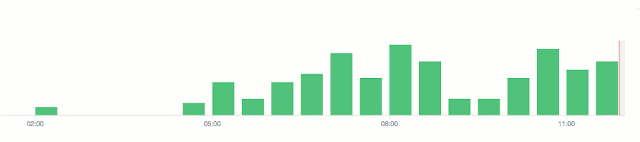
Campaign Details We observed an uptick in scanning of our internet facing honeypots starting shortly before 5am EST (9am UTC).
Infrastructure Analysis Cisco Umbrella researchers first observed requests for one of WannaCry's killswitch domains (iuqerfsodp9ifjaposdfjhgosurijfaewrwergwea[.]com) starting at 07:24 UTC, then rising to a peak of just over 1,400 nearly 10 hours later.
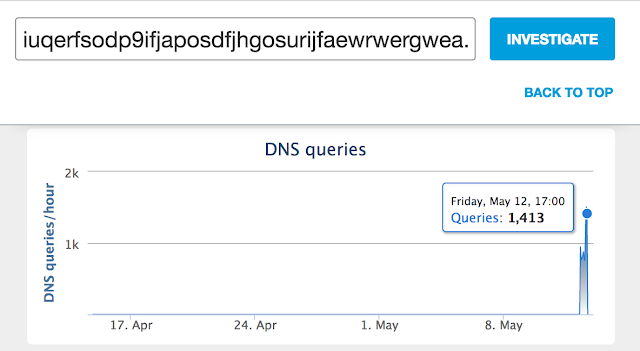
The domain composition looks almost human typed, with most characters falling into the top and home rows of a keyboard.
Communication to this domain might be categorized as a kill switch domain due to its role in the overall execution of the malware:
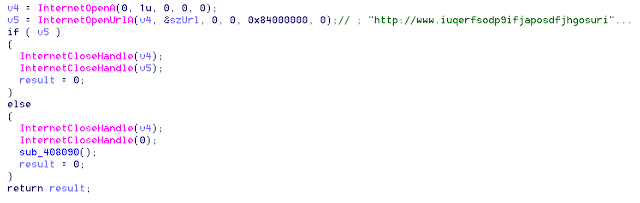
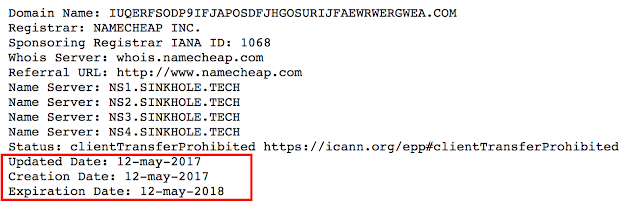
The above subroutine attempts an HTTP GET to this domain, and if it fails, continues to carry out the infection. However if it succeeds, the subroutine exits. The domain is registered to a well known sinkhole, effectively causing this sample to terminate its malicious activity.
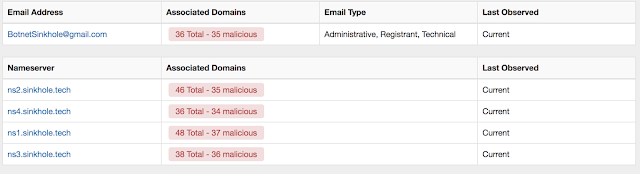
The raw registration information re-enforces this as it was registered on 12 May 2017:
Malware Analysis An initial file "mssecsvc.exe" drops and executes "tasksche.exe", this exe tests the kill switch domains. One complete, the service mssecsvc2.0 is created, this is a method of persistance for the malware. This service executes "mssecsvc.exe" with a different entry point than the initial execution. This second execution executes 2 threads. The first thread checks the IP address of the infected machine and attempts to connect to TCP445 (SMB) of each host/IP address in the same subnet and second thread generates random IP address on the Internet to perform the same action. When the malware successfully connects to a machine, a connection is initiated and data is transferred. The malware exploits the SMB vulnerability addressed by Microsoft in the bulletin MS17-010 (ETERNALBLUE) in order to implant the DOUBLEPULSAR backdoor. The backdoor is used to execute WANNACRY on the new compromised system.
The file tasksche.exe checks for disk drives, including network shares and removable storage devices mapped to a letter, such as 'C:/', 'D:/' etc. The malware then checks for files with a file extension as listed in the appendix and encrypts these using 2048-bit RSA encryption. While the files are being encrypted, the malware creates a new file directory 'Tor/' into which it drops tor.exe and nine dll files used by tor.exe. Additionally, it drops two further files: taskdl.exe & taskse.exe. The former deletes temporary files while the latter launches @[email protected] to display the ransom note on the desktop to the end user. The @[email protected] is not in and of itself the ransomware, only the ransom note. The encryption is performed in the background by tasksche.exe.
The tor.exe file is executed by @[email protected]. This newly executed process initiates network connections to Tor nodes. This allows WannaCry to attempt to preserve anonymity by proxying their traffic through the Tor network.
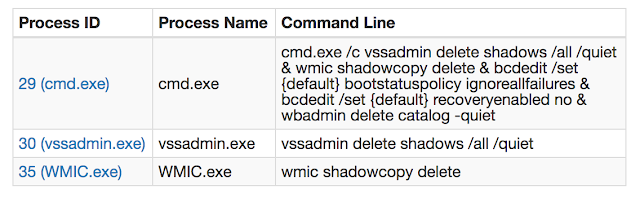
Typical of other ransomware variants, the malware also deletes any shadow copies on the victim's machine in order to make recovery more difficult. It achieve this by using WMIC.exe, vssadmin.exe and cmd.exe.
WannaCry uses various methods to attempt to aid its execution by leveraging both attrib.exe to modify the +h flag (hide) and also icacls.exe to allow full access rights for all users, "icacls . /grant Everyone:F /T /C /Q"
The malware has been designed as a modular service. It appears to us that the executable files associated with the ransomware have been written by a different individual than whomever developed the service module. Potentially, this means that the structure of this malware can be used to deliver and run different malicious payloads.
After encryption is complete, the malware displays the following ransomware note. One interesting aspect of this ransomware variant is that the ransom screen is actually an executable and not an image, HTA file, or text file.
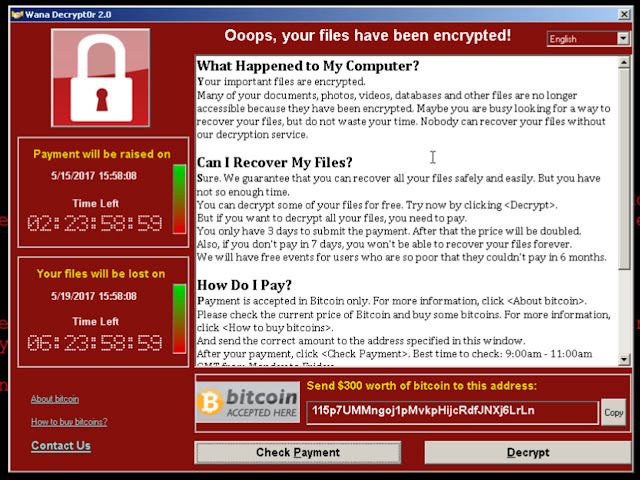
Organisations should be aware that there is no obligation for criminals to supply decryption keys following the payment of a ransom. Talos strongly urges anyone who has been compromised to avoid paying the ransom if possible as paying the ransom directly funds development of these malicious campaigns.
Mitigation and Prevention Organizations looking to mitigate the risk of becoming compromised should follow the following recommendations:
- Ensure all Windows-based systems are fully patched. At a very minimum, ensure Microsoft bulletin MS17-010 has been applied.
- In accordance with known best practices, any organization who has SMB publically accessible via the internet (ports 139, 445) should immediately block inbound traffic.
Additionally, organizations should strongly consider blocking connections to TOR nodes and TOR traffic on network. Known TOR exit nodes are listed within the Security Intelligence feed of ASA Firepower devices. Enabling this to be blocklisted will prevent outbound communications to TOR networks.
In addition to the mitigations listed above, Talos strongly encourages organizations take the following industry-standard recommended best practices to prevent attacks and campaigns like this and similar ones.
- Ensure your organization is running an actively supported operating system that receives security updates.
- Have effective patch management that deploys security updates to endpoints and other critical parts of your infrastructure in a timely manner.
- Run anti-malware software on your system and ensure you regularly receive malware signature updates.
- Implement a disaster recovery plan that includes backing up and restoring data from devices that are kept offline. Adversaries frequently target backup mechanisms to limit the possibilities a user may be able to restore their files without paying the ransom.
Coverage Snort Rule: 42329-42332, 42340, 41978
Open Source Snort Subscriber Rule Set customers can stay up to date by downloading the latest rule pack available for purchase on Snort.org. Additional ways our customers can detect and block this threat are listed below.
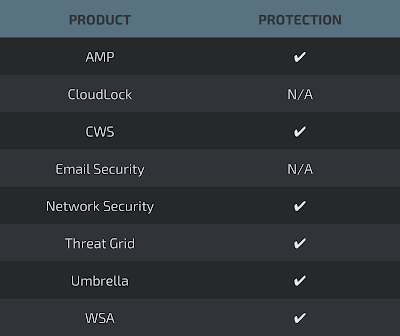
Advanced Malware Protection (AMP) is ideally suited to prevent the execution of the malware used by these threat actors.
CWS or WSA web scanning prevents access to malicious websites and detects malware used in these attacks.
Network Security appliances such as NGFW, NGIPS, and Meraki MX can detect malicious activity associated with this threat.
AMP Threat Grid helps identify malicious binaries and build protection into all Cisco Security products.
Umbrella prevents DNS resolution of the domains associated with malicious activity.
Stealthwatch detects network scanning activity, network propagation, and connections to CnC infrastructures, correlating this activity to alert administrators.
IoCs
File names
- d5e0e8694ddc0548d8e6b87c83d50f4ab85c1debadb106d6a6a794c3e746f4fa b.wnry
- 055c7760512c98c8d51e4427227fe2a7ea3b34ee63178fe78631fa8aa6d15622 c.wnry
- 402751fa49e0cb68fe052cb3db87b05e71c1d950984d339940cf6b29409f2a7c r.wnry
- e18fdd912dfe5b45776e68d578c3af3547886cf1353d7086c8bee037436dff4b s.wnry
- 4a468603fdcb7a2eb5770705898cf9ef37aade532a7964642ecd705a74794b79 taskdl.exe
- 2ca2d550e603d74dedda03156023135b38da3630cb014e3d00b1263358c5f00d taskse.exe
- 97ebce49b14c46bebc9ec2448d00e1e397123b256e2be9eba5140688e7bc0ae6 t.wnry
- b9c5d4339809e0ad9a00d4d3dd26fdf44a32819a54abf846bb9b560d81391c25 u.wnry
Observed IPs - 188[.]166[.]23[.]127:443 - Tor Exit Node
- 193[.]23[.]244[.]244:443 - Tor Exit Node
- 2[.]3[.]69[.]209:9001 - Tor Exit Node
- 146[.]0[.]32[.]144:9001 - Tor Exit Node
- 50[.]7[.]161[.]218:9001 - Tor Exit Node
- 128.31.0[.]39 - Tor Exit Node
- 213.61.66[.]116 - Tor Exit Node
- 212.47.232[.]237 - Tor Exit Node
- 81.30.158[.]223 - Tor Exit Node
- 79.172.193[.]32 - Tor Exit Node
Tor C2s
- xxlvbrloxvriy2c5.onion
- cwwnhwhlz52maqm7.onion
- gx7ekbenv2riucmf.onion
- 57g7spgrzlojinas.onion
- 76jdd2ir2embyv47.onion
Observed hash values - ed01ebfbc9eb5bbea545af4d01bf5f1071661840480439c6e5babe8e080e41aa
- c365ddaa345cfcaff3d629505572a484cff5221933d68e4a52130b8bb7badaf9
- 09a46b3e1be080745a6d8d88d6b5bd351b1c7586ae0dc94d0c238ee36421cafa
- 0a73291ab5607aef7db23863cf8e72f55bcb3c273bb47f00edf011515aeb5894
- 428f22a9afd2797ede7c0583d34a052c32693cbb55f567a60298587b6e675c6f
- 5c1f4f69c45cff9725d9969f9ffcf79d07bd0f624e06cfa5bcbacd2211046ed6
- 62d828ee000e44f670ba322644c2351fe31af5b88a98f2b2ce27e423dcf1d1b1
- 72af12d8139a80f317e851a60027fdf208871ed334c12637f49d819ab4b033dd
- 85ce324b8f78021ecfc9b811c748f19b82e61bb093ff64f2eab457f9ef19b186
- a1d9cd6f189beff28a0a49b10f8fe4510128471f004b3e4283ddc7f78594906b
- a93ee7ea13238bd038bcbec635f39619db566145498fe6e0ea60e6e76d614bd3
- b43b234012b8233b3df6adb7c0a3b2b13cc2354dd6de27e092873bf58af2693c
- eb47cd6a937221411bb8daf35900a9897fb234160087089a064066a65f42bcd4
- 24d004a104d4d54034dbcffc2a4b19a11f39008a575aa614ea04703480b1022c
- 2c2d8bc91564050cf073745f1b117f4ffdd6470e87166abdfcd10ecdff040a2e
- 7a828afd2abf153d840938090d498072b7e507c7021e4cdd8c6baf727cafc545
- a897345b68191fd36f8cefb52e6a77acb2367432abb648b9ae0a9d708406de5b
- fb0b6044347e972e21b6c376e37e1115dab494a2c6b9fb28b92b1e45b45d0ebc
- 9588f2ef06b7e1c8509f32d8eddfa18041a9cc15b1c90d6da484a39f8dcdf967
- b43b234012b8233b3df6adb7c0a3b2b13cc2354dd6de27e092873bf58af2693c
- 4186675cb6706f9d51167fb0f14cd3f8fcfb0065093f62b10a15f7d9a6c8d982
- 09a46b3e1be080745a6d8d88d6b5bd351b1c7586ae0dc94d0c238ee36421cafa Tor Artifacts
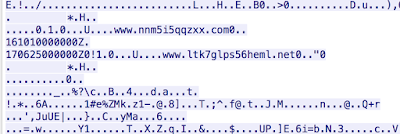
There will be odd looking domains which are artifacts from Tor visible in network PCAPs, these domains are not considered IOCs and should not be considered malicious.
Appendix List of file names encrypted by the ransomware:
.der, .pfx, .key, .crt, .csr, .p12, .pem, .odt, .sxw, .stw, .3ds, .max, .3dm, .ods, .sxc, .stc, .dif, .slk, .wb2, .odp, .sxd, .std, .sxm, .sqlite3, .sqlitedb, .sql, .accdb, .mdb, .dbf, .odb, .mdf, .ldf, .cpp, .pas, .asm, .cmd, .bat, .vbs, .sch, .jsp, .php, .asp, .java, .jar, .class, .mp3, .wav, .swf, .fla, .wmv, .mpg, .vob, .mpeg, .asf, .avi, .mov, .mp4, .mkv, .flv, .wma, .mid, .m3u, .m4u, .svg, .psd, .tiff, .tif, .raw, .gif, .png, .bmp, .jpg, .jpeg, .iso, .backup, .zip, .rar, .tgz, .tar, .bak, .ARC, .vmdk, .vdi, .sldm, .sldx, .sti, .sxi, .dwg, .pdf, .wk1, .wks, .rtf, .csv, .txt, .msg, .pst, .ppsx, .ppsm, .pps, .pot, .pptm, .pptx, .ppt, .xltm, .xltx, .xlc, .xlm, .xlt, .xlw, .xlsb, .xlsm, .xlsx, .xls, .dotm, .dot, .docm, .docx, .doc, Text extracted automatically; images, tables and formatting may be missing. Original: https://blog.talosintelligence.com/wannacry/