Info Stealing - The cyber security expert Marco Ramilli spotted a new operation in the wild
Indicators of compromiseauto-extracted · verify before use · export allAll →
| Type | Indicator | Context |
|---|---|---|
| domain | ssrdevelopments.co | ns and drops everything up to C2 by posting parameters to : ssrdevelopments.co.za/cgi-bin/ IoC : Following the principal IoC for the descr |
| sha1 | 0960726560a94fbbb327aa84244f9588a3c68be8 | 26e79d95365fe1d461 46bb0b10d790a3f21867308e7dcdeb06784a1570 0960726560a94fbbb327aa84244f9588a3c68be8 a480a75c3af576e5656abadb47d11515a18a82be 2ba809c53eda2a475b |
| sha1 | 0b4299ffb3f9aa59e19dd726e79d95365fe1d461 | b5ca36656adebd0d0f 2875d1b54337b1c17c8f4cd5f6b2d579667ee3d9 0b4299ffb3f9aa59e19dd726e79d95365fe1d461 46bb0b10d790a3f21867308e7dcdeb06784a1570 0960726560a94fbbb3 |
| sha1 | 144b34b4816062c2308a755273159e0460ffd604 | ee0e760f3e0faaab15 c93851627ffd996443f85d916f3dbedd70e0ff69 144b34b4816062c2308a755273159e0460ffd604 98293b80ccf312a8da99c2b5ca36656adebd0d0f 2875d1b54337b1c17c |
| sha1 | 2875d1b54337b1c17c8f4cd5f6b2d579667ee3d9 | 5273159e0460ffd604 98293b80ccf312a8da99c2b5ca36656adebd0d0f 2875d1b54337b1c17c8f4cd5f6b2d579667ee3d9 0b4299ffb3f9aa59e19dd726e79d95365fe1d461 46bb0b10d790a3f218 |
| sha1 | 2ba809c53eda2a475b1353c34f87ce62b6496e16 | 84244f9588a3c68be8 a480a75c3af576e5656abadb47d11515a18a82be 2ba809c53eda2a475b1353c34f87ce62b6496e16 5b0c3071aa63e18aa91af59083223d3cceb0fa3c dc780bf338053e9c1b |
| sha1 | 46bb0b10d790a3f21867308e7dcdeb06784a1570 | d5f6b2d579667ee3d9 0b4299ffb3f9aa59e19dd726e79d95365fe1d461 46bb0b10d790a3f21867308e7dcdeb06784a1570 0960726560a94fbbb327aa84244f9588a3c68be8 a480a75c3af576e565 |
| sha1 | 55abcfb85e664fbc8ad1cb8b60a08409c2d26caa | 570b66ec2d4fa674a6 b15b69170994918621ceb33cb339149bdff5b065 55abcfb85e664fbc8ad1cb8b60a08409c2d26caa f843427e9b7890f056eaa9909a5103bba6ffb8fd f2b81e66fcb1032238 |
| sha1 | 5b0c3071aa63e18aa91af59083223d3cceb0fa3c | db47d11515a18a82be 2ba809c53eda2a475b1353c34f87ce62b6496e16 5b0c3071aa63e18aa91af59083223d3cceb0fa3c dc780bf338053e9c1b0fdf259c831eb8a2768169 As final thought I |
| sha1 | 62c9d2ae7bafa9c594230c570b66ec2d4fa674a6 | o.za/cgi-bin/ Related hashes from harvesting Dropping URL : 62c9d2ae7bafa9c594230c570b66ec2d4fa674a6 b15b69170994918621ceb33cb339149bdff5b065 55abcfb85e664fbc8a |
| sha1 | 6a38e4acd9ade0d85697d10683ec84fa0daed11c | 2 : ac55ee783f3ed0bd23eccd01040a128dc6dc7851 Hash Stage 3 : 6a38e4acd9ade0d85697d10683ec84fa0daed11c Persistence : HKEY_CURRENT_USER\Software\Microsoft\Windows\ |
| sha1 | 7f1860673de9b1c2e6f7d6963a499e8ba4e412a1 | the principal IoC for the described threat. Hash Stage 1 : 7f1860673de9b1c2e6f7d6963a499e8ba4e412a1 bf4a26c9e52a8cacc7afd7d95d197bff1e47fb00 Hash Stage 2 : ac5 |
| sha1 | 98293b80ccf312a8da99c2b5ca36656adebd0d0f | 916f3dbedd70e0ff69 144b34b4816062c2308a755273159e0460ffd604 98293b80ccf312a8da99c2b5ca36656adebd0d0f 2875d1b54337b1c17c8f4cd5f6b2d579667ee3d9 0b4299ffb3f9aa59e1 |
| sha1 | a480a75c3af576e5656abadb47d11515a18a82be | 8e7dcdeb06784a1570 0960726560a94fbbb327aa84244f9588a3c68be8 a480a75c3af576e5656abadb47d11515a18a82be 2ba809c53eda2a475b1353c34f87ce62b6496e16 5b0c3071aa63e18aa9 |
| sha1 | ac55ee783f3ed0bd23eccd01040a128dc6dc7851 | 2a1 bf4a26c9e52a8cacc7afd7d95d197bff1e47fb00 Hash Stage 2 : ac55ee783f3ed0bd23eccd01040a128dc6dc7851 Hash Stage 3 : 6a38e4acd9ade0d85697d10683ec84fa0daed11c Per |
| sha1 | b15b69170994918621ceb33cb339149bdff5b065 | ing Dropping URL : 62c9d2ae7bafa9c594230c570b66ec2d4fa674a6 b15b69170994918621ceb33cb339149bdff5b065 55abcfb85e664fbc8ad1cb8b60a08409c2d26caa f843427e9b7890f056 |
| sha1 | bf4a26c9e52a8cacc7afd7d95d197bff1e47fb00 | at. Hash Stage 1 : 7f1860673de9b1c2e6f7d6963a499e8ba4e412a1 bf4a26c9e52a8cacc7afd7d95d197bff1e47fb00 Hash Stage 2 : ac55ee783f3ed0bd23eccd01040a128dc6dc7851 Has |
| sha1 | c1ba30d7adec6d545d5274f95943f787ad4c03e7 | 83b75b3fe8bf28247d cab90f7c935d355172b0db123d20b6a7d1403f65 c1ba30d7adec6d545d5274f95943f787ad4c03e7 ed9959bb0087f2c985b603cee0e760f3e0faaab15 c93851627ffd99644 |
| sha1 | c93851627ffd996443f85d916f3dbedd70e0ff69 | 95943f787ad4c03e7 ed9959bb0087f2c985b603cee0e760f3e0faaab15 c93851627ffd996443f85d916f3dbedd70e0ff69 144b34b4816062c2308a755273159e0460ffd604 98293b80ccf312a8da |
| sha1 | cab90f7c935d355172b0db123d20b6a7d1403f65 | 909a5103bba6ffb8fd f2b81e66fcb1032238415b83b75b3fe8bf28247d cab90f7c935d355172b0db123d20b6a7d1403f65 c1ba30d7adec6d545d5274f95943f787ad4c03e7 ed9959bb0087f2c985 |
| sha1 | dc780bf338053e9c1b0fdf259c831eb8a2768169 | c34f87ce62b6496e16 5b0c3071aa63e18aa91af59083223d3cceb0fa3c dc780bf338053e9c1b0fdf259c831eb8a2768169 As final thought I’d like to highlight the following key co |
| sha1 | f2b81e66fcb1032238415b83b75b3fe8bf28247d | 8b60a08409c2d26caa f843427e9b7890f056eaa9909a5103bba6ffb8fd f2b81e66fcb1032238415b83b75b3fe8bf28247d cab90f7c935d355172b0db123d20b6a7d1403f65 c1ba30d7adec6d545d |
| sha1 | f843427e9b7890f056eaa9909a5103bba6ffb8fd | 3cb339149bdff5b065 55abcfb85e664fbc8ad1cb8b60a08409c2d26caa f843427e9b7890f056eaa9909a5103bba6ffb8fd f2b81e66fcb1032238415b83b75b3fe8bf28247d cab90f7c935d355172 |
| url | http://ssrdevelopments.co.za/a2/off.exe | ommand A fashionable powershell command drops and executes: hxxp://ssrdevelopments.co.za/a2/off.exe . Powershell seems to be a “must have” in contemporary Malw |
Full article1,177 words · extracted from securityaffairs.com · click to collapse
 Pierluigi Paganini
 December 29, 2017

The Italia cyber security expert Marco Ramilli, founder of Yoroi, published an interesting analysis of a quite new InfoStealer Malware delivered by eMail to many International Companies.
Attack attribution is always a very hard work. False Flags, Code Reuse and Spaghetti Code makes impossible to assert “This attack belongs to X”. Indeed nowadays makes more sense talking about Attribution Probability rather then Attribution by itself. “This attack belongs to X with 65% of attribution probability” it would be a correct sentence.
I made this quick introduction because the following analysis would probably take the reader to think about specific attribution, but it won’t be so accurate, so please be prepared to have not such a clear conclusions.
Today I’d like to show an interesting analysis of a quite new InfoStealer Malware delivered by eMail to many International Companies. The analysis shows up interesting Code Reuse capabilities, apparently originated by Japanese Attackers reusing an English Speaker Attacker source code. Again I have not enough artifacts to give attributions but only few clues as follows. In the described analysis, the original sample was delivered by [email protected] (with high probability a compromised South Africa account) to one of my spamming email addresses.
The obtained sample is a Microsoft Word document within macro in it. The macros were heavily obfuscated by using four rounds of substitutions and UTF-8 encoding charsets (which, by the way, is super annoying). The following image shows the obfuscated macro code with UTF-8 charsets.
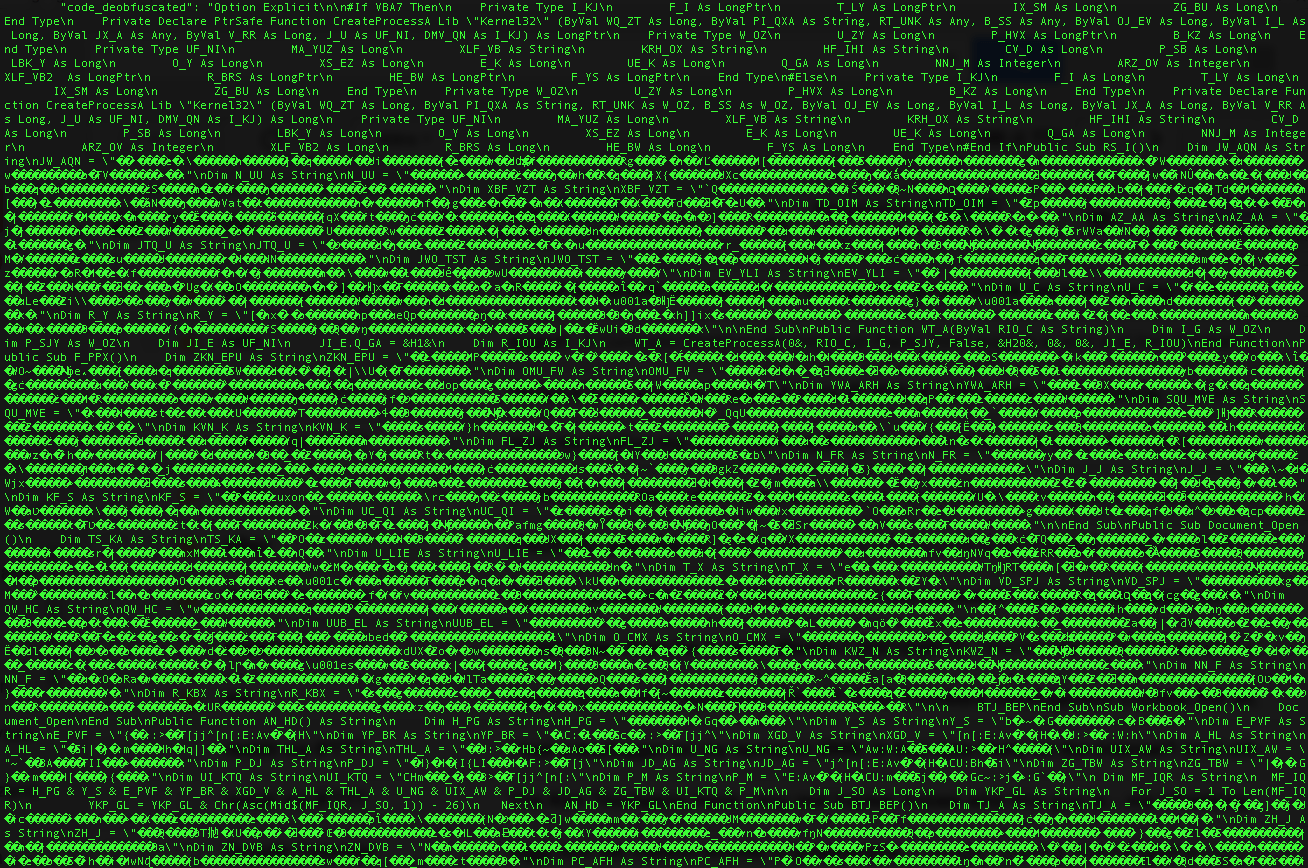 |
| Stage 1: Obfuscation |
By using oletools and “tons” of cups of coffee (to be awake until late night to make recursive steps) I finally was able to extract the invoked command, showed in the following image.
 |
| Stage 1: Invoked Command |
A fashionable powershell command drops and executes: hxxp://ssrdevelopments.co.za/a2/off.exe. Powershell seems to be a “must have” in contemporary Malware. Analyzing the “dropping” url and tracking down the time it is in “Index Of” mode (2017-0-13), I suspect it is not a compromised website rather a crafted web server or a compromised host of a dead company.
 |
| Dropping Web Site |
By surfing the Malware propagator website I founded out many malicious executables (sees IoC section) each one showing up specific behaviors such as: password stealers, RAT, and Banking Trojans. Even if the samples were developed for different targets, all of them shared the following basic behaviors:
- Check for victims IP address before getting into Malicious activities (maybe related to targeted activities)
- Install itself into auto execution path
- Tries to fingerprint the target system (such as CPU, HD, Memory, Username, System, etc..)
- Sniff for Keystrokes
I’d like to write a simple analysis for each found sample, but today time is not my friend, so let’s focalize to one of the malicious samples. Let’s get done the received sample by digging into the “second stage” dropped by the pPowerShell “first stage” from ssrdevelopments.co.za/a2/off.exe. After few seconds on second stage (off.exe) it became clear that it was a .NET software. By reversing the interpreted .NET language some clear text comments appeared interesting. Japanese language such as comments and variable names came out from static analysis. Let’s have a look to them.
 |
| Stage 2: Apparently Japanese characters |
While the sample pretends to be compiled from “Coca-Cola Enterprise” (maybe a target operation against Coca-Cola ? Or a targeted operation agains Coca-Cola Suppliers ? So why it ended up to my inbox ? Anyway … ) google translator suggests me that Japanese characters are in text: such as the “Entry Point”, “Class names” and “Function Names”.
 |
| Stage 2: Japanese Names and Self Encoding Structures |
It was not hard to figure out that Stage 2 was auto-extracting bytes from itself (local variables) and saving them back to hard drive after having set up auto execution registry key on windows local registry. The following image shows the xoring function used to decrypt converted bytes to the real payload.
 |
| Stage 2: Xoring function to extract Stage 3 |
On my run, the xored payload took the name of GIL.exe; another .NET executable. We are now facing the third stage. By analyzing the decompiled sample it became clear that:
- The coding style was quite different from the previous stage (Stage 2)
- The implementation style was different from the previous stage as well
- The sample was interested in information about the user, the machine, the web services on the PC and to many more windows specific parameters.
 |
| Stage 3: New Language in Strings and Class names |
 |
| Stage 3: New Code Style |
By closely investigating Stage 3, the analyst would probably notice the heavy presence of “decorators”, a different format in the definition style and last but not least the core composition. Everything looks like belonging to different single developers. The variable language, the comments structure and the general usage of terms, takes the analyst to believe in having found two different developers belonging to different cultures (maybe countries). Finally the malware looks for users, computes, and web services informations and drops everything up to C2 by posting parameters to : ssrdevelopments.co.za/cgi-bin/
IoC:
Following the principal IoC for the described threat.
- Hash Stage 1:
- 7f1860673de9b1c2e6f7d6963a499e8ba4e412a1
- bf4a26c9e52a8cacc7afd7d95d197bff1e47fb00
- Hash Stage 2:
- ac55ee783f3ed0bd23eccd01040a128dc6dc7851
- Hash Stage 3:
- 6a38e4acd9ade0d85697d10683ec84fa0daed11c
- Persistence: HKEY_CURRENT_USER\Software\Microsoft\Windows\CurrentVersion\Run\kij %APPDATA%\Roaming\kij\kij.exe
- Dropping URL:
- ssrdevelopments.co.za
- Command and Control:
- ssrdevelopments.co.za/cgi-bin/
- Related hashes from harvesting Dropping URL:
- 62c9d2ae7bafa9c594230c570b66ec2d4fa674a6
- b15b69170994918621ceb33cb339149bdff5b065
- 55abcfb85e664fbc8ad1cb8b60a08409c2d26caa
- f843427e9b7890f056eaa9909a5103bba6ffb8fd
- f2b81e66fcb1032238415b83b75b3fe8bf28247d
- cab90f7c935d355172b0db123d20b6a7d1403f65
- c1ba30d7adec6d545d5274f95943f787ad4c03e7
- ed9959bb0087f2c985b603cee0e760f3e0faaab15
- c93851627ffd996443f85d916f3dbedd70e0ff69
- 144b34b4816062c2308a755273159e0460ffd604
- 98293b80ccf312a8da99c2b5ca36656adebd0d0f
- 2875d1b54337b1c17c8f4cd5f6b2d579667ee3d9
- 0b4299ffb3f9aa59e19dd726e79d95365fe1d461
- 46bb0b10d790a3f21867308e7dcdeb06784a1570
- 0960726560a94fbbb327aa84244f9588a3c68be8
- a480a75c3af576e5656abadb47d11515a18a82be
- 2ba809c53eda2a475b1353c34f87ce62b6496e16
- 5b0c3071aa63e18aa91af59083223d3cceb0fa3c
- dc780bf338053e9c1b0fdf259c831eb8a2768169
As final thought I’d like to highlight the following key concept of that analysis:
- From a single email, the analyst could discover attacker’s assets, mapping them and disarming them (through IoC).
- The analyzed code shows apparent evidences to belonging to different groups of attackers.
- The analyzed samples show code reuse. Code reuse is dangerous because it makes attackers more powerful and extremely quick to change Malware behavior.
Hope you enjoyed.
The original post published by Marco Ramilli on his blog at the following URL:
https://marcoramilli.blogspot.it/2017/12/info-stealing-new-operation-in-wild.html
About the author: Marco Ramilli, Founder of Yoroi
 I am a computer security scientist with an intensive hacking background. I do have a MD in computer engineering and a PhD on computer security from University of Bologna. During my PhD program I worked for US Government (@ National Institute of Standards and Technology, Security Division) where I did intensive researches in Malware evasion techniques and penetration testing of electronic voting systems.
 I do have experience on security testing since I have been performing penetration testing on several US electronic voting systems. I’ve also been encharged of testing uVote voting system from the Italian Minister of homeland security. I met Palantir Technologies where I was introduced to the Intelligence Ecosystem. I decided to amplify my cyber security experiences by diving into SCADA security issues with some of the most biggest industrial aglomerates in Italy. I finally decided to found Yoroi: an innovative Managed Cyber Security Service Provider developing some of the most amazing cyber security defence center I’ve ever experienced ! Now I technically lead Yoroi defending our customers strongly believing in: Defence Belongs To Humans
Text extracted automatically; images, tables and formatting may be missing. Original: https://securityaffairs.com/67213/malware/info-stealing-attack.html