Unpublished security flaws (0days) massively exploited
Vulnerabilities mentionedAll →
| CVE | Vulnerability | CVSS | EPSS | Flags | Affected | Exposure | Published |
|---|---|---|---|---|---|---|---|
| CVE-2026-75650 | Unauthenticated Template Injection RCE in Adobe Commerce and Magento (CVE-2026-75650) Adobe Commerce and Magento (including Adobe Commerce B2B) contain an improper neutralization of special elements used in a template engine (CWE-1336), a template-injection flaw that permits arbitrary code execution in the context of the current user. The flaw is reachable over the network by unauthenticated attackers, requires no user interaction, and its changed scope (CVSS 3.1 S:C) means injected code executes beyond the vulnerable component, producing a maximum-severity (CVSS 10.0) remote code execution condition. A successful attacker gains arbitrary code execution on the storefront server; in the observed campaign, intruders installed a Rust backdoor and a PHP web shell (dubbed 'StyleSmuggler') on compromised servers. Any organization running an Adobe Commerce, Adobe Commerce B2B, or Magento storefront is in scope, with internet-facing e-commerce deployments most exposed. Exploitation is confirmed in the wild: the bug was abused as a zero-day before patching and was added to CISA's Known Exploited Vulnerabilities catalog on 2026-09-08. Do: Apply Adobe's released patches immediately per vendor instructions, prioritizing internet-facing Commerce/Magento storefronts, and ensure compliance with CISA BOD 26-04 timelines for KEV entries. Hunt for 'StyleSmuggler' indicators of compromise, including unexpected Rust backdoor binaries and PHP web shells on hosts, and review template/theme customizations for tampering. Exact fixed version numbers are not included in the available data, so consult Adobe's advisory for the correct patched release for your Commerce/Magento version line. | 10.0 | 2% | KEV PoC |
| massroughly 100,000-300,000 internet-facing storefronts |
Full article691 words · extracted from sansec.io · click to collapse
Online credit card theft has been all over the news: criminals inject hidden card stealers on legitimate checkout pages. But how are they are able to inject anything in the first place? As it turns out, thieves are massively exploiting unpublished security flaws (aka 0days) in popular store extension software.
While the extensions differ, the attack method is the same: PHP Object Injection (POI). This attack vector abuses PHP's unserialize() function to inject their own PHP code into the site. With that, they are able to modify the database or any Javascript files. As of today, many popular PHP applications still use unserialize(). Magento replaced most of the vulnerable functions by json_decode() in patch 8788, but many of its popular extensions did not.
It appears that attackers have amassed a large number of extensions and found numerous POI vulnerabilities. And they are now probing Magento stores in the wild for these extensions. Sansec collected the following probes. If you are running any of them, you'd better disable them quickly and search your logs for unauthorized activity.
POST /index.php/madecache/varnish/esi/
POST /index.php/freegift/cart/gurlgift/
POST /index.php/qquoteadv/download/downloadCustomOption/
POST /index.php/ajaxproducts/index/index/
POST /index.php/minifilterproducts/index/ajax/
POST /index.php/advancedreports/chart/tunnel/
POST /index.php/bssreorderproduct/list/add/
POST /index.php/rewards/notifications/unsubscribe/
POST /index.php/emaildirect/abandoned/restore/
POST /index.php/vendors/withdraw/review/
POST /index.php/vendors/credit_withdraw/review/
POST /index.php/gwishlist/Gwishlist/updategwishlist/
POST /index.php/rewards/customer/notifications/unsubscribe/
POST /index.php/aheadmetrics/auth/index/
POST /index.php/customgrid/index/index/
POST /index.php/customgrid/Blcg/Column/Renderer/index/index/
POST /index.php/tabshome/index/ajax/
POST /index.php/customgrid/Blcg_Column_Renderer_index/index/
POST /index.php/rewards/customer_notifications/unsubscribe/
POST /index.php/vendors/credit/withdraw/review/
POST /index.php/multidealpro/index/edit/
POST /index.php/layaway/view/add/
POST /index.php/simplebundle/Cart/add/
POST /index.php/CustomGrid/index/index/
POST /index.php/netgocust/Gwishlist/updategwishlist/
POST /index.php/prescription/Prescription/amendQuoteItemQty/
POST /index.php/ajax/Showroom/submit/
The payload for all of these POSTs is a specially crafted Zend_Log object that contains rogue code. Max Chadwick wrote a nice summary of this vulnerability class.
Fixing this mess
Now, Sansec contacted several authors (kudo's to Webcooking for being the first to fix their code within hours!), but the original author cannot be derived from all of these URLs. So our request to you: do you recognize any extension in these URLs? Please contact the author and let us know (email/twitter DM). Together we can get all of these extensions fixed quickly.
| URI | Module | Status | Org |
|---|---|---|---|
| rewards/* | TBT_Rewards | fixed in 1.8.7.3 | link |
| simplebundle | Webcooking_SimpleBundle | reported and fixed in 1.6.9 | link |
| ajaxproducts/index | EM_AjaxProducts | fixed in 1.0.0 | link |
| qquoteadv/download | Cart2Quote | fixed in 5.4.5 | link |
| advancedreports/chart | AW_AdvancedReports | reported, fix announced | link |
| aheadmetrics/auth | AW_AheadMetrics | reported, abandoned | link |
| ajax/Showroom | ? | ? | |
| bssreorderproduct/list | BSS_ReorderProduct | fixed in 1.2.4 | link |
| customgrid/* | BL_CustomGrid? | abandoned | link |
| emaildirect/abandoned | Campaigner | fixed in 1.1.6 | link |
| freegift/cart | MW_Gift? | ? | |
| */Gwishlist | mageGwhishlist | reported, not fixed | link |
| layaway/view | Ced_Layaway? | ? | link |
| madecache/varnish | Made_Cache | reported and fixed | link |
| minifilterproducts/index | EM_ProductsFilterWidget | reported | link |
| multidealpro/index | EM_Multideal | reported | link |
| prescription/Prescription | ? | ? | |
| tabshome/index | Ves_Tabshome | ? | |
| vendors/credit | Ves_VendorsCredit | ? | link |
| vendors/credit_withdraw | ? | ? | |
| vendors/withdraw | ? | ? |
Modus operandi
Some more info on this group's modus operandi. Once any of the probes above is successful, a malicious actor will come back and insert a customized Javascript payment overlay for the specific site. This works for sites that have external payments, or no credit card payments at all, because a fake credit card payment section is inserted. Once a user enters his CC details and clicks submit, the fake credit card form disappears and the unsuspecting (?) user will likely try again. The fake form will not show a second time, because a cookie is set to prevent that.
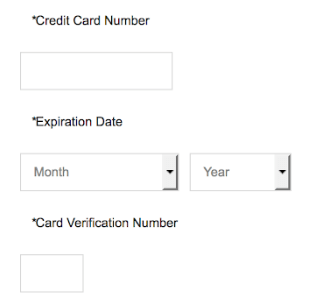
fake cc form
Under the hood it currently uses a two step payment exfiltration method. First, a jQuery call is made to one of these (the first one has been taken down already):
records.nstatistics.com/records.php
stat.statisticvisit.com/rec.php
Up to now, they have returned various CC drop servers in the ngrok.io domain, such as:
b0b127c6.ngrok.io
f0c806aa.ngrok.io
e7900f9c.ngrok.io
As Ngrok takes these down quickly (as Sansec predicted earlier), they use this mechanism to easily switch drop servers.
How to block all probes?
As suggested by Sean H, you could hard block specific requests to these modules in Nginx. Their functionality will probably break though:
location ~* ^/index.php/(madecache|freegift|qquoteadv|ajaxproducts|minifilterproducts|advancedreports|bssreorderproduct|rewards|gwishlist|aheadmetrics|customgrid|tabshome|vendors|multidealpro|layaway|simplebundle|netgocust|prescription|ajax/Showroom)/.* { deny all; }
Header image credits: Maxpixel
Read more
- Bad extensions now main source of Magento hacks: a solution!
- StyleSmuggler: Magento and Adobe Commerce 0-day RCE (CVE-2026-75650) under active attack
- Adobe patches critical Magento account takeover (APSB26-92)
- Amasty patches dozens of Magento extensions, 2 critical
- Unauthenticated file upload in Amasty Order Attributes for Magento
Text extracted automatically; images, tables and formatting may be missing. Original: https://sansec.io/research/magecart-extension-0days