Kelvir changes its approach
Indicators of compromiseauto-extracted · verify before use · export allAll →
| Type | Indicator | Context |
|---|---|---|
| url | http://www.[edited | [email protected] User #1 gets a link which looks like this: hxxp://www.[edited].us/[edited]/[email protected] User #2 gets |
Full article426 words · extracted from securelist.com · click to collapse



Today we detected a new variant of IM-Worm.Win32.Kelvir – we detect it as Kelvir.k. As always Kelvir is accompanied with an IRCBot, which we detect as Backdoor.Win32.Rbot.gen.
This new Kelvir variant uses a new social engineering tactic to spread. Instead of hyperlinking to, for instance, a .pif or .scr file, Kelvir.k links to a .php file. The thing about links to .php files is that you can append extra data (letters and numbers) to them. This additional data will be sent to the server when the link is clicked. And that’s exactly what Kelvir.k does – it appends the IM user’s MSN address to the link.
To make things a bit clearer, here’s an example.
IM user #1 has the email address [email protected]
IM user #2 has the email address: [email protected]
User #1 gets a link which looks like this: hxxp://www.[edited].us/[edited]/[email protected]
User #2 gets a link which looks like this: hxxp://www.[edited].us/[edited]/[email protected].
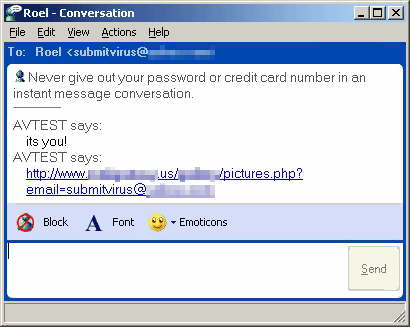
When the link is clicked, the user is presented with a prompt to execute or save an MS-DOS application. By now, users will hopefully be suspicious and not run the application.
But as soon as the user clicks the link, their email address is harvested. So even if the user doesn’t run the MS-DOS application, the brains behind Kelvir get another address to spam.
So is this new tactic being used because of MSNM 7’s new ‘anti-malware’ features? I don’t think so. While I was writing this, we detected a repacked version of Kelvir.e. And Kelvir.e uses a hyperlink to a .scr file to spread, something which isn’t filtered by MSNM 7.
The use of new social engineering tactics leads me to believe that IM-users have learned to be more careful – ‘traditional’ IM-Worms don’t seem to be as effective as they used to be, and attackers are looking for new ways to install their malware on a large number of machines.
Latest Webinars
Reports
Kaspersky researchers have discovered new Mirage Kitten attacks using previously undocumented malware families: NodeRabbit in Node.js and PollCat in JavaScript.
Our experts discovered a new CoolClient backdoor variant with a kernel-mode rootkit driver that hides malicious processes, files, and network connections from security tools and threat analysts.
Kaspersky experts break down a new Armored Likho campaign that poses as a fundraising efforts and delivers a new Still Toolkit aimed at stealing Telegram data and eavesdropping on victims.
Kaspersky researchers reveal previously undocumented malware attributed to Mirage Kitten (UNC1549, Smoke Sandstorm, Nimbus Manticore): NightLedger backdoor, ArcBridge, and BridgeHead tunneling tools.
Text extracted automatically; images, tables and formatting may be missing. Original: https://securelist.com/kelvir-changes-its-approach/29995/