Hackers using pixel tracking to build data for better phishing practices
Full article722 words · extracted from cyberscoop.com · click to collapse
Get our latest cybersecurity news first on Google.
A technique used by marketers and advertisers is now being leveraged by cybercriminals.
A technique used by marketers and advertisers to track web users and email recipients has been repurposed by cybercriminals and online spies as a way of discovering potential hacking targets, according to new security research.
“We’ve seen a lot more use of this tactic recently as a probing or information-gathering tool,” by phishers and other cybercriminals, Donald Meyer of Check Point Software Technologies Ltd., told CyberScoop.
Tracking pixels, or web beacons, are tiny images, one pixel large, that are downloaded when a user opens an email or visits a website. Because they’re so small, most users don’t even notice them. “Often the image is designed to blend into the background,” according to the Network Advertising Initiative, a trade association and standards group of the digital advertising industry.
Because of the way most email programs and web browsers work, tracking pixels, once downloaded, can collect and report information about the user, operating system, device, software and IP address. Email marketers can use this data to measure the effectiveness of their campaigns — by A/B testing two kinds of email blasts for example, and discovering which is opened more often. Advertisers can also use it to compile data about the hardware and software their targets employ.
But, as Meyer explained in a blog post Monday, everything which makes tracking pixels great for marketers and advertisers — unobtrusiveness, automaticity and the amount of data captured — also makes them great for hackers’ reconnaissance.
“You can build a ton of ‘get’ requests into the image,” he told CyberScoop, to obtain information about devices on the network being targeted.
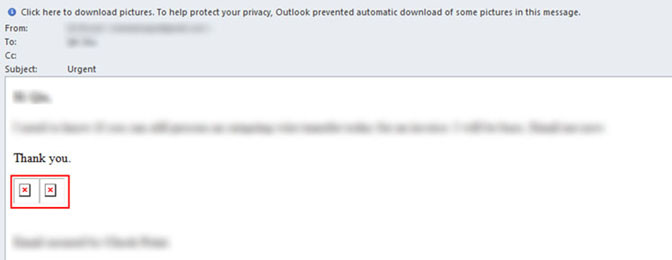
Phishing email using tracking pixels (outlined in red) Source: Check Point
Hackers trying to break into a network have to explore its architecture first to find points of entry and ways to move around the system undetected, explained Meyer. During this reconnaissance stage, an attacker will often send booby-trapped messages known as phishing emails to map out the network, locate potential weak points and figure out who in the organization is most likely to open suspicious-looking mail and click on links or attachments.
Unlike a full-fledged hacking attack, such a reconnaissance won’t involve any executable code, and will generally get under the security radar. Checkpoint recommends that email programs be set so they don’t automatically download images.
By sending emails equipped with a tracking pixel, Meyer said, a hacker can catalogue network IP addresses; track employees’ working hours; even A/B test potential phishing emails — working out which ones are most likely to be opened. They can also find out what operating system and other software is being used on certain machines — helping them identify potential vulnerable points for entry.
Tracking pixels can even be embedded in Microsoft Office documents and spreadsheets. If the emails or documents attached to them are forwarded around an organization, the hackers will get the same data about anyone who opens it.
“Hackers are always looking for the low-hanging fruit,” explained Meyer. “The information they can get [from a tracking pixel] helps them find it.”
Latest Podcasts
Government
FBI officials say AI is bolstering adversaries, emphasizing need to focus on cyber basics, patching
Feds accuse China of ‘systematic’ distillation of U.S. AI models
CIA’s Michael Ellis says cyber intelligence is changing how the agency operates
Jail time for Maine child in 764 marks turning point in federal law enforcement
Technology
Threats
Chinese espionage groups swarm to exploit triple-link chain of zero-days
Microsoft discloses two actively exploited zero-days among 974 vulnerabilities
Russian national extradited to US for alleged involvement in bank-account takeover scheme
Attackers exploit zero-days in consistently besieged SonicWall product
Policy
Whistleblower says USPS deploying new, ‘untested’ IT systems governing mail-in ballots
‘Watershed 250’ test program in Texas looks to private sector for water cybersecurity help
Former sexual abuse victims say Grok used their images, videos to train deepfake capabilities
Cyber threats nudge Trump to sign executive order on foreign equipment in U.S. energy infrastructure
Text extracted automatically; images, tables and formatting may be missing. Original: https://cyberscoop.com/pixel-tracking-hacking-check-point/