Zbot and CVE2010
Vulnerabilities mentionedAll →
| CVE | Vulnerability | CVSS | EPSS | Flags | Affected | Exposure | Published |
|---|---|---|---|---|---|---|---|
| CVE-2010-0188 | Arbitrary Code Execution in Adobe Reader and Acrobat via Malicious PDF Handling CVE-2010-0188 is an unspecified code-injection (CWE-94) flaw in Adobe Reader and Acrobat that allows attackers to cause a denial of service or possibly execute arbitrary code on the victim's machine. It is triggered when an affected application processes a maliciously crafted PDF document, typically delivered as an email attachment or downloaded from a website, so simply viewing the file with vulnerable software is enough to expose the user. A successful attack gives the attacker code execution in the context of the logged-on user, which can be leveraged to install malware or ransomware. Anyone running Adobe Reader or Acrobat is affected; CISA lists the products without published version ranges, so all Adobe deployments should be treated as potentially in scope. Exploitation is confirmed in the wild: the flaw is in CISA KEV (added 2022-03-03) with known ransomware use, and EPSS assigns an 88.2% probability of exploitation within 30 days (100th percentile). Do: Apply updates per vendor instructions: install the Adobe security update that fixes CVE-2010-0188 on any legacy Acrobat/Reader deployment and migrate unsupported installations to a currently supported Acrobat/Reader release. Given the known ransomware association, hunt for signs of compromise such as suspicious PDF attachments opened around malware activity, and block or sandbox PDFs at email and web gateways. Verify no critical hosts or automated workflows still depend on outdated Reader/Acrobat components for PDF processing. | — | 88% | KEV ransomware |
| masshundreds of millions of installed copies (Reader/Acrobat historically shipped as the default PDF handler on most Windows PCs; exact count of still-vulnerable… |
Full article384 words · extracted from securelist.com · click to collapse



I just came across a suspicious PDF file, so I decided to take a deeper look. Once the file was unpacked, I got an xml file with TIFF image. However, the whole thing looked very strange. The whole thing looked very fishy, and ultimately, it turned out that the xml file contained an exploit for CVE-2010-0188.
I thought it was a bit odd that we hadn’t come across files like this before, so I decided to tak a look at stats for this vulnerability:
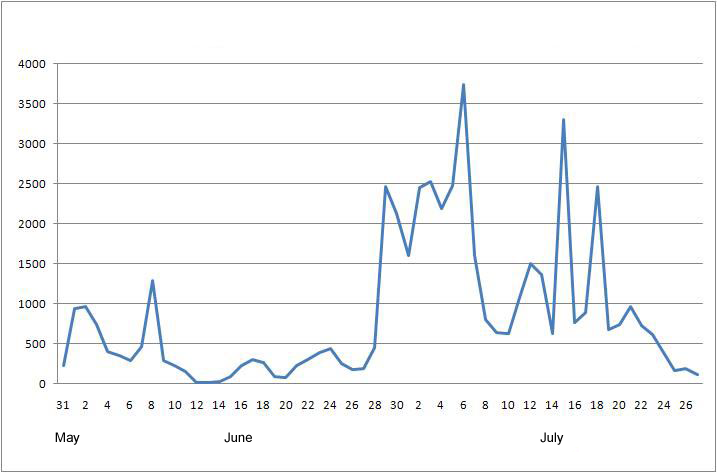
CVE-2010-0188 exploit statistics 2010
The graph shows that malware exploiting CVE=2010-0188 started spreading actively at the end of June. It was pretty much a rarity until then. Maybe the virus writers needed a few months to catch up with creating exploits for the new hole in Adobe – who knows?
When I took a closer look, it turned out that the PDF was mainly designed to download and launch another file, Trojan-Dropper.Win32.Zbot.cm. Which, in its turn, is mainly designed to secretly install Zbot (ZeuS) to the system and to combat antivirus software.
I was able to get a final example of Zbot, but it turned out to be encrypted and obfuscated. I then got its dump and decrypted strings, which included a clear link to the banking site under attack, the bot’s http requests and some of the commands used by the botnet C&C:

Part of the decrypted Zbot file
This is the first example of an encrypted Zbot variant spreading via CVE-2010-0188. Clearly, the guys behind this program aren’t sitting on their hands, but working on the most up-to-date methods of delivering their malware to end users.
Latest Webinars
Reports
Kaspersky researchers have discovered new Mirage Kitten attacks using previously undocumented malware families: NodeRabbit in Node.js and PollCat in JavaScript.
Our experts discovered a new CoolClient backdoor variant with a kernel-mode rootkit driver that hides malicious processes, files, and network connections from security tools and threat analysts.
Kaspersky experts break down a new Armored Likho campaign that poses as a fundraising efforts and delivers a new Still Toolkit aimed at stealing Telegram data and eavesdropping on victims.
Kaspersky researchers reveal previously undocumented malware attributed to Mirage Kitten (UNC1549, Smoke Sandstorm, Nimbus Manticore): NightLedger backdoor, ArcBridge, and BridgeHead tunneling tools.
Text extracted automatically; images, tables and formatting may be missing. Original: https://securelist.com/zbot-and-cve2010-0188/29619/