The TJX Hacker Black SEO Campaign
Indicators of compromiseauto-extracted · verify before use · export allAll →
| Type | Indicator | Context |
|---|---|---|
| domain | arm.com | om/johzs.php h**p://*****pod.com/oagnz.php h**p://**********arm.com/lekgz.php etc All these links are not malicious by themselv |
Full article408 words · extracted from securelist.com · click to collapse



While I was reading the Wired article on how Alberto Gonzalez, the TJX hacker who caused $171.5 million in losses, was sentenced to 20 years in prison, I came across an interesting black SEO campaign that distributes fake AVs through Google.
Here’s how the Google SERP looked like after my innocent search for this hot topic:
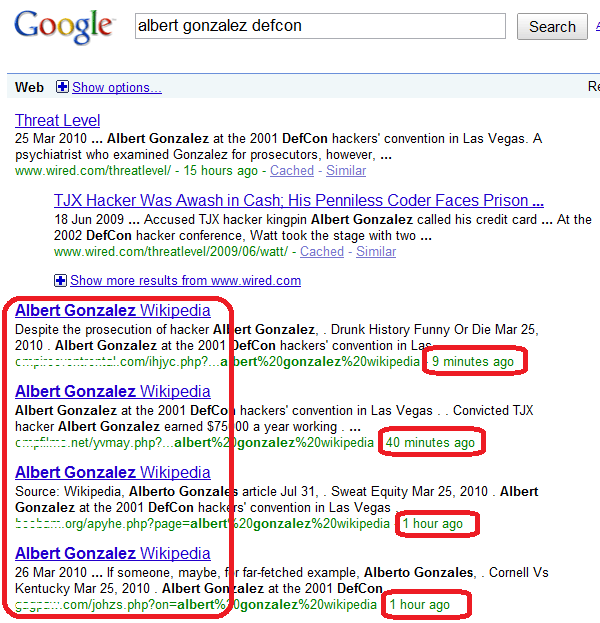
As you can see, some odd looking links are among the first results. And those links appeared very recently in the Google results page, within the last hour to be more specific. Still, the link that showed up just “9 minutes ago” is actually the second result in the Google ranking, right after the Wired article. Makes you think of how hard the cybercriminals are working to bypass Google’s algorithms, eh?But what’s with these links? Well, they might look like legitimate Wikipedia articles to the untrained eye, but they’re not. These randomly named PHP scripts were uploaded to compromised legitimate websites and then spammed using black SEO techniques right to the top of the Google results page.
The URLs look like this:
h**p://*****ms.net/yvmay.php
h**p://***************ring.com/cedxz.php
h**p://*****m.org/apyhe.php
h**p://*****w.com/johzs.php
h**p://*****pod.com/oagnz.php
h**p://**********arm.com/lekgz.php
etc
All these links are not malicious by themselves, but they serve as redirectors – sending all the traffic towards one main malicious website hosted on h**p://************.**rg.pl/ which is distributing fake antivirus software (or rogue AVs) that looks like this:
We were able to reproduce the attack on almost all of the hot searches on Google at that time.
Of course, this is simply yet another example of how cybercriminals are using good or bad
news happening around the world to try and push out their malware.
A lot of cyber security depends on each and every one of us – be careful out there and, if in doubt, don’t click! 🙂
Latest Webinars
Reports
Kaspersky researchers have discovered new Mirage Kitten attacks using previously undocumented malware families: NodeRabbit in Node.js and PollCat in JavaScript.
Our experts discovered a new CoolClient backdoor variant with a kernel-mode rootkit driver that hides malicious processes, files, and network connections from security tools and threat analysts.
Kaspersky experts break down a new Armored Likho campaign that poses as a fundraising efforts and delivers a new Still Toolkit aimed at stealing Telegram data and eavesdropping on victims.
Kaspersky researchers reveal previously undocumented malware attributed to Mirage Kitten (UNC1549, Smoke Sandstorm, Nimbus Manticore): NightLedger backdoor, ArcBridge, and BridgeHead tunneling tools.
Text extracted automatically; images, tables and formatting may be missing. Original: https://securelist.com/the-tjx-hacker-black-seo-campaign/29586/