Threat Brief: Microsoft Critical Vulnerabilities (CVE-2022-26809, CVE-2022-26923, CVE-2022
Vulnerabilities mentionedAll →
| CVE | Vulnerability | CVSS | EPSS | Flags | Affected | Exposure | Published |
|---|---|---|---|---|---|---|---|
| CVE-2022-26809 | Remote Procedure Call Runtime Remote Code Execution Vulnerability Remote Procedure Call Runtime Remote Code Execution Vulnerability NVD description · AI analysis pending | 9.8 | 91% |
| — | ||
| CVE-2022-26923 | Authenticated Privilege Escalation in Microsoft Active Directory Domain Services CVE-2022-26923 is an elevation-of-privilege flaw in Microsoft Active Directory Domain Services (CWE-295, improper certificate validation), widely known as the 'sAMAccountName spoofing' issue. An attacker with ordinary domain-user credentials can create or rename a computer account so its sAMAccountName matches a domain controller's name, obtain a certificate for that account, and use the flawed certificate-to-account name mapping to authenticate as that domain controller. Successful exploitation grants the attacker Domain Admin privileges and effectively full control over the Active Directory forest. Any organization running AD DS on the affected Windows 10/11, Windows 8.1, Windows RT 8.1, or Windows Server releases is exposed until patched. The flaw was fixed in Microsoft's May 2022 Patch Tuesday updates and is confirmed exploited in the wild: CISA added it to the Known Exploited Vulnerabilities Catalog on 2022-08-18, EPSS puts its 30-day exploitation probability at 83.5% (100th percentile), no public PoC is cataloged, and ransomware use is unknown. Do: Apply Microsoft's May 2022 security updates (or later cumulative updates) to every domain controller and affected Windows/Windows Server host, prioritizing domain controllers, and verify patch status fleet-wide. Until patched, audit recently created or renamed computer accounts whose sAMAccountName matches a domain controller name, restrict which users can add machine accounts, and monitor for unusual certificate-based logons by privileged accounts. Patching is required for U.S. federal agencies since the flaw is in CISA's KEV catalog (required action: apply updates per vendor instructions). | 8.8 | 84% | KEV |
| massmillions of domain-joined systems across effectively all enterprise AD forests that had not yet applied the May 2022 updates | |
| CVE-2022-26925 | Spoofing Flaw in Windows LSA (CVE-2022-26925) Exploited Against Domain Controllers CVE-2022-26925 is a spoofing vulnerability in the Windows Local Security Authority (LSA) that lets an unauthenticated network attacker make a spoofed call to LSA on a remote Windows host. It is triggered over the network with no user interaction, typically by coercing a Windows system—most critically a domain controller—into authenticating via NTLM to an attacker-controlled machine, in the manner of the PetitPotam forced-authentication attacks referenced in CISA's catalog update. By spoofing the client when LSA processes that authentication, the attacker undermines NTLM's authentication guarantees and, when chained with relay techniques, can authenticate to a domain controller with elevated privileges, which is reflected in the CVSS high-integrity impact. Any organization running affected Windows clients or Windows Server versions is exposed, with domain controllers the highest-value targets. The flaw was exploited as a zero-day before Microsoft's June 2022 Patch Tuesday fixes and is now listed in CISA's Known Exploited Vulnerabilities catalog, with CISA ordering federal agencies to patch. Do: Apply Microsoft's June 2022 Patch Tuesday updates (per CISA's guidance for the June Microsoft patch, https://www.cisa.gov/guidance-applying-june-microsoft-patch) across all affected Windows versions, prioritizing domain controllers; systems that cannot yet patch should be protected with NTLM-related mitigations (e.g., enforced SMB signing, LDAP signing/channel binding, and restricting or auditing NTLM use) per CISA/Microsoft remediation guidance. Check whether domain controllers are internet-exposed or reachable from untrusted networks, and hunt for signs of forced-authentication/relay activity. Note that a related PetitPotam KEV entry was superseded, so ensure this newer LSA fix—not just the older PetitPotam patch—is deployed. | 5.9 | 11% | KEV |
| mass≈1 billion+ Windows installations worldwide (essentially every Windows environment, and domain controllers at virtually every Windows-running organization) |
Full article1,643 words · extracted from unit42.paloaltonetworks.com · click to collapse
Executive Summary
Microsoft introduced patches for several critical vulnerabilities in their April and May 2022 security updates, including the following vulnerabilities:
- CVE-2022-26809: An unauthorized attacker can exploit this vulnerability by sending a specially crafted Remote Procedure Call (RPC) to remotely execute arbitrary code on the vulnerable device.
- CVE-2022-26923: A low-privileged user can escalate privilege to a domain administrator in a default Active Directory environment with the “Active Directory Certificate Services” server role installed.
- CVE-2022-26925: Unauthenticated attackers can remotely exploit and force domain controllers to authenticate them via the Windows NT LAN Manager (NTLM) security protocol.
We highly recommend that customers apply these security updates to address these issues.
Palo Alto Networks customers receive protections from these vulnerabilities through the Next-Generation Firewall with a Threat Prevention subscription, Cortex XDR and other products.
| CVEs discussed | CVE-2022-26809, CVE-2022-26923, CVE-2022-26925 |
Affected Versions
CVE-2022-26809
The following versions of the Microsoft Windows OS are vulnerable to CVE-2022-26809:
Windows 7 for 32-bit systems Service Pack 1
Windows 7 for x64-based systems Service Pack 1
Windows 8.1 for 32-bit systems
Windows RT 8.1
Windows 8.1 for x64-based systems
Windows 10 Version 20H2 for ARM64-based systems
Windows 10 Version 1909 for ARM64-based systems
Windows 10 Version 1809 for x64-based systems
Windows 10 for 32-bit systems
Windows 10 Version 21H2 for x64-based systems
Windows 10 Version 21H2 for ARM64-based systems
Windows 10 Version 21H2 for 32-bit systems
Windows 10 Version 1809 for 32-bit systems
Windows 10 Version 21H1 for 32-bit systems
Windows 10 Version 21H1 for ARM64-based systems
Windows 10 Version 21H1 for x64-based systems
Windows 10 Version 20H2 for 32-bit systems
Windows 10 Version 20H2 for x64-based systems
Windows 10 Version 1607 for x64-based systems
Windows 10 Version 1607 for 32-bit systems
Windows 10 for x64-based systems
Windows 10 Version 1909 for x64-based systems
Windows 10 Version 1909 for 32-bit systems
Windows 10 Version 1809 for ARM64-based systems
Windows 11 for ARM64-based systems
Windows 11 for x64-based systems
Windows Server 2008 R2 for x64-based systems Service Pack 1 (Server Core installation)
Windows Server 2008 R2 for x64-based systems Service Pack 1
Windows Server 2008 for x64-based systems Service Pack 2 (Server Core installation)
Windows Server 2008 for x64-based systems Service Pack 2
Windows Server 2008 for 32-bit systems Service Pack 2 (Server Core installation)
Windows Server 2008 for 32-bit systems Service Pack 2
Windows Server 2012 R2 (Server Core installation)
Windows Server 2012 R2
Windows Server 2012 (Server Core installation)
Windows Server 2012
Windows Server 2016
Windows Server 2016 (Server Core installation)
Windows Server, version 20H2 (Server Core Installation)
Windows Server 2019 (Server Core installation)
Windows Server 2019
Windows Server 2022 (Server Core installation)
Windows Server 2022
CVE-2022-26923
The following versions of the Microsoft Windows OS are vulnerable to CVE-2022-26923:
Windows Server 2012 R2 (Server Core installation)
Windows Server 2012 R2
Windows RT 8.1
Windows 8.1 for x64-based systems
Windows 8.1 for 32-bit systems
Windows Server 2016 (Server Core installation)
Windows Server 2016
Windows 10 Version 1607 for x64-based systems
Windows 10 Version 1607 for 32-bit systems
Windows 10 for x64-based systems
Windows 10 for 32-bit systems
Windows 10 Version 21H2 for x64-based systems
Windows 10 Version 21H2 for ARM64-based systems
Windows 10 Version 21H2 for 32-bit systems
Windows 11 for ARM64-based systems
Windows 11 for x64-based systems
Windows Server, version 20H2 (Server Core Installation)
Windows 10 Version 20H2 for ARM64-based systems
Windows 10 Version 20H2 for 32-bit systems
Windows 10 Version 20H2 for x64-based systems
Windows Server 2022 (Server Core installation)
Windows Server 2022
Windows 10 Version 21H1 for 32-bit systems
Windows 10 Version 21H1 for ARM64-based systems
Windows 10 Version 21H1 for x64-based systems
Windows 10 Version 1909 for ARM64-based systems
Windows 10 Version 1909 for x64-based systems
Windows 10 Version 1909 for 32-bit systems
Windows Server 2019 (Server Core installation)
Windows Server 2019
Windows 10 Version 1809 for ARM64-based systems
Windows 10 Version 1809 for x64-based systems
Windows 10 Version 1809 for 32-bit systems
CVE-2022-26925
The following versions of the Microsoft Windows OS are vulnerable to CVE-2022-26925:
Windows Server 2012 R2 (Server Core installation)
Windows Server 2012 R2
Windows Server 2012 (Server Core installation)
Windows Server 2012
Windows Server 2008 R2 for x64-based systems Service Pack 1 (Server Core installation)
Windows Server 2008 R2 for x64-based systems Service Pack 1
Windows Server 2008 for x64-based systems Service Pack 2 (Server Core installation)
Windows Server 2008 for x64-based systems Service Pack 2
Windows Server 2008 for 32-bit systems Service Pack 2 (Server Core installation)
Windows Server 2008 for 32-bit systems Service Pack 2
Windows RT 8.1
Windows 8.1 for x64-based systems
Windows 8.1 for 32-bit systems
Windows 7 for x64-based systems Service Pack 1
Windows 7 for 32-bit systems Service Pack 1
Windows Server 2016 (Server Core installation)
Windows Server 2016
Windows 10 Version 1607 for x64-based systems
Windows 10 Version 1607 for 32-bit systems
Windows 10 for x64-based systems
Windows 10 for 32-bit systems
Windows 10 Version 21H2 for x64-based systems
Windows 10 Version 21H2 for ARM64-based systems
Windows 10 Version 21H2 for 32-bit systems
Windows 11 for ARM64-based systems
Windows 11 for x64-based systems
Windows Server, version 20H2 (Server Core Installation)
Windows 10 Version 20H2 for ARM64-based systems
Windows 10 Version 20H2 for 32-bit systems
Windows 10 Version 20H2 for x64-based systems
Windows Server 2022 (Server Core installation)
Windows Server 2022
Windows 10 Version 21H1 for 32-bit systems
Windows 10 Version 21H1 for ARM64-based systems
Windows 10 Version 21H1 for x64-based systems
Windows 10 Version 1909 for ARM64-based systems
Windows 10 Version 1909 for x64-based systems
Windows 10 Version 1909 for 32-bit systems
Windows Server 2019 (Server Core installation)
Windows Server 2019
Windows 10 Version 1809 for ARM64-based systems
Windows 10 Version 1809 for x64-based systems
Windows 10 Version 1809 for 32-bit systems
Mitigations for CVE-2022-26809, CVE-2022-26923, CVE-2022-26925
Microsoft released patches for CVE-2022-26809, CVE-2022-26923 and CVE-2022-26925. All three vulnerabilities and exploit details are publicly available, and CVE-2022-26925 was detected as being exploited in the wild. We strongly recommend patching them as soon as possible.
Exploits
CVE-2022-26809 – RPC Remote Code Execution Vulnerability
In Microsoft’s April security update, there was a severe RPC vulnerability that could lead to remote code execution. This would provide an adversary with a remote attack surface, allowing them to attack the Windows SMB service remotely and execute code. This threat is not limited to Windows SMB service and may affect other services using the vulnerable RPC component.
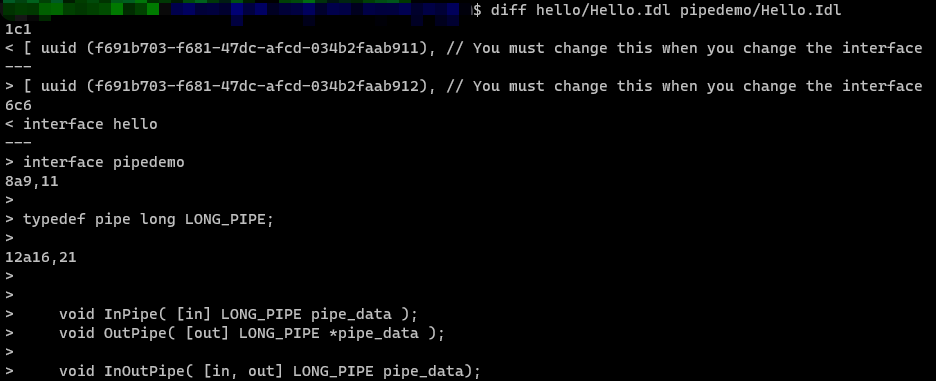
On May 1, 2022, we observed a public proof of concept (PoC) published on GitHub. The researcher conducted analysis of CVE-2022-26809 and created the PoC to trigger the vulnerable function OSF_SCALL::GetCoalescedBuffer. The PoC is created based on an RPC sample code, Hello, from Microsoft. Since all interfaces for programs using RPC must be defined in Microsoft Interface Definition Language (MIDL) and compiled with the MIDL compiler, the researcher added a new pipe type and several functions in the IDL file. This is because the server side needs to use pipe in order to trigger the vulnerability. The related modifications are shown in Figure 1:
The PoC client utilizes impacket.dcerpc.v5.rpcrt to send the data. Additionally, the researcher modified the packet handling logic of the rpcrt library. Although the PoC only works on a customized RPC server and a successful exploitation of this vulnerability requires specific settings on the server side, it could be modified by an attacker to construct a feasible exploit for the default Windows service. We strongly recommend patching CVE-2022-26809 as soon as possible.
CVE-2022-26923 – Active Directory Domain Service Privilege Escalation Vulnerability
This vulnerability allows a low-privileged user to escalate privileges to a domain administrator in a default Active Directory environment with the “Active Directory Certificate Services” server role installed. It is a logic issue that gets a valid certificate by using a fake domain controller, dNSHostName, and then gets the domain controller privileges by authenticating the certificate to the domain controller. Microsoft fixed CVE-2022-26923 in May’s security update but the vulnerability and exploit details are publicly available. We strongly recommend patching it as soon as possible.
CVE-2022-26925 – Windows LSA Spoofing Vulnerability
An unauthenticated attacker could call a method on the LSARPC interface and coerce the domain controller to authenticate the attacker using NTLM. Once the attacker gets the NTLM hash by the NTLM relay attack, the attacker can further use the leaked main controller NTLM hash to attack the system. CVE-2022-26925 was detected as being exploited in the wild and is publicly available. Microsoft fixed this vulnerability in May’s security update. We strongly recommend patching it as soon as possible.
Conclusion
CVE-2022-26809 is still being actively monitored due to its potential to be exploited in widespread attacks. Given the information currently available, this vulnerability may have a high impact in the future. RPC is widely used by a wide variety of Windows and Windows Server versions. Besides that, the vulnerable rpcrt4.dll is not only used by Microsoft services but also by other applications. CVE-2022-26923 and CVE-2022-26925 exploits are publicly available, and it’s only a matter of time until those vulnerabilities are abused by attackers. Users are encouraged to take all necessary steps to ensure they are protected against these vulnerabilities.
The Palo Alto Networks Next-Generation Firewall with a Threat Prevention subscription can block the attack traffic related to these vulnerabilities.
- CVE-2022-26809 Coverage: Threat ID 92490 (Application and Threat content update 8557)
- CVE-2022-26923 Coverage: Threat ID 92548 (Application and Threat content update 8568)
- CVE-2022-26925 Coverage: Threat ID 92549 (Application and Threat content update 8568)
Palo Alto Networks Cortex customers are protected from CVE-2022-26923 and CVE-2022-26925.
Additional Resources
Remote Procedure Call Runtime Remote Code Execution Vulnerability – Microsoft
Active Directory Domain Services Elevation of Privilege Vulnerability – Microsoft
Certifried: Active Directory Domain Privilege Escalation (CVE-2022–26923) – IFCR
PetitPotam – GitHub
Microsoft fixes new PetitPotam Windows NTLM Relay attack vector – BleepingComputer
Windows LSA Spoofing Vulnerability – Microsoft
Remote procedure call (RPC) – Microsoft
Text extracted automatically; images, tables and formatting may be missing. Original: https://unit42.paloaltonetworks.com/microsoft-cve-2022-26925-etc/