The IM worms armada
Full article256 words · extracted from securelist.com · click to collapse



We’ve noticed an increase in the prevalence of Y!/MSN-aware worms. These rely on various social engineering tricks to lure the user into a malicious website. For instance, IM-Worm.Win32.Qucan.c sends messages like this:
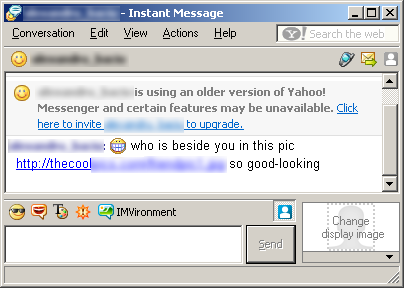
The link shows a URL nicely disguised as a JPEG file. The actual page, which contains an encrypted javascript to avoid direct inspection, uses a combination of Exploit.JS.ADODB.Stream.e and a more recent MDAC (MS06-014) exploit to install the worm in the system. Unfortunately, even though a patch for the MDAC exploit had been released in May 2006, we have quite a few Qucan.c/Sohanad.e cases reported.
Of course, if you have Firefox or Opera set as the default browser, the exploit doesn’t work.
BTW, if you’re still – for some obscure reason – using IE, it may be worth checking v7, which was just released. It works only on XP+SP2, though.
Latest Webinars
Reports
Kaspersky researchers have discovered new Mirage Kitten attacks using previously undocumented malware families: NodeRabbit in Node.js and PollCat in JavaScript.
Our experts discovered a new CoolClient backdoor variant with a kernel-mode rootkit driver that hides malicious processes, files, and network connections from security tools and threat analysts.
Kaspersky experts break down a new Armored Likho campaign that poses as a fundraising efforts and delivers a new Still Toolkit aimed at stealing Telegram data and eavesdropping on victims.
Kaspersky researchers reveal previously undocumented malware attributed to Mirage Kitten (UNC1549, Smoke Sandstorm, Nimbus Manticore): NightLedger backdoor, ArcBridge, and BridgeHead tunneling tools.
Text extracted automatically; images, tables and formatting may be missing. Original: https://securelist.com/the-im-worms-armada/30246/