Full article710 words · extracted from arstechnica.com · click to collapse
Jake Williams, VP of research and development at consultancy Hunter Strategy, said the union of these previously disparate engines would allow updates to be made to the Windows firewall on a per-domain name basis. The result, he said, is a mechanism that allows organizations to, in essence, tell clients “only use our DNS server, that uses TLS, and will only resolve certain domains.” Microsoft calls this DNS server or servers the “protective DNS server.”
By default, the firewall will deny resolutions to all domains except those enumerated in allow lists. A separate allow list will contain IP address subnets that clients need to run authorized software. Key to making this work at scale inside an organization with rapidly changing needs. Networking security expert Royce Williams (no relation to Jake Williams) called this a “sort of a bidirectional API for the firewall layer, so you can both trigger firewall actions (by input *to* the firewall), and trigger external actions based on firewall state (output *from* the firewall). So instead of having to reinvent the firewall wheel if you are an AV vendor or whatever, you just hook into WFP.”
How it works
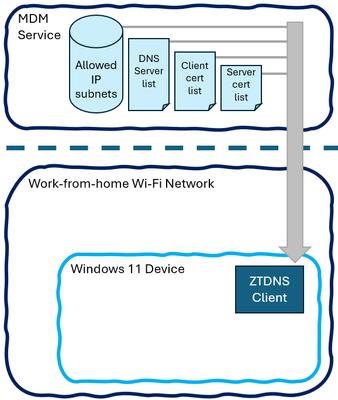
Microsoft provided a conceptual illustration showing how ZTDNS will fit into its mobile device management platform—which helps admins secure and control remote devices authorized to connect to a network—and interface with devices connected from home or other remote locations.
ZTDNS overview
Credit:
Microsoft
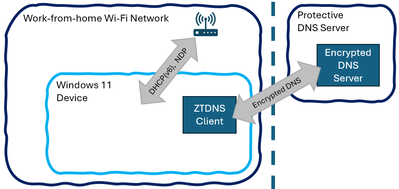
ZTDNS blocks outbound connections from the client device to all IPv4 or IPv6 IP addresses except for those to protective DNS servers, DHCP, DHCPv6, and NDP servers as needed for network discovery.
Treatment of outbound traffic by ZTDNS
Credit:
Microsoft
Microsoft continued:
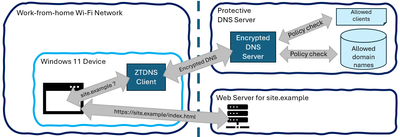
Going forward, DNS responses from one of the Protective DNS servers that contain IP address resolutions will trigger outbound allow exceptions for those IP addresses. This ensures that applications and services that use the system DNS configuration will be allowed to connect to the resolved IP addresses. This is because the destination IP address will be approved and unblocked before the domain name resolutions are returned to the caller.
IP addresses allowed
Credit:
Microsoft
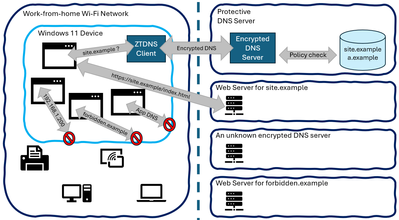
When applications and services try to send IPv4 or IPv6 traffic to an IP address that was not learned through ZTDNS (and is not on the manual exceptions list), the traffic will be blocked. This is not because ZTDNS tried to identify malicious or forbidden traffic to block, but because the traffic was not proven to be allowed. This makes ZTDNS a useful tool in the Zero Trust toolbelt: it assumes traffic is forbidden by default. This will allow administrators to define domain-name-based lockdown using policy-aware Protective DNS servers. Optionally, client certs can be used to provide policy-affecting client identities to the server rather than relying on client IP addresses, which are both not secure signals and not reliably stable for work-from-anywhere devices.
Domain-name-based lockdown
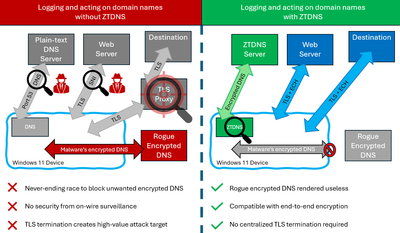
By using ZTDNS to augment their Zero Trust deployments, administrators can achieve name labeling of all outbound IPv4 and IPv6 traffic without relying on intercepting plain-text DNS traffic, engaging in an arms race to identify and block encrypted DNS traffic from apps or malware, inspecting the soon-to-be encrypted SNI, or relying on vendor-specific networking protocols. Instead, administrators can block all traffic whose associated domain name or named exception cannot be identified. This renders the use of hard-coded IP addresses or unapproved encrypted DNS servers irrelevant without having to introduce TLS termination and miss out on the security benefits of end-to-end encryption.
Comparison system with and without ZTDNS
Credit:
Microsoft
For DNS servers to be used as Protective DNS servers for ZTDNS lockdown, the minimum requirement is to support either DNS over HTTPS (DoH) or DNS over TLS (DoT), as ZTDNS will prevent the use of plain-text DNS by Windows. Optionally, use of mTLS on the encrypted DNS connections will allow Protective DNS to apply per-client resolution policies. In all cases, ZTDNS does not introduce any novel network protocols, which makes it a promising interoperable approach to domain-name-based lockdown.
Ryan Hurst, CEO of Peculiar Ventures, said that the mass adoption of encrypted connections inside networks has created difficulties in some large organizations because so many of the security tools admins use rely on their ability to inspect and monitor plain-text traffic. In an interview, he wrote: