Former NSA, Cyber Command chief Paul Nakasone says U.S. falling behind its enemies in cyberspace
Full article1,164 words · extracted from cyberscoop.com · click to collapse
Get our latest cybersecurity news first on Google.
In a wide-ranging speech and interview, Nakasone also talked about Trump administration moves and the shape of cyber offensive operations.
Listen to this article
0:00
Learn more.
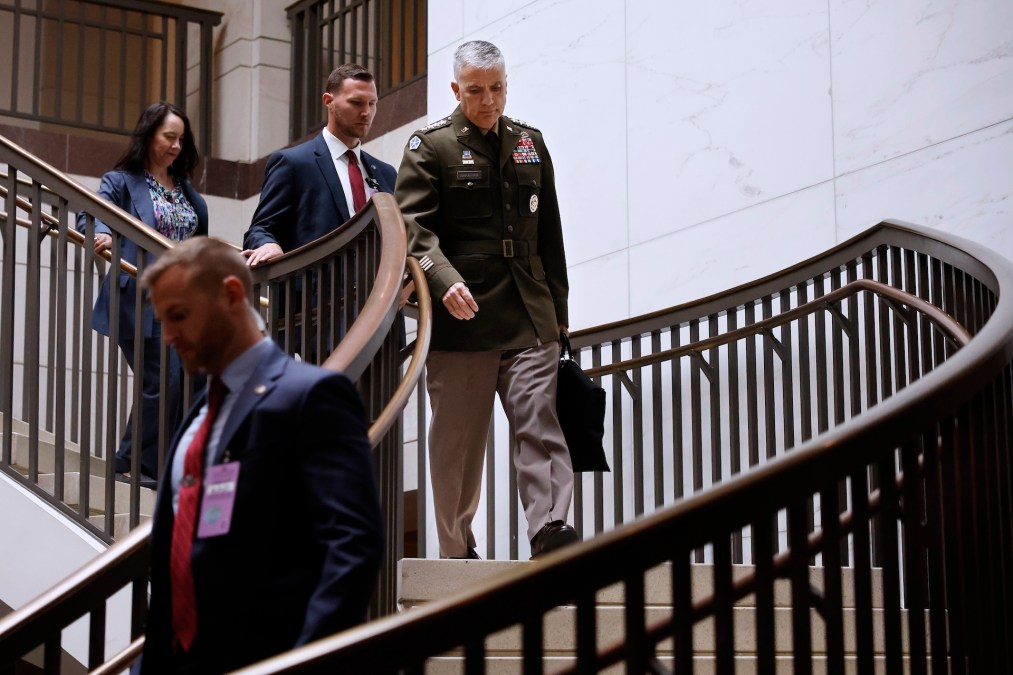
The United States is falling “increasingly behind” its adversaries in cyberspace, a former Cyber Command and National Security Agency boss said Saturday.
Speaking at the DistrictCon cybersecurity conference in Washington, D.C., retired Gen. Paul Nakasone said that “our adversaries are continuing to be able to broaden the spectrum of what they’re able to do to us.”
Nakasone said incidents like Chinese government-backed breaches of U.S. telecommunications companies and other critical infrastructure — as well as a steady drumbeat of ransomware attacks against U.S. targets — illustrate “the fact that we’re unable to secure our networks, the fact that we’re unable to leverage the software that’s being provided today, the fact that we have adversaries that continue to maintain this capability.”
Nakasone, who led NSA and CYBERCOM from 2018 until early last year and is now founding director of Vanderbilt University’s Institute of National Security, said he fears the threats of the future are only going to get more dangerous.
One example is “we are starting to see the beginnings of the bleed from the non-kinetic to the kinetic for cyber operations,” he said, referring to actual physical damage.
“What’s next is that we are going to see cyberattacks against a series of platforms being able to actually down platforms with ones and zeros,” Nakasone said.
A board member for OpenAI, Nakasone also talked about how artificial intelligence could make cyber offense more potent. Specifically, he mentioned the notion of generative targeting, such as the idea of physical drones choosing their targets powered by AI.
“We’re starting to challenge this idea of humans in the middle of the loop, and I also offer to you as we think about artificial intelligence models, think about cyber weaponry,” he said. “How far are we talking to this idea of being able to create an agent that’s going to move through your network, that’s going to change based upon topology in the network, being able to evade the defenses that are there, choosing targets of the future?”
Members of the Trump administration, and some members from both parties in Congress, have called for the United States to get more aggressive with offensive operations in cyberspace. In a separate conversation with reporters, Nakasone said he agreed with those sentiments.
Nakasone’s Cyber Command conducted operations dating back to at least 2018 to disrupt Iranian and Russian hackers in conjunction with more defensive “hunt forward” missions in other nations designed to fortify allies’ defenses and detect future threats against the United States. He also advocated for a philosophy of “persistent engagement” — to be in constant contact with cyber enemies, proactively rather than reactively.
“We need to do more of that, certainly,” Nakasone said of offensive operations. “It’s not just the only thing we need.”
One of the points of persistent engagement was to ensure anyone who attacked U.S. election infrastructure knew they would suffer consequences from the United States, he said.
“Can we be more forthcoming in terms of some of the things we did?” Nakasone said. “Yeah, I think there is opportunity.”
In his speech, Nakasone said the top priority for the United States should be hiring top talent. Under President Donald Trump, the government has been removing some of those who were in the cyber talent pipeline.
Eventually, “we’re going to have to be able to engage folks again and say, ‘Hey, please come and work in government,’” Nakasone said. It’s an open question how long any damage to the trust of potential hires will last, he said.
Another change under Trump is that Defense Secretary Pete Hegseth has reportedly sped up the implementation of a Cyber Command overhaul, from 180 days to 45 days.
“How doable is it? It’s really doable when you get that direction from the secretary,” Nakasone said in response to a question from CyberScoop. Asked if he was worried about whether the tightened timeline would lead to that implementation suffering, Nakasone answered only that the concepts of Cyber Command 2.0 have been in the works for a while already.
During a question-and-answer session with the DistrictCon audience, Nakasone also didn’t voice any criticisms of Trump’s purge of top military officials, such as Gen. Charles “CQ” Q. Brown, chairman of the Joint Chiefs of Staff.
“At the end of the day, the president gets to choose his own principal military adviser,” he said, while praising Brown.
Update 2/23/25: This story has been updated with the correct title of Vanderbilt University’s Institute of National Security.
More Scoops
Former NSA chiefs worry American offensive edge in cybersecurity is slipping
A systemic numbness to cyberattacks has exposed the U.S. economy and its institutions to ever-widening threats. Retired four-star military officials worry the worst day in cyber is…
Cyber Command leader says budget powers are shaving time to complete tasks that once took years
Cyber Command’s rotation ‘problem’ exacerbates talent shortage amid growing digital threat
Latest Podcasts
Government
FBI officials say AI is bolstering adversaries, emphasizing need to focus on cyber basics, patching
Feds accuse China of ‘systematic’ distillation of U.S. AI models
CIA’s Michael Ellis says cyber intelligence is changing how the agency operates
The G7 tells industry to hurry up and prep for post-quantum encryption
Technology
Threats
Microsoft discloses two actively exploited zero-days among 974 vulnerabilities
Russian national extradited to US for alleged involvement in bank-account takeover scheme
Attackers exploit zero-days in consistently besieged SonicWall product
Jail time for Maine child in 764 marks turning point in federal law enforcement
Policy
Whistleblower says USPS deploying new, ‘untested’ IT systems governing mail-in ballots
‘Watershed 250’ test program in Texas looks to private sector for water cybersecurity help
Former sexual abuse victims say Grok used their images, videos to train deepfake capabilities
Cyber threats nudge Trump to sign executive order on foreign equipment in U.S. energy infrastructure
Text extracted automatically; images, tables and formatting may be missing. Original: https://cyberscoop.com/former-nsa-cyber-command-chief-paul-nakasone-enemies-cyberspace/