Warrant requirements, Democratic worries could factor into spy law renewal debate
Full article818 words · extracted from cyberscoop.com · click to collapse
Get our latest cybersecurity news first on Google.
Listen to this article
0:00
Learn more.
A fresh effort is mounting in Congress to require federal agents to obtain a warrant before searching a government surveillance database for information about U.S. citizens, as Congress again faces an impending deadline, in four months, to renew a major surveillance law.
But there are also signs that renewal of Section 702 of the Foreign Intelligence Surveillance Act (FISA), set to expire in April, could see the reversal of political headwinds that endangered the last reauthorization two years ago: Democrats are now concerned about President Donald Trump’s usage of those spying powers, rather than Republicans being worried about then-President Joe Biden.
A key debate in 2024 was the idea of a warrant requirement, and a House Judiciary Committee hearing Thursday made clear it’s set to reemerge. Under Section 702 of FISA, the government can warrantlessly surveil foreign targets. But it also doesn’t require a warrant to warrantlessly search a database using U.S. individuals’ personal information to obtain communications from people who are electronically communicating with surveillance targets.
A House vote to require a warrant for U.S. person queries fell on a tie vote in 2024 before Congress ultimately passed the Reforming Intelligence and Securing America Act with changes intended to rein in government surveillance abuses. Proponents say a warrant is the best way to protect U.S. citizens’ Fourth Amendment rights against unreasonable searches and seizures. Opponents, including FBI Director Kash Patel, say it would slow crucial national security investigations.
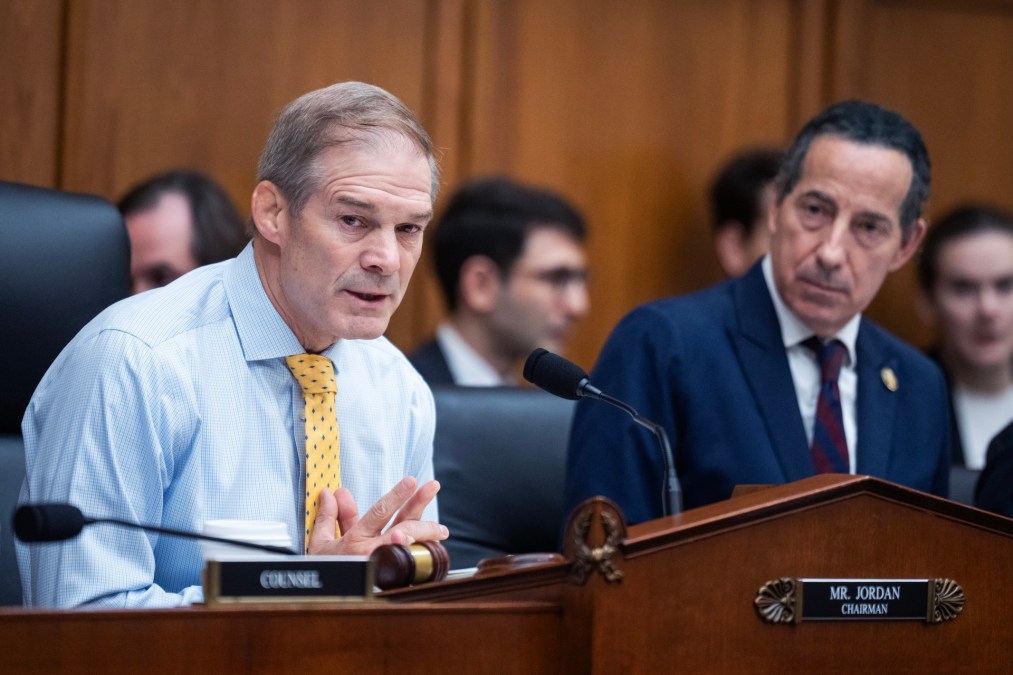
House Judiciary Chairman Jim Jordan, R-Ohio, said the 2024 law included some “good reforms.” He cited a watchdog report from October that the number of warrantless U.S. person queries had dropped to around 9,000 in the first year of the law’s existence, down from 3.4 million.
But Jordan said Congress still needs to require warrants.
“If you’re going to search this database and you’re going to search using an American’s name, phone number, email address, we believe you should go to a separate and equal branch of government to do so,” he said. “We think that’s fundamental.”
Others weren’t as convinced about the progress. Witnesses told lawmakers that the FBI has changed the definition of a “query” in ways that distort that figure.
‘Apparently what the FBI did recently is they started treating a mechanism by which they sort data in the database — which of course requires them to look at the names and identifying information about specific people — that apparently they have some kind of a sorting process that they go through when looking through the data, and they don’t count the sorting as a query,” said Gene Schaerr, general counsel for the Project for Privacy & Surveillance Accountability
“They only actually count as a query when they drill down on a specific individual.”
Arizona Republican Rep. Andy Biggs, a leading figure in Congress pushing for warrant requirements, said he was dismayed that there was “no way to determine how many actual queries are taking place.”
Under Trump, Democrats could be less willing to vote to renew the expiring surveillance powers, however.
The top Democrat on the Judiciary panel, Maryland Rep. Jamie Raskin, said “the results are alarming” when looking at surveillance in the United States since the passage of the 2024 law, such as the Trump administration moving to consolidate databases on U.S. citizen information.
”The landscape has changed,” Raskin said. “We have a lot to be concerned about at this point.”
Latest Podcasts
Government
FBI officials say AI is bolstering adversaries, emphasizing need to focus on cyber basics, patching
Feds accuse China of ‘systematic’ distillation of U.S. AI models
CIA’s Michael Ellis says cyber intelligence is changing how the agency operates
The G7 tells industry to hurry up and prep for post-quantum encryption
Technology
Threats
Chinese espionage groups swarm to exploit triple-link chain of zero-days
Microsoft discloses two actively exploited zero-days among 974 vulnerabilities
Russian national extradited to US for alleged involvement in bank-account takeover scheme
Attackers exploit zero-days in consistently besieged SonicWall product
Policy
Whistleblower says USPS deploying new, ‘untested’ IT systems governing mail-in ballots
‘Watershed 250’ test program in Texas looks to private sector for water cybersecurity help
Former sexual abuse victims say Grok used their images, videos to train deepfake capabilities
Cyber threats nudge Trump to sign executive order on foreign equipment in U.S. energy infrastructure
Text extracted automatically; images, tables and formatting may be missing. Original: https://cyberscoop.com/warrant-requirements-democratic-worries-could-factor-into-spy-law-renewal-debate/