North Korean hackers posed as Meta recruiter on LinkedIn
Full article525 words · extracted from cyberscoop.com · click to collapse
Get our latest cybersecurity news first on Google.
Targets of the operation were given phony coding challenges that delivered a range of malware including a previously-unseen backdoor.

A North Korean cyberespionage operation targeted employees of an aerospace company in Spain using a previously unreported backdoor and a creative phishing campaign featuring a phony Silicon Valley recruiter, demonstrating a “significant advancement in malicious capabilities,” researchers with the cybersecurity firm ESET said Friday.
Hackers linked with North Korea’s Lazarus Group — an umbrella term for a collection of North Korean cyber units — posed as a recruiter for Meta and contacted employees of the unnamed company via LinkedIn and sent two coding challenges supposedly part of the hiring process but which were in fact laced with malware, Peter Kálnai, an ESET researcher, wrote in a report published Friday.
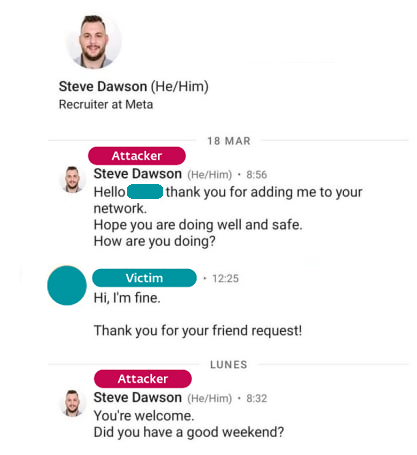
The operation, carried out some time last year, is just the latest example of North Korean-linked cyber operations using phony job opportunities to target various professionals, including journalists, security researchers and software developers, among others.
The ostensible coding challenges were contained in malicious files named “Quiz1.exe” and “Quiz2.exe” and when downloaded and executed on a company device delivered a remote access trojan ESET dubbed “LightlessCan.”
The malware mimicked a “wide range of native Windows commands,” Kálnai said, and enabled “discreet execution within the RAT itself instead of noisy console executions.”
The “strategic shift enhances stealth, making detecting and analyzing the attacker’s motives more challenging,” he said. The malware was also set to decrypt only on an intended target’s machine, “effectively preventing decryption on unintended machines, such as those of security researchers.”
LightlessCan has support for up to 68 distinct commands, he added, but only 43 are implemented in the current version of the malware with some functionality, suggesting the potential for ongoing development and refinement.
Latest Podcasts
Government
FBI officials say AI is bolstering adversaries, emphasizing need to focus on cyber basics, patching
CIA’s Michael Ellis says cyber intelligence is changing how the agency operates
The G7 tells industry to hurry up and prep for post-quantum encryption
Jail time for Maine child in 764 marks turning point in federal law enforcement
Technology
Threats
Chinese espionage groups swarm to exploit triple-link chain of zero-days
Microsoft discloses two actively exploited zero-days among 974 vulnerabilities
Russian national extradited to US for alleged involvement in bank-account takeover scheme
Attackers exploit zero-days in consistently besieged SonicWall product
Policy
Whistleblower says USPS deploying new, ‘untested’ IT systems governing mail-in ballots
‘Watershed 250’ test program in Texas looks to private sector for water cybersecurity help
Former sexual abuse victims say Grok used their images, videos to train deepfake capabilities
Cyber threats nudge Trump to sign executive order on foreign equipment in U.S. energy infrastructure
Text extracted automatically; images, tables and formatting may be missing. Original: https://cyberscoop.com/north-korea-meta-linkedin/