Patch Tuesday, March 2024 Edition
Vulnerabilities mentionedAll →
| CVE | Vulnerability | CVSS | EPSS | Flags | Affected | Exposure | Published |
|---|---|---|---|---|---|---|---|
| CVE-2024-21334 | Open Management Infrastructure (OMI) Remote Code Execution Vulnerability Open Management Infrastructure (OMI) Remote Code Execution Vulnerability NVD description · AI analysis pending | 9.8 | 20% |
| — | ||
| CVE-2024-21390 | Microsoft Authenticator Elevation of Privilege Vulnerability Microsoft Authenticator Elevation of Privilege Vulnerability NVD description · AI analysis pending | 7.1 | 1% |
| — | ||
| CVE-2024-21437 +1 in the same advisory: …21433 | Windows Graphics Component Elevation of Privilege Vulnerability Windows Graphics Component Elevation of Privilege Vulnerability NVD description · AI analysis pending | 7.8 group max | 8% |
| — | ||
| CVE-2024-21435 | Windows OLE Remote Code Execution Vulnerability Windows OLE Remote Code Execution Vulnerability NVD description · AI analysis pending | 8.8 | 2% |
| — | ||
| CVE-2024-23225 +1 in the same advisory: …23296 | Memory Corruption Kernel Protection Bypass in Apple iOS, macOS, tvOS, visionOS CVE-2024-23225 is a memory-corruption flaw (CWE-787, out-of-bounds write) in the kernels of Apple's iOS, iPadOS, macOS, tvOS, visionOS and watchOS, addressed with improved memory validation in Apple's March 2024 updates. It is triggered locally (CVSS AV:L/PR:L/UI:N) after an attacker has already obtained arbitrary kernel read and write capability, typically as the final stage of an exploit chain, and requires no user interaction. Successful abuse lets the attacker bypass the kernel's memory protections, converting an existing kernel read/write primitive into deeper and more reliable system compromise. Affected users are those running iPhone/iPad software older than iOS/iPadOS 17.4 (or 16.7.6 on the iOS 16 line), Macs older than macOS Sonoma 14.4 / Ventura 13.6.5 / Monterey 12.7.4, Apple TV units older than tvOS 17.4, Apple Vision Pro units older than visionOS 1.1, and Apple Watch units older than watchOS 10.4. Apple has stated the issue may have been exploited in the wild, CISA added it to the KEV on 2024-03-06 as part of the March 2024 emergency update batch, and EPSS currently assigns a 1.5% probability of exploitation within 30 days (72nd percentile). Do: Patch immediately to iOS/iPadOS 17.4 (or 16.7.6 for devices that cannot run 17), macOS Sonoma 14.4 / Ventura 13.6.5 / Monterey 12.7.4, tvOS 17.4, visionOS 1.1 and watchOS 10.4; there is no known workaround, so updating is the only mitigation. Because the flaw is KEV-listed, federal agencies must apply the vendor fixes within the BOD 22-01 deadline, and all defenders should verify installed OS versions fleet-wide (e.g., via MDM) and prioritize internet-facing and high-risk users. | 7.8 | 1% | KEV |
| mass≈2 billion active Apple devices (combined installed base); virtually all devices on pre-March 2024 OS builds were affected at disclosure | |
| CVE-2024-26170 | Windows Composite Image File System (CimFS) Elevation of Privilege Vulnerability Windows Composite Image File System (CimFS) Elevation of Privilege Vulnerability NVD description · AI analysis pending | 7.8 | 7% |
| — | ||
| CVE-2024-26182 | Windows Kernel Elevation of Privilege Vulnerability Windows Kernel Elevation of Privilege Vulnerability NVD description · AI analysis pending | 7.8 | 6% |
| — |
Full article749 words · extracted from krebsonsecurity.com · click to collapse
Apple and Microsoft recently released software updates to fix dozens of security holes in their operating systems. Microsoft today patched at least 60 vulnerabilities in its Windows OS. Meanwhile, Apple’s new macOS Sonoma addresses at least 68 security weaknesses, and its latest update for iOS fixes two zero-day flaws.

Last week, Apple pushed out an urgent software update to its flagship iOS platform, warning that there were at least two zero-day exploits for vulnerabilities being used in the wild (CVE-2024-23225 and CVE-2024-23296). The security updates are available in iOS 17.4, iPadOS 17.4, and iOS 16.7.6.
Apple’s macOS Sonoma 14.4 Security Update addresses dozens of security issues. Jason Kitka, chief information security officer at Automox, said the vulnerabilities patched in this update often stem from memory safety issues, a concern that has led to a broader industry conversation about the adoption of memory-safe programming languages [full disclosure: Automox is an advertiser on this site].
On Feb. 26, 2024, the Biden administration issued a report that calls for greater adoption of memory-safe programming languages. On Mar. 4, 2024, Google published Secure by Design, which lays out the company’s perspective on memory safety risks.
Mercifully, there do not appear to be any zero-day threats hounding Windows users this month (at least not yet). Satnam Narang, senior staff research engineer at Tenable, notes that of the 60 CVEs in this month’s Patch Tuesday release, only six are considered “more likely to be exploited” according to Microsoft.
Those more likely to be exploited bugs are mostly “elevation of privilege vulnerabilities” including CVE-2024-26182 (Windows Kernel), CVE-2024-26170 (Windows Composite Image File System (CimFS), CVE-2024-21437 (Windows Graphics Component), and CVE-2024-21433 (Windows Print Spooler).
Narang highlighted CVE-2024-21390 as a particularly interesting vulnerability in this month’s Patch Tuesday release, which is an elevation of privilege flaw in Microsoft Authenticator, the software giant’s app for multi-factor authentication. Narang said a prerequisite for an attacker to exploit this flaw is to already have a presence on the device either through malware or a malicious application.
“If a victim has closed and re-opened the Microsoft Authenticator app, an attacker could obtain multi-factor authentication codes and modify or delete accounts from the app,” Narang said. “Having access to a target device is bad enough as they can monitor keystrokes, steal data and redirect users to phishing websites, but if the goal is to remain stealth, they could maintain this access and steal multi-factor authentication codes in order to login to sensitive accounts, steal data or hijack the accounts altogether by changing passwords and replacing the multi-factor authentication device, effectively locking the user out of their accounts.”
CVE-2024-21334 earned a CVSS (danger) score of 9.8 (10 is the worst), and it concerns a weakness in Open Management Infrastructure (OMI), a Linux-based cloud infrastructure in Microsoft Azure. Microsoft says attackers could connect to OMI instances over the Internet without authentication, and then send specially crafted data packets to gain remote code execution on the host device.
CVE-2024-21435 is a CVSS 8.8 vulnerability in Windows OLE, which acts as a kind of backbone for a great deal of communication between applications that people use every day on Windows, said Ben McCarthy, lead cybersecurity engineer at Immersive Labs.
“With this vulnerability, there is an exploit that allows remote code execution, the attacker needs to trick a user into opening a document, this document will exploit the OLE engine to download a malicious DLL to gain code execution on the system,” Breen explained. “The attack complexity has been described as low meaning there is less of a barrier to entry for attackers.”
A full list of the vulnerabilities addressed by Microsoft this month is available at the SANS Internet Storm Center, which breaks down the updates by severity and urgency.
Finally, Adobe today issued security updates that fix dozens of security holes in a wide range of products, including Adobe Experience Manager, Adobe Premiere Pro, ColdFusion 2023 and 2021, Adobe Bridge, Lightroom, and Adobe Animate. Adobe said it is not aware of active exploitation against any of the flaws.
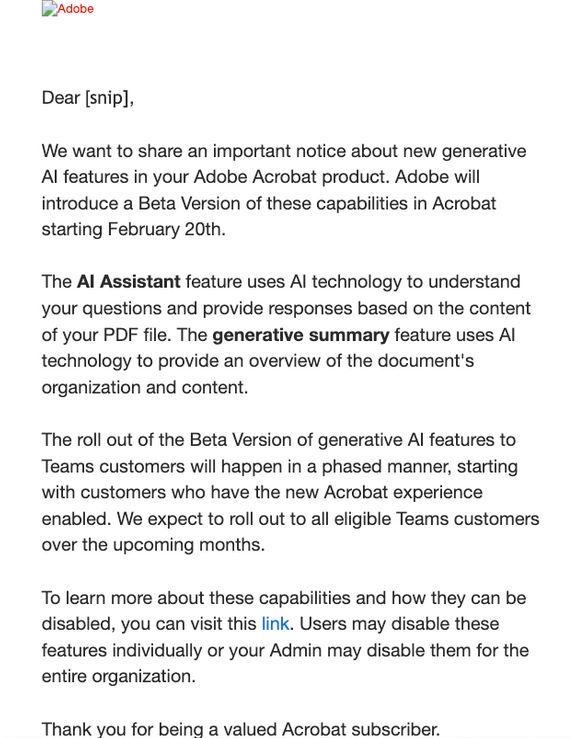
By the way, Adobe recently enrolled all of its Acrobat users into a “new generative AI feature” that scans the contents of your PDFs so that its new “AI Assistant” can “understand your questions and provide responses based on the content of your PDF file.” Adobe provides instructions on how to disable the AI features and opt out here.
Text extracted automatically; images, tables and formatting may be missing. Original: https://krebsonsecurity.com/2024/03/patch-tuesday-march-2024-edition/