Democratic groups sue to block Trump administration’s elections order
Full article1,295 words · extracted from cyberscoop.com · click to collapse
Get our latest cybersecurity news first on Google.
The lawsuit casts much of the order as broadly illegal and outside the scope of the executive branch’s constitutional powers.
Listen to this article
0:00
Learn more.
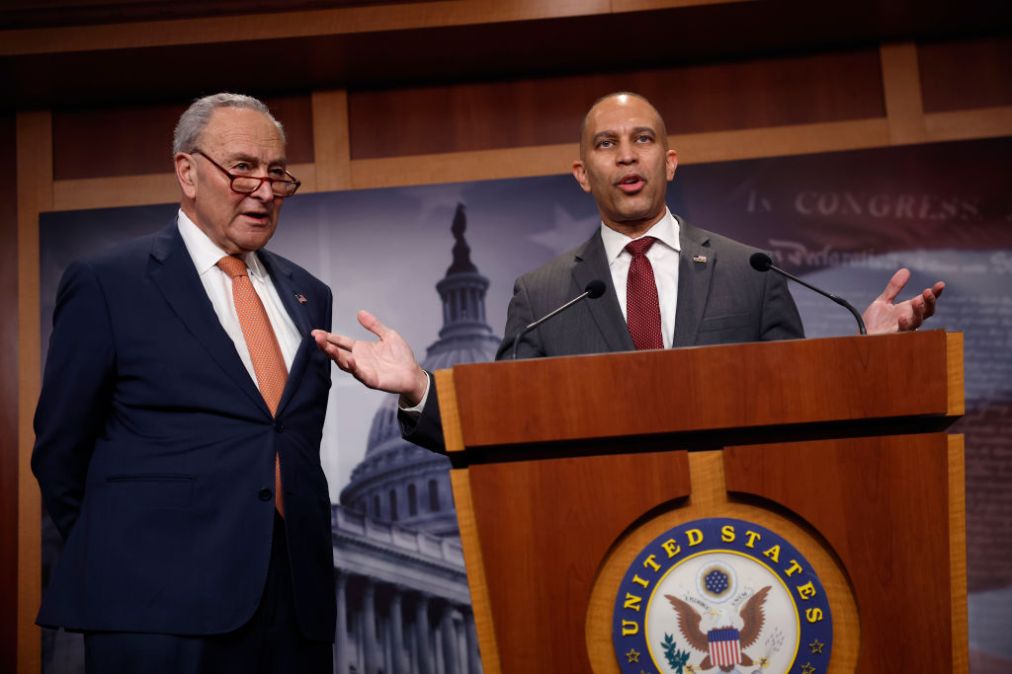
The Democratic Party has filed a lawsuit against the Trump administration over its elections executive order, arguing the president lacks the constitutional authority to regulate elections by fiat.
The suit, filed Monday in the District of Columbia District Court, was brought by Senate Minority Leader Chuck Schumer, D-N.Y., House Minority Leader Hakeem Jeffries, D-N.Y., the Democratic National Committee, Democratic Governors Association, Democratic Senatorial Campaign Committee and Democratic Congressional Campaign Committee.
The parties are represented by Elias Law Group, a law firm founded by Democratic lawyer Marc Elias, who pledged last week to challenge the order in court.
It names President Donald Trump, 13 other U.S. officials and 11 federal departments and agencies as defendants, and casts much of the order as broadly illegal and outside the scope of the executive branch’s constitutional powers.
“This executive order is an unconstitutional power grab from Donald Trump that attacks vote by mail, gives DOGE sensitive personal information and makes it harder for states to run their own free and fair elections,” the plaintiffs said in a statement. “It will even make it harder for military members serving overseas and married women who have changed their name to have their votes count.”
The order cites “no source of legal authority” for the administration’s demand that the Election Assistance Commission alter voter registration forms to include “documentary proof” of U.S. citizenship section, or command states to use it, the complaint alleges.
Nor does the executive branch have the power to order the EAC — an agency Congress explicitly created to be independent and bipartisan — to cut off federal funding to states that don’t comply with the president’s demands, alter voting certification guidelines or force a mass recertification of voting machines used by states.
The suit claims that mail voting provisions infringe upon the states’ 10th Amendment rights and aims to nullify state laws without going through Congress, while also accusing the EAC and other federal agencies of imposing funding conditions that encroach on Congress’ budgetary authority.
“Not one of these conditional spending provisions considers — let alone derives authority from — any applicable statutes or regulations authorizing the relevant federal agencies to disburse federal funds to State and local governments,” the lawsuit continues.
Because states heavily rely on Help America Vote Act grants for upgrading voting equipment, officials must either comply with the president’s policies or lose crucial federal funds needed to run and maintain secure elections.
The plaintiffs are asking the court to declare parts of the order void, other parts unconstitutional and enjoin federal agencies from seeking to enforce it.
The White House did not immediately return a request for comment.
Since first coming into office in 2017, Trump and his allies have repeatedly claimed that U.S. elections are rife with voter fraud, non-citizen voting and manipulation by the Democratic party. But he has consistently failed to provide evidence for any kind of systemic fraud through dozens of court challenges and a failed voter fraud commission established in his first term.
Further, non-citizen voting, double voting and other forms of voter fraud are felony offenses, and voters must affirm on their registration form under penalty of perjury that they are citizens eligible to vote. Election experts have pointed out that few if any individuals are likely willing to risk a felony charge to cast a single vote in elections with hundreds of thousands or millions of votes, and recent state audits of voter rolls in Georgia, Ohio, Iowa and others have validated this view, finding only a small number of registered noncitizen voters and even fewer who actually cast a vote.
State officials charged with election administration have been absorbing the order since it was released, attempting to discern which parts may be legal or binding. Some have embraced the order while others pledged to fight it in court.
Minnesota Secretary of State Steve Simon, a Democrat, said his office was exploring legal options. He warned the order would disenfranchise millions of eligible voters and add “costly and burdensome requirements” for those registering to vote.
“We already use paper ballots, maintain secure voter registration systems, and count only ballots matched to a registered voter and received by election day,” Simon said in a statement. “This executive order would undermine the balance of security and accessibility and erode the freedom to vote for millions of eligible Americans.”
However, Tennessee’s Office of the Secretary of State praised the order, telling WBIR in Knoxville that they “appreciate” Trump’s willingness to increase access to federal databases for citizenship verification purposes.
“As we continue to review the president’s order, we believe this significant step will strengthen our efforts to ensure only eligible voters cast a ballot in Tennessee,” the office said.
More Scoops

Election official says Tina Peters would be consultant, won’t have access to election systems
Shasta County registrar Clint Curtis told CyberScoop he needs Peters to help manage the county’s 2026 elections and he’s not concerned about her past conviction.
SCOTUS tosses one of two injunctions against Trump USPS mail-in ballot rules
Postal Service moves to finalize mail ballot regs before SCOTUS ruling
Latest Podcasts
Government
FBI officials say AI is bolstering adversaries, emphasizing need to focus on cyber basics, patching
Feds accuse China of ‘systematic’ distillation of U.S. AI models
CIA’s Michael Ellis says cyber intelligence is changing how the agency operates
The G7 tells industry to hurry up and prep for post-quantum encryption
Technology
Threats
Chinese espionage groups swarm to exploit triple-link chain of zero-days
Microsoft discloses two actively exploited zero-days among 974 vulnerabilities
Russian national extradited to US for alleged involvement in bank-account takeover scheme
Attackers exploit zero-days in consistently besieged SonicWall product
Policy
‘Watershed 250’ test program in Texas looks to private sector for water cybersecurity help
Former sexual abuse victims say Grok used their images, videos to train deepfake capabilities
Cyber threats nudge Trump to sign executive order on foreign equipment in U.S. energy infrastructure
Bipartisan Senate bill aims to prepare energy sector for Q-Day
Text extracted automatically; images, tables and formatting may be missing. Original: https://cyberscoop.com/democratic-groups-challenge-trump-election-order/