FBI to private industry: Attribution won’t deter North Korean hacking
Full article805 words · extracted from cyberscoop.com · click to collapse
Get our latest cybersecurity news first on Google.
North Korean hacking “will continue unabated, regardless of the U.S. government public attribution" the FBI said in an alert obtained by CyberScoop.
The FBI has told American companies that North Korean government hackers will continue to target financial institutions worldwide despite the U.S. government’s public attribution of such activity to Pyongyang.
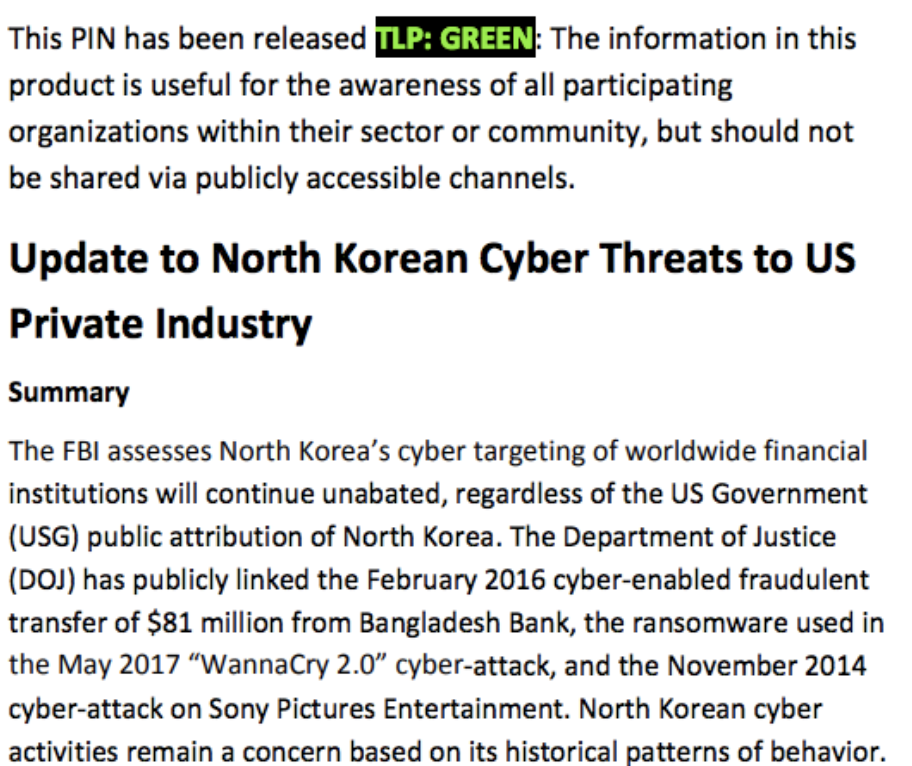
The targeting “will continue unabated, regardless of the U.S. government public attribution of North Korea,” the FBI’s cyber division said in an industry advisory dated Oct. 25 and obtained by CyberScoop. “North Korean cyber activities remain a concern based on its historical patterns of behavior,” the notice says.
In conceding that attribution will not change North Korea’s calculus in cyberspace, the FBI is reiterating what is widely recognized in the cybersecurity industry: that Kim Jong Un’s regime is too brazen to care about being called out for its hacking.
In September, the DOJ announced charges against North Korean spy Park Jin Hyok for his alleged role in the destructive 2014 cyberattack against Sony Pictures Entertainment and the 2017 WannaCry ransomware attack. It was the first time the U.S. government had charged a North Korean for hacking. Analysts told CyberScoop that the broad set of North Korean hackers that includes Park would be undeterred and continue to evolve and clean up its operational security.
In the Oct. 25 alert, the FBI said it “does not have reporting to indicate North Korea will likely retaliate based on the unsealing of the complaint.”
The advisory is labeled “Traffic Light Protocol (TLP) Green,” meaning private-sector recipients can share it with partner organizations but not publicly. TLP classifications measure the sensitivity of threat information the government disseminates to the private sector.
“In furtherance of public-private partnerships, the FBI routinely advises private industry of various cyberthreat indicators observed during the course of our investigations,” an FBI spokesperson told CyberScoop. “This data is provided in order to help systems administrators guard against the actions of persistent cyber criminals.”
DOJ officials have argued that, regardless of whether a hacker sees the inside of a U.S. courtroom, bringing charges sends an important message that the hacking will not be tolerated. The efficacy of U.S. deterrence tools – whether sanctions, public shaming, offensive cyber operations, or other measures – vary depending on the foreign government targeted.
In response to North Korea’s testing of nuclear weapons and missiles, the U.S. government has repeatedly imposed economic sanctions to squeeze the Kim Jong Un regime’s financing. Under that pressure, the Pyongyang has used hacking operations to raise significant money, according to researchers.
In the weeks that followed the DOJ charges against Park, cybersecurity company FireEye released evidence documenting a distinct group of North Korean hackers that has helped finance the Kim Jong Un regime. “This is an active … threat against financial institutions all around the world,” FireEye’s Sandra Joyce said in announcing the research.
The Oct. 25 FBI alert lists some of the tactics and techniques North Korean hackers have used to target the financial and energy sectors in recent years. The North Koreans have used spear-phishing on both sectors, while employing custom malware to hit financial institutions and a master boot record wiper malware against the energy sector, the alert says.
The FBI advisory also attributes “the leak of a foreign power plant blueprints” to North Koreans, which is likely a reference to a December 2014 breach of a South Korean power company’s IT system. The hackers stole the blueprints of Korea Hydro and Nuclear Power Co. nuclear reactors along with the company’s estimates of radiation exposure to local residents.
A screenshot of the FBI alert is below.
Latest Podcasts
Government
FBI officials say AI is bolstering adversaries, emphasizing need to focus on cyber basics, patching
Feds accuse China of ‘systematic’ distillation of U.S. AI models
CIA’s Michael Ellis says cyber intelligence is changing how the agency operates
The G7 tells industry to hurry up and prep for post-quantum encryption
Technology
Threats
Chinese espionage groups swarm to exploit triple-link chain of zero-days
Microsoft discloses two actively exploited zero-days among 974 vulnerabilities
Russian national extradited to US for alleged involvement in bank-account takeover scheme
Attackers exploit zero-days in consistently besieged SonicWall product
Policy
Whistleblower says USPS deploying new, ‘untested’ IT systems governing mail-in ballots
‘Watershed 250’ test program in Texas looks to private sector for water cybersecurity help
Former sexual abuse victims say Grok used their images, videos to train deepfake capabilities
Cyber threats nudge Trump to sign executive order on foreign equipment in U.S. energy infrastructure
Text extracted automatically; images, tables and formatting may be missing. Original: https://cyberscoop.com/fbi-north-korea-hacking-wont-stop-tlp-green/