The Mystery of Duqu: Part Seven (Back to Stuxnet)
Full article364 words · extracted from securelist.com · click to collapse



We have been studying the Duqu Trojan for two months now, exploring how it emerged, where it was distributed and how it operates. Despite the large volume of data obtained (most of which has yet to be published), we still lack the answer to the fundamental question – who is behind Duqu?
In addition, there are other issues, mostly to do with the creation of the Trojan, or rather the platform used to implement Duqu as well as Stuxnet.
In terms of architecture, the platform used to create Duqu and Stuxnet is the same. This is a driver file which loads a main module designed as an encrypted library. At the same time, there is a separate configuration file for the whole malicious complex and an encrypted block in the system registry that defines the location of the module being loaded and name of the process for injection.
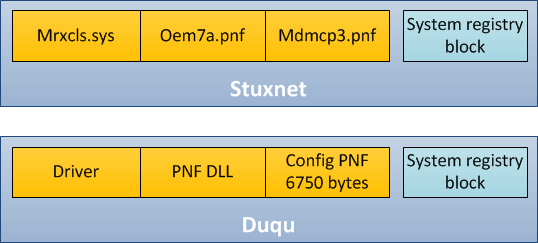
This platform can be conventionally named as ‘Tilded’ as its authors are, for some reason, inclined to use file names which start with “~d”.
We believe Duqu and Stuxnet were simultaneous projects supported by the same team of developers.
Several other details have been uncovered which suggest there was possibly at least one further spyware module based on the same platform in 2007-2008, and several other programs whose functionality was unclear between 2008 and 2010.
These facts significantly challenge the existing “official” history of Stuxnet. We will try to cover them in this publication, but let us first recap the story so far.
Latest Webinars
Reports
Kaspersky researchers have discovered new Mirage Kitten attacks using previously undocumented malware families: NodeRabbit in Node.js and PollCat in JavaScript.
Our experts discovered a new CoolClient backdoor variant with a kernel-mode rootkit driver that hides malicious processes, files, and network connections from security tools and threat analysts.
Kaspersky experts break down a new Armored Likho campaign that poses as a fundraising efforts and delivers a new Still Toolkit aimed at stealing Telegram data and eavesdropping on victims.
Kaspersky researchers reveal previously undocumented malware attributed to Mirage Kitten (UNC1549, Smoke Sandstorm, Nimbus Manticore): NightLedger backdoor, ArcBridge, and BridgeHead tunneling tools.
Text extracted automatically; images, tables and formatting may be missing. Original: https://securelist.com/the-mystery-of-duqu-part-seven-back-to-stuxnet/31612/