How we developed our simple Harbour decompiler
Full article1,244 words · extracted from securelist.com · click to collapse



https://github.com/KasperskyLab/hb_dec
Every once in a while we get a request that leaves us scratching our heads. With these types of requests, existing tools are usually not enough and we have to create our own custom tooling to solve the “problem”. One such request dropped onto our desk at the beginning of 2018, when one of our customers – a financial institution – asked us to analyze a sample. This in itself is nothing unusual – we receive requests like that all the time. But what was unusual about this particular request was that the sample was written in ‘Harbour’. For those of you who don’t know what Harbour is (just like us), you can take a look here, or carry on reading.
Harbour is a programming language originally designed by Antonio Linares that saw its first release in 1999. It’s based on the old Clipper system and is primarily used for the creation of database programs.
Understanding Harbour’s internals
Let us take a “Hello, world” example from the Harbour repository tests – hello.prg.
|
1 2 3 4 5 6 7 |
// Typical welcome message PROCEDURE Main() ?"Hello, world!" RETURN |
Figure 1: Harbour version of “Hello, world!”
It prints the “Hello, world!” message to the terminal. For that, you need to build a Harbour binary to execute the code (there are also other ways to run it without building a binary, but we chose this path because the received sample was an executable).
Compiling is as simple as calling:
hbmk2.exe hello.prg
This command will generate C code and compile the C code into the final executable. The generated C code for hello.prg can be found in Figure 2.
|
1 2 3 4 5 6 7 8 9 10 11 12 13 14 15 16 17 18 19 20 21 22 23 24 25 26 27 28 29 30 31 32 33 34 35 36 |
/* * Harbour 3.0.0 (Rev. 16951) * MinGW GNU C 4.5.2 (32-bit) * Generated C source from "hello.prg" */ #include "hbvmpub.h" #include "hbinit.h" HB_FUNC(MAIN); HB_FUNC_EXTERN(QOUT); HB_INIT_SYMBOLS_BEGIN(hb_vm_SymbolInit_HELLO) {"MAIN",{HB_FS_PUBLIC|HB_FS_FIRST|HB_FS_LOCAL},{HB_FUNCNAME(MAIN)},NULL}, {"QOUT",{HB_FS_PUBLIC},{HB_FUNCNAME(QOUT)},NULL} HB_INIT_SYMBOLS_EX_END(hb_vm_SymbolInit_HELLO,"hello.prg",0x0,0x0003) #if defined( HB_PRAGMA_STARTUP ) #pragma startup hb_vm_SymbolInit_HELLO #elif defined( HB_DATASEG_STARTUP ) #define HB_DATASEG_BODY HB_DATASEG_FUNC( hb_vm_SymbolInit_HELLO ) #include "hbiniseg.h" #endif HB_FUNC(MAIN) { staticconstHB_BYTE pcode[]= { 36,5,0,176,1,0,106,14,72,101,108,108,111,44, 32,119,111,114,108,100,33,0,20,1,36,7,0,7 }; hb_vmExecute(pcode,symbols); } |
Figure 2: Generated C code for hello.prg
You can see that the MAIN function starts the Harbour virtual machine (HVM) function hb_vmExecute with two parameters: the pcode, precompiled Harbour code; and the symbols, which are defined by a different macro above the MAIN function. As you can imagine, the pcode (portable code) contains the instructions that are interpreted by the HVM. You can find the official explanation of the pcode in the link below.
https://github.com/harbour/core/blob/master/doc/pcode.txt
After the C program has been compiled (by MINGW in our case), we find almost the same structures inside it: symbol table and pcode (Figure 3 and Figure 4 respectively).
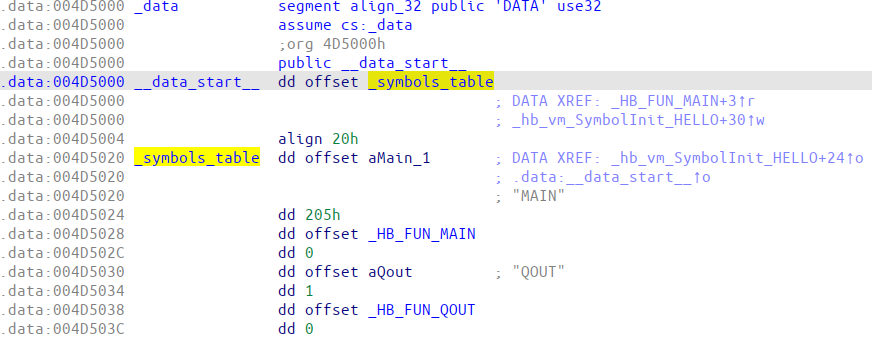
Figure 3: Harbour symbols table of hello.exe

Figure 4: Harbour pcode of hello.exe
Decompilation
Back to our sample. We now know that we need to find the pcodes and symbols in the executable and see which opcodes belong to which instruction. If we do this, we can get a fair grasp of how the program works. As you can probably guess, there were no readily available tools to do this. So, we wrote our own.
The aim of our decompiler is to make the bytecode readable by a human. We chose to mix the resulting pseudocode in assembler with C (it’s still hard to read in some places, but was fine for our purposes).
|
1 2 3 4 5 6 7 8 9 10 11 12 13 14 15 16 17 18 19 20 21 22 23 24 25 26 27 28 29 30 31 32 33 34 35 36 37 38 39 40 41 42 43 44 45 46 47 48 49 50 |
./hb_dec hello.exe e_magic:5a4d e_lfanew(PE):80 OptionalHeader.AddressOfEntryPoint:1160 OptionalHeader.ImageBase:400000 Found hb source filename:hello.prg Cheсking ifthisprogram compiled by MINGW .data section found usual padding size correct(20==20) yes,it isMINGW hb_symbols_table_va:4d5020 hb_symbols_table_raw_offset:d4620 hb_symb#0 name:MAIN scope.value:205[HB_FS_PUBLIC|HB_FS_FIRST|HB_FS_LOCAL] value.pFunPtr:4013c0 pDynSym:0 === pcode offset4d706eforlocal functionMAIN === hb_symb#1 name:QOUT scope.value:1[HB_FS_PUBLIC] value.pFunPtr:44b7c0 pDynSym:0 === hb_symb#2 name:EVAL scope.value:1[HB_FS_PUBLIC] value.pFunPtr:442860 pDynSym:0 === hb_symb#3 name:hb_stackInit scope.value:2[HB_FS_STATIC] value.pFunPtr:0 pDynSym:0 === found pcode forlocal functionMAIN4D708A-4D706E=1C PCODE forlocal functionMAIN pcode size1C 00000000240500/* currently compiled source code line number 5 */ 00000003B00100push offset QOUT 000000066A0E48656C6C6F2C...push offset"Hello, world!" 000000161401call1/* call a function from STACK[-1] and discard the results */ 00000018240700/* currently compiled source code line number 7 */ 0000001b07endproc |
Figure 5 – The decompiled output of the hello.prg program
Figure 5 also shows that Harbour is a stack-based compiler. The first push argument is the function name, after which the variables are pushed, followed by the call 1 command, where 1 is the number of function parameters to be popped. The above lines can thus be interpreted in C pseudocode as:
|
1 |
QOUT("Hello, world!"); |
We hope this decompiler makes analyzing samples written in Harbour a little bit easier for others as well.
Latest Webinars
Reports
Kaspersky researchers have discovered new Mirage Kitten attacks using previously undocumented malware families: NodeRabbit in Node.js and PollCat in JavaScript.
Our experts discovered a new CoolClient backdoor variant with a kernel-mode rootkit driver that hides malicious processes, files, and network connections from security tools and threat analysts.
Kaspersky experts break down a new Armored Likho campaign that poses as a fundraising efforts and delivers a new Still Toolkit aimed at stealing Telegram data and eavesdropping on victims.
Kaspersky researchers reveal previously undocumented malware attributed to Mirage Kitten (UNC1549, Smoke Sandstorm, Nimbus Manticore): NightLedger backdoor, ArcBridge, and BridgeHead tunneling tools.
Text extracted automatically; images, tables and formatting may be missing. Original: https://securelist.com/how-we-developed-our-simple-harbour-decompiler/95517/