FBI issues flash alert on Apache Struts vulnerability
Vulnerabilities mentionedAll →
| CVE | Vulnerability | CVSS | EPSS | Flags | Affected | Exposure | Published |
|---|---|---|---|---|---|---|---|
| CVE-2017-5638 | Unauthenticated RCE in Apache Struts Jakarta Multipart parser CVE-2017-5638 is an improper input validation flaw (CWE-20) in the Jakarta Multipart parser of Apache Struts, in which the parser mishandles the Content-Type value of a file upload and allows malicious upload leading to remote code execution. It is triggered remotely without authentication by sending a crafted Content-Type header in a multipart request to a Struts endpoint; no valid upload or credentials are required. A successful attacker gains code execution in the security context of the application server, which typically enables host compromise, data theft, or ransomware deployment. Any organization running Apache Struts applications that use the Jakarta Multipart parser is affected; the provided data specifies only "Apache Struts" and gives no version ranges. Exploitation is confirmed in the wild: the flaw is listed in CISA KEV (added 2021-11-03) with known ransomware use, EPSS assigns it roughly a 100% exploitation probability (100th percentile), and no public PoC is catalogued in the source data. Do: Apply updates per vendor instructions: upgrade Apache Struts to the releases that fix this flaw (2.3.32 / 2.5.10.1 or later, per Apache advisory S2-045), and check for Struts jars bundled inside application packages and vendor appliances. Prioritize internet-facing apps, and as an interim mitigation validate or filter the Content-Type header on multipart requests. Because exploitation is in the wild and ransomware use is known, also review web and application server logs for evidence of successful compromise. | 9.8 | 100% | KEV ransomware PoC ×10 |
| masslikely hundreds of thousands of deployments (tens of thousands of Struts hosts were internet-exposed in public scans) |
Full article790 words · extracted from cyberscoop.com · click to collapse
Get our latest cybersecurity news first on Google.
A FBI flash alert obtained by CyberScoop shows the FBI is pushing the private sector to close the vulnerability linked to the massive data breach at Equifax

Law enforcement is just beginning to understand the damage caused by a single, highly publicized software vulnerability that was labeled as a key reason credit reporting agency Equifax suffered a disastrous data breach earlier this year.
The FBI is asking for help from the private sector to identify and track a group that recently was found to target older versions of the open source web application framework Apache Struts.
The vulnerability, which was originally disclosed in March, remains present inside hundreds of corporate networks. Apache Struts is especially popular within the U.S.’s three big credit reporting agencies. More than 145 million people were affected by the Equifax breach.
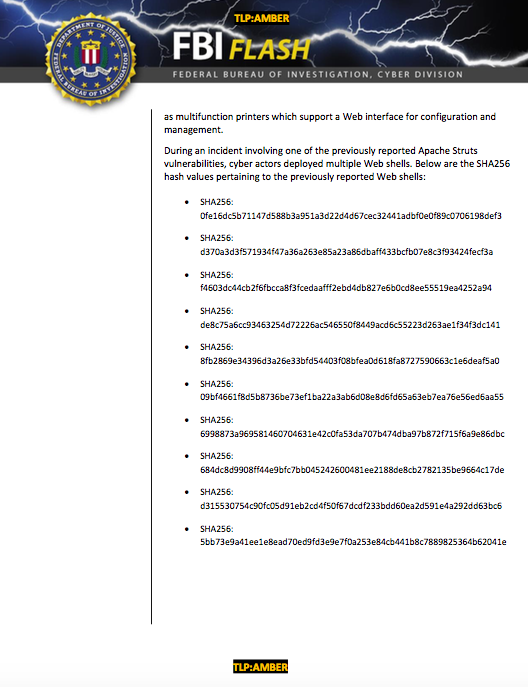
This call for information comes in the form of an FBI Flash alert sent Sept. 29 and obtained by CyberScoop. The flash alert, labeled “TLP:AMBER,” provides technical indicators related to a recent, unnamed corporate breach involving a hacker exploiting a remote code execution vulnerability in Apache Struts to deploy simple backdoor implants known as web shells, which allowed for wide access within a compromised network.

The Apache Struts flaw referred to in the alert is known as CVE-2017-5638. It allows for an attacker to remotely run code on a web server, access files and bypass security controls by sending unauthenticated web requests to an unpatched machine.
Although left nameless in the FBI document, the company in question may be the recently breached Equifax due to an apparent overlap in the techniques and tools reportedly used by the attacker and those subsequently mentioned in the alert.
The cryptographic signatures for the web shells found are included in the report so that defenders can check their own networks for possible intrusions and other evidence. A cursory search for these SHA256 hash values on the malware signature database VirusTotal provides few additional clues, as many of the hashes do not appear to have been uploaded.
“During an incident involving one of the previously reported Apache Struts vulnerabilities, cyber actors deployed multiple Web shells,” the flash alert obtained by CyberScoop reads. “These vulnerabilities affect numerous industries, including financial firms and third-party vendors on which financial firms rely. Vulnerabilities associated with Apache Struts can exist on Web applications hosted on traditional servers as well as be embedded in hardware devices such as multifunction printers which support a Web interface for configuration and management.”
Bloomberg previously reported, citing an internal security assessment, that the hackers responsible for the Equifax breach had exploited an outdated version of Apache Struts to install upwards of 30 web shells during their operation into the credit monitoring giant. The web shells reportedly helped them steal login credentials, personal records and other information.
Some of the hackers behind this incident may be state-sponsored, according to Bloomberg, due to the reported discovery of indicators previously linked to Chinese intelligence.
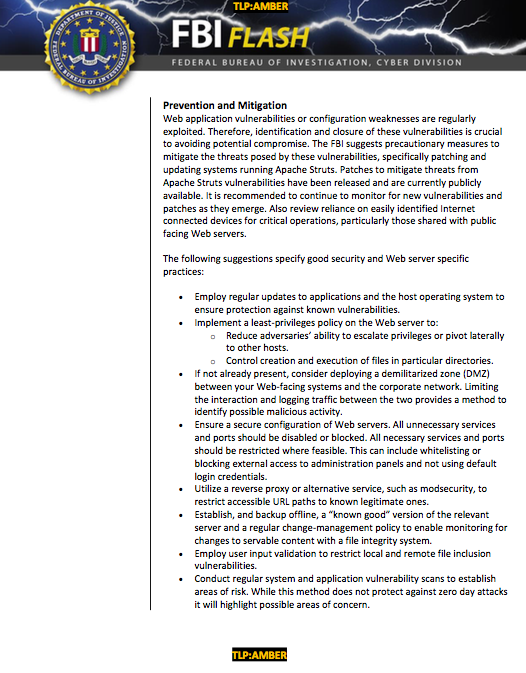
The FBI alert encourages companies to take proactive steps to decrease the potential for these types of attacks, specifically by “patching and updating systems running Apache Struts” and conducting “regular system and application vulnerability scans to establish areas of risk,” among other recommendations.
More broadly, the FBI flash alert serves to highlight the complex, multidimensional and interconnected nature of large scale cybercrime cases — which are often dependent on gathering evidence from private, commercial databases that are beyond the immediate reach of law enforcement.
Latest Podcasts
Government
FBI officials say AI is bolstering adversaries, emphasizing need to focus on cyber basics, patching
Feds accuse China of ‘systematic’ distillation of U.S. AI models
CIA’s Michael Ellis says cyber intelligence is changing how the agency operates
The G7 tells industry to hurry up and prep for post-quantum encryption
Technology
Threats
Microsoft discloses two actively exploited zero-days among 974 vulnerabilities
Russian national extradited to US for alleged involvement in bank-account takeover scheme
Attackers exploit zero-days in consistently besieged SonicWall product
Jail time for Maine child in 764 marks turning point in federal law enforcement
Policy
Whistleblower says USPS deploying new, ‘untested’ IT systems governing mail-in ballots
‘Watershed 250’ test program in Texas looks to private sector for water cybersecurity help
Former sexual abuse victims say Grok used their images, videos to train deepfake capabilities
Cyber threats nudge Trump to sign executive order on foreign equipment in U.S. energy infrastructure
Text extracted automatically; images, tables and formatting may be missing. Original: https://cyberscoop.com/apache-struts-fbi-flash-equifax-hack/