Forget Amazon, get your books by spam!
Full article437 words · extracted from securelist.com · click to collapse



Russian Internet users got an unusual surprise recently when they found a book in their mailboxes. The email from the author included links to his site, a selection of his poems, and a message saying “Today you get a book with your spam. Enjoy reading ‘Man with a capital letter’, the first spam book in Russia.”
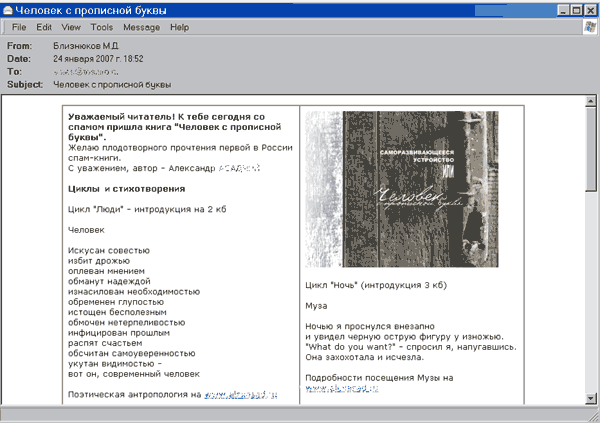
I’m a spam analyst, not a literary critic, but the poems in my mailbox struck me as definitely being of the Moon/June variety.
So instead of analyzing the quality of the writing, I started thinking about a different issue. Is this book really spam in the traditional sense of the word?
If we use the standard definition of spam, then the answer is yes: an unsolicited message that was anonymously mass mailed. ( By anonymously I mean that the mailing was conducted using a zombie network, with no clue as to the original source.) And although the author isn’t exhorting the recipients to actually buy his book, it’s still advertising and it’s still PR.
Of course, it’s nicer to get poetry by email than to get a message exhorting you to enlarge everything it’s possible to enlarge, or to stock up on Viagra for the next hundred years. But if this becomes a trend, where will it end? Users will find themselves buried in unliterary ditties, blueprints from mad inventors, and the political and economic plans of everyone who’s ever decided that their country needs a new government.
Like most users, I don’t want to see any of this in my personal mailbox. I want to get mail from friends and relatives. I want to read the books that I choose when I want to read them, not when they get sent to me by email. So sorry, but the place for this book isn’t in my mailbox, or even on my ebookshelf. It belongs with the rest of the spam – in the recycle bin.
Latest Webinars
Reports
Kaspersky researchers have discovered new Mirage Kitten attacks using previously undocumented malware families: NodeRabbit in Node.js and PollCat in JavaScript.
Our experts discovered a new CoolClient backdoor variant with a kernel-mode rootkit driver that hides malicious processes, files, and network connections from security tools and threat analysts.
Kaspersky experts break down a new Armored Likho campaign that poses as a fundraising efforts and delivers a new Still Toolkit aimed at stealing Telegram data and eavesdropping on victims.
Kaspersky researchers reveal previously undocumented malware attributed to Mirage Kitten (UNC1549, Smoke Sandstorm, Nimbus Manticore): NightLedger backdoor, ArcBridge, and BridgeHead tunneling tools.
Text extracted automatically; images, tables and formatting may be missing. Original: https://securelist.com/forget-amazon-get-your-books-by-spam/30292/