Court rules ‘fired’ FTC commissioners be reinstated — again
Full article1,294 words · extracted from cyberscoop.com · click to collapse
Get our latest cybersecurity news first on Google.
In a 2-1 decision, an appeals court upheld a 1935 Supreme Court precedent restricting the president’s ability to fire FTC commissioners.
Listen to this article
0:00
Learn more.
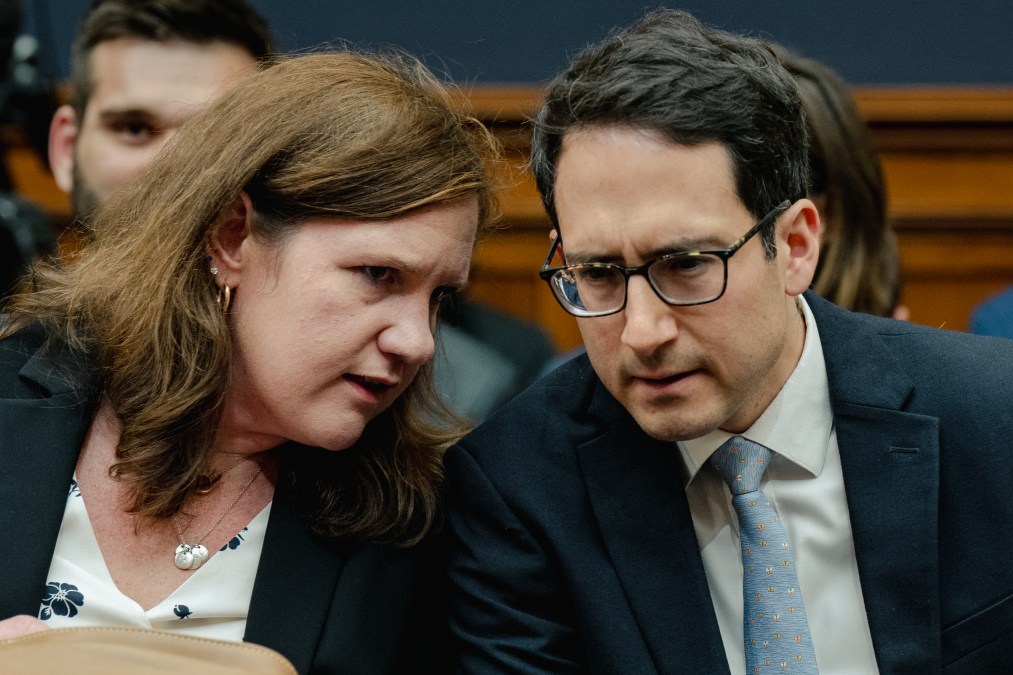
For the second time, a court has ruled that President Donald Trump’s attempted firing of Federal Trade Commission members Rebecca Slaughter and Alvaro Bedoya was illegal and ordered the agency to reinstate the commissioners.
By law, the FTC governs by a bipartisan 3-2 split, with the president’s party getting an extra seat and controlling the chair. But earlier this year, Trump attempted to fire just Bedoya and Slaughter, leaving only Republican-appointed members on the commission.
A district court temporarily reinstated Slaughter but that decision was reversed in another court ruling just days later. Bedoya eventually resigned his position, citing financial difficulties.
Now, the District Court of Appeals for the District of Columbia has ruled 2-1 that the attempted firings ran afoul of the law, this time saying the government was likely to lose its case on the merits.
In their opinion, Judges Cornelia Pillard and Patricia Millett specifically cited the precedent set by the Supreme Court in Humphrey’s Executor v. United States, a 1935 case in which justices unanimously ruled that FTC commissioners could only be fired for specific cause.
That precedent, the judges wrote, remains the law of the land until the Supreme Court says otherwise.
“The government has no likelihood of success on appeal given controlling and directly on point Supreme Court precedent,” Pillard and Millett wrote. “Specifically, ninety years ago, a unanimous Supreme Court upheld the constitutionality of the Federal Trade Commission Act’s for-cause removal protection for Federal Trade Commissioners.”
After Trump’s attempted firings in March, Slaughter and Bedoya quickly challenged the legality of the move in court, saying they were fired “not because they were inefficient, neglectful of their duties, or engaged in malfeasance, but simply because their ‘continued service on the FTC is’ supposedly ‘inconsistent with [his] Administration’s priorities.’”
While Humphrey’s Executor remains the law of the land, the administration and some former officials have argued that the FTC now plays a far more important policy role in the executive branch than it did in 1935, when the court cited the “quasi-legislative” and “quasi-judicial” functions of the agency.
The current Supreme Court, they argue, does not share the same views, pointing to a 2020 case where the court majority suggested that the conclusions about the FTC’s role in Humphrey’s Executor “has not withstood the test of time.”
“No administration until now has wanted to push the limits on that but the current administration has made clear they think it’s wrongly decided,” one former FTC official, who requested anonymity to speak candidly, told CyberScoop in March.
The DC District Court of Appeals said the government “acknowledges that Humphrey’s Executor ‘remains binding on this Court’” but argues that the court should disregard that precedent.”
“Over the ensuing decades — and fully informed of the substantial executive power exercised by the Commission — the Supreme Court has repeatedly and expressly left Humphrey’s Executor in place, and so precluded Presidents from removing Commissioners at will,” Pillard and Millett wrote.
Millett and Pillard argued that the FTC in 1935 had the same core authorities and mission as it does today: to promulgate rules and regulations, investigate violations of federal law, issue subpoenas and enforce violations.
The “present-day Commission exercises the same powers that the Court understood it to have in 1935 when Humphrey’s Executor was decided,” they added, and “bucking such precedent is not within this court’s job description.”
The D.C. District Court likely won’t have the last word. The administration continues to appeal and most observers expect the matter to ultimately reach the Supreme Court. In the meantime, Slaughter said she intends to return to her job this week.
“Amid the efforts by the Trump admin to illegally abolish independent agencies, [including] the Federal Reserve, I’m glad the court has recognized that he is not above the law,” Slaughter wrote on X Tuesday after the decision. “I’m eager to get back first thing tomorrow to the work I was entrusted to do on behalf of the American people.”
In a dissent, Judge Neomi Rao referred to the FTC as a “so-called independent agency” and disagreed with the court majority, saying she believed the government would ultimately prevail on the merits.
The circuit court “need not definitively determine whether Slaughter’s removal was lawful” because in previous cases this year where officials fired by the president were reinstated by courts, the Supreme Court has intervened on the administration’s behalf — at least while the cases are winding through the court system.
By forcing FTC staff to ignore the president’s directive and treat Slaughter as commissioner in good standing, the district court’s decision “directly interferes with the President’s supervision of the Executive Branch and therefore goes beyond the power of the federal courts,” Rao wrote.
More Scoops
SCOTUS tosses one of two injunctions against Trump USPS mail-in ballot rules
The 6-3 decision dismisses one lawsuit brought by states, saying they have no standing to sue because the disputed sections “neither requires nor forbids anything of anyone outside…
Postal Service moves to finalize mail ballot regs before SCOTUS ruling
Supreme Court approves mail-in ballots that arrive after Election Day
Latest Podcasts
Government
FBI officials say AI is bolstering adversaries, emphasizing need to focus on cyber basics, patching
Feds accuse China of ‘systematic’ distillation of U.S. AI models
CIA’s Michael Ellis says cyber intelligence is changing how the agency operates
The G7 tells industry to hurry up and prep for post-quantum encryption
Technology
Threats
Chinese espionage groups swarm to exploit triple-link chain of zero-days
Microsoft discloses two actively exploited zero-days among 974 vulnerabilities
Russian national extradited to US for alleged involvement in bank-account takeover scheme
Attackers exploit zero-days in consistently besieged SonicWall product
Policy
‘Watershed 250’ test program in Texas looks to private sector for water cybersecurity help
Former sexual abuse victims say Grok used their images, videos to train deepfake capabilities
Cyber threats nudge Trump to sign executive order on foreign equipment in U.S. energy infrastructure
Election official says Tina Peters would be consultant, won’t have access to election systems
Text extracted automatically; images, tables and formatting may be missing. Original: https://cyberscoop.com/court-rules-ftc-commissioners-reinstated-again-rebecca-slaughter-alvaro-bedoya/