Monthly Malware Statistics, March 2011
Vulnerabilities mentionedAll →
| CVE | Vulnerability | CVSS | EPSS | Flags | Affected | Exposure | Published |
|---|---|---|---|---|---|---|---|
| CVE-2010-0840 | Unspecified Remote Vulnerability in Oracle Java Runtime Environment (JRE) CVE-2010-0840 is an unspecified vulnerability in the Java Runtime Environment (JRE) component of Oracle Java SE that allows remote attackers to affect confidentiality, integrity, and availability through vectors Oracle did not publicly detail. Because the advisory withheld technical specifics, the exact trigger is undocumented, but the flaw is remotely exploitable, and the era's threat reporting (2011 exploit-kit and Java malware headlines) is consistent with drive-by exploitation of Java clients. A successful attacker gains the ability to compromise the confidentiality, integrity, or availability of the affected system, and Java flaws of this period were commonly leveraged to install malware such as bots. Any organization or end user running the affected JRE releases — whether the browser Java plug-in on desktops or server-side Java — is exposed, making the affected population extremely broad. The flaw is listed in CISA's Known Exploited Vulnerabilities catalog (added 2022-05-25), EPSS assigns it a 96.3% probability of exploitation in the next 30 days, and no public proof-of-concept is known. Do: Apply the Oracle Java SE updates specified by the vendor as required by CISA's KEV listing, and remove or disable obsolete or unsupported JRE versions, especially the browser Java plug-in where it is no longer needed. Prioritize internet-exposed and end-user systems, check for lingering legacy Java applets in use, and note that remediation is mandatory for federal agencies under the KEV program. | — | 96% | KEV |
| masshundreds of millions of JRE installations across desktops and servers | |
| CVE-2011-0609 | Unspecified Remote Code Execution Vulnerability in Adobe Flash Player Adobe Flash Player contains an unspecified vulnerability that allows remote attackers to execute arbitrary code or cause a denial-of-service condition. The flaw is triggered remotely, almost certainly via malicious Flash content processed by the player in a browser or standalone runtime, although Adobe did not disclose detailed technical specifics for this CVE. Successful exploitation gives an attacker the ability to run code with the privileges of the user running Flash, or to crash the application. Anyone running affected builds of Flash Player is exposed; at the time of disclosure in 2011 that meant nearly every internet-connected desktop, whereas today it is limited to residual end-of-life installs. The vulnerability is listed in the CISA KEV catalog (added 2022-06-08) and carries a high EPSS score of 66.8% (99th percentile), indicating known exploitation in the wild, though no public proof-of-concept is known. Do: Flash Player is end-of-life and no longer receives security updates, so inventory systems for any remaining Flash installs and remove or disable them where possible; CISA's required action is to disconnect impacted products if still in use. For legacy systems that must retain Flash, isolate them from untrusted web content and treat this code execution flaw as actively exploited. | — | 67% | KEV |
| masson the order of hundreds of millions of installs at the time of disclosure (Flash ran on ~99% of internet-connected PCs in 2011); the number of residual… |
Full article718 words · extracted from securelist.com · click to collapse
March in figures
The following statistics were compiled in March using data from computers running Kaspersky Lab products:
- 241,151,171 network attacks blocked;
- 85,853,567 attempted web-borne infections prevented;
- 219,843,736 malicious programs detected and neutralized on users’ computers;
- 96,702,092 heuristic verdicts registered.
One man’s misfortune is another man’s gain
We have already written on a number of occasions that criminals are not averse to exploiting tragedies, and the Japanese earthquake and tsunami, plus the death of Elizabeth Taylor, did nothing to buck this trend.
Thousands of people in Japan have lost loved ones and have been left homeless, while the world looks on in trepidation as events unfold at the Fukushima nuclear plant. But that hasn’t stopped scammers and malware writers from spreading malicious links to their own versions of the “latest news”, creating malicious websites with content connected in some way to the disaster in Japan and sending out ‘Nigerian’ letters making emotional requests for money to be transferred to the message sender in order to help those who have suffered.
One spam message contained a link that claimed to lead to the latest news from Japan. Clicking on the link triggered a drive-by download attack that made use of exploit packs. If the attack was successful, Trojan-Downloader.Win32.CodecPack was downloaded to the user’s computer. Each variant of this family is inextricably linked to three command centers with which it communicates and receives lists of malicious files that are downloaded and run on infected computers. On one website that we detected, visitors were asked to download a video clip showing events from Japan. However, instead of a video, users ended up downloading a backdoor.
It seems the most switched-on cybercriminals use Twitter – malicious links exploiting Elizabeth Taylor’s death appeared on the social network within a day of the news being announced.
Exploits
Exploits remain one of the favorite tools in the cybercriminals’ arsenals, so the appeals from IT security companies to regularly update computer software are as relevant as ever.
Java exploits
The number of Java exploits is considerable – they make up approximately 14% of all known exploits. Three of them made it into this month’s Top 20 malicious programs detected on the Internet. Two of them – Exploit.Java.CVE-2010-0840.d in 15th place and Exploit.Java.CVE-2010-0840.c in 19th – are new exploits for the CVE-2010-0840 vulnerability in Java. Active use of this loophole was recorded for the first time in February.
According to Kaspersky Security Network (KSN) statistics, malware writers are actively modifying the exploits they use in drive-by attacks in order to avoid detection. This is demonstrated in the graph below which shows detections for the Exploit.Java.CVE-2010-0840 family.
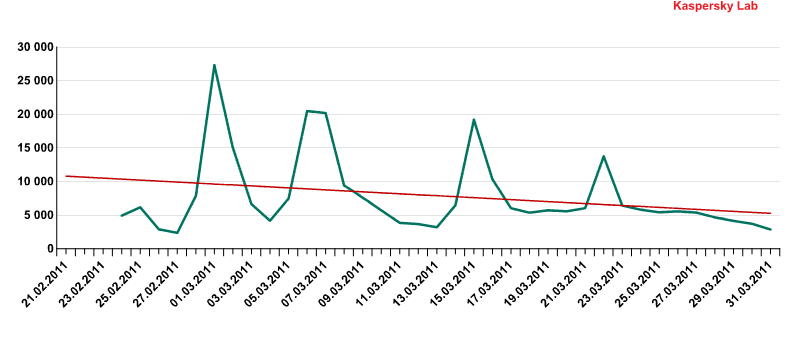
Detection of the Exploit.Java.CVE-2010-0840 family
The peaks in the graph correspond to periods when exploits of this family were detected in drive-by attacks, while the troughs show when newer variants of the exploit replaced older versions.
Exploits and vulnerabilities in Adobe Flash Player
Malware writers are surprisingly quick to react to announcements of new vulnerabilities. A good example of this is a vulnerability in Adobe Flash Player that was announced on 14 March. The vulnerability in question was in authplay.dll and because it offered cybercriminals an opportunity to gain control of a user’s computer it was rated as critical.
On 15 March, Kaspersky Lab had already detected an exploit for the vulnerability – an Excel file that contained a malicious SWF file and which is detected as Trojan-Dropper.SWF.CVE-2011-0609.a.
On 25 March, we detected one more variant of the exploit – an HTML page that contained shellcode in JavaScript and which loaded a malicious Flash file. The malicious SWF file exploited a security breach which allowed the shellcode to gain control. The malicious HTML and SWF files are detected as Exploit.JS.CVE-2011-0609 and Exploit.SWF.CVE-2011-0609 respectively.

A fragment of the Exploit.JS.CVE-2011-0609.d code
This story has a happy ending though – the vulnerability was quickly fixed. Adobe announced the problem had been resolved on 22 March. Of course, the happy ending will only apply to those users who updated the software on their computers in time.
Malicious HTML pages: avoiding detection
We make regular announcements about the detection of HTML pages that cybercriminals use as part of their scams or to spread malware. The malevolent people behind such pages are constantly coming up with new ways to hide their creations from antivirus programs.
Use of
Text extracted automatically; images, tables and formatting may be missing. Original: https://securelist.com/monthly-malware-statistics-march-2011/36352/