Apple thwarts Safari-based ransomware scheme with iOS 10.3 update
Indicators of compromiseauto-extracted · verify before use · export allAll →
| Type | Indicator | Context |
|---|---|---|
| domain | europe.com | mmers include networksafetydept@usa[.]com and cybercrimegov@europe[.]com. The ransomware targets individuals who download music on |
| domain | pay-police.com | fter an iPhone owner, while using Safari, was redirected to pay-police[.]com. Other domains registered by the scammers include network |
| domain | usa.com | omains registered by the scammers include networksafetydept@usa[.]com and cybercrimegov@europe[.]com. The ransomware targets in |
Full article659 words · extracted from cyberscoop.com · click to collapse
Get our latest cybersecurity news first on Google.
Apple’s newly released update for iPhones and iPads fixes a crucial software bug that previously allowed scammers to spam users with pop-ups.

Apple’s newly released update to its mobile operating system fixes a crucial software bug in the Safari web browser that previously allowed scammers to spam users with JavaScript pop-ups, according to mobile security company Lookout.
An attacker could execute a ransomware-style attack in past versions of iOS by abusing the pop-up dialogs in Safari, thereby locking victims out from using their web browser until a payment is received. In this scenario, victims would be typically redirected to a malicious website, which is designed to appear like it belongs to a faux law enforcement agency, where a payment — in the form of iTunes gift cards — is demanded for a fake “fine.”
iOS 10.3 protects against this attack by making Safari run “on a per-tab basis so that if one tab is misbehaving, the user can close it out and/or move to another one,” a blog post by Lookout researchers Andrew Blaich and Jeremy Richards explains.
The flaw in Safari was discovered by Lookout after an iPhone owner, while using Safari, was redirected to pay-police[.]com. Other domains registered by the scammers include networksafetydept@usa[.]com and cybercrimegov@europe[.]com.
The ransomware targets individuals who download music online or visit pornography websites.
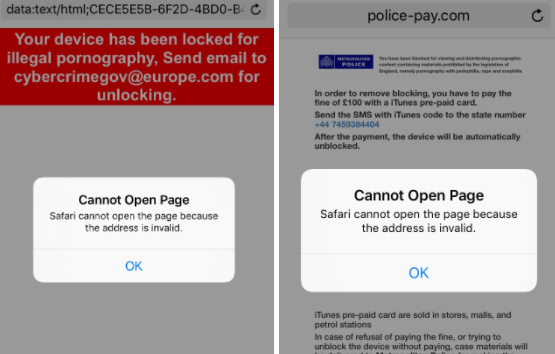
Image via LookOut
Typically victims lose control after being redirected from a website they were visiting to pay-police[dot]com domain, where an infinite loop of dialogue boxes quickly appear with the message “Cannot Open Page.” Pressing “Ok” on the dialogue box only resets the alert. It’s impossible to navigate to a different browser tab after the first box appears.
After a period of time the victim is prompted with a payment request and other warnings.
“Lookout found this attack in the wild last month, along with several related websites used in the campaign, discovered the root cause, and shared the details with Apple. As part of the iOS 10.3 patch released today, Apple closed the attack vector by changing how mobile Safari handles website pop-up dialogs, making them per-tab rather than taking over the entire app,” Blaich and Richards wrote.
The only available fix prior to Monday’s update required that users clear their Safari cache to regain control, effectively erasing web history and other temporary internet data would help stop the scammers.
The ransomware scheme carries no exploit code. It is contained within the app sandbox of the Safari browser itself, meaning that it cannot migrate into other applications or the iPhone’s larger software framework. Researchers believed the attack, which Lookout found previously on a Russian website, was originally developed to target iOS 8 but it remained functional until iOS 10.3.
Latest Podcasts
Government
FBI officials say AI is bolstering adversaries, emphasizing need to focus on cyber basics, patching
Feds accuse China of ‘systematic’ distillation of U.S. AI models
CIA’s Michael Ellis says cyber intelligence is changing how the agency operates
Jail time for Maine child in 764 marks turning point in federal law enforcement
Technology
FCC proposes public scorecard to rate telecoms on anti-robocall efforts
Pegasus, NoviSpy variant spyware found on devices of Serbian activists
The Collective Cyber Defense letter wrote your next vendor questionnaire
Former sexual abuse victims say Grok used their images, videos to train deepfake capabilities
Threats
Chinese espionage groups swarm to exploit triple-link chain of zero-days
Microsoft discloses two actively exploited zero-days among 974 vulnerabilities
Russian national extradited to US for alleged involvement in bank-account takeover scheme
Attackers exploit zero-days in consistently besieged SonicWall product
Policy
Whistleblower says USPS deploying new, ‘untested’ IT systems governing mail-in ballots
‘Watershed 250’ test program in Texas looks to private sector for water cybersecurity help
Cyber threats nudge Trump to sign executive order on foreign equipment in U.S. energy infrastructure
Election official says Tina Peters would be consultant, won’t have access to election systems
Text extracted automatically; images, tables and formatting may be missing. Original: https://cyberscoop.com/apple-ios-10-3-update-safari-ransomware-scheme/