Report: U.S. military can't guarantee retaliation against major cyber attack
Full article846 words · extracted from cyberscoop.com · click to collapse
Get our latest cybersecurity news first on Google.
Without an assured retaliation capability, the military cannot effectively deter cyber strikes, a situation that "threatens to place the United States in an untenable strategic position," the Defense Science Board report states.
For at least the next decade, cyber superpowers Russia and China will have the capability to launch devastating online attacks against U.S. vital industries like banking and telecommunication, that will “far exceed” any ability of the U.S. military to defend against, Pentagon science advisors say in a new report.
Worse, concludes the “Final Report of the Defense Science Board Task Force on Cyber Deterrence,” published this week, the U.S. military itself has a “deep and extensive dependence on information technology as well” — making it vulnerable to cyberattacks that might thwart an American response to such an online assault.
Without assured retaliation capability, the U.S. cannot effectively deter cyber strikes, a situation that “threatens to place the United States in an untenable strategic position,” the report states.
As a result, the task force recommends the Pentagon must create a cyber-resilient second-strike capability that it calls a “thin line” element — to ensure it can strike back even after a massive surprise cyber attack and effectively “underwrite deterrence of major attacks by major powers.”
Even regional powers like Iran and North Korea “have a growing potential to use indigenous or purchased cyber tools to conduct catastrophic attacks on U.S. critical infrastructure.”
U.S. authorities must “work with the private sector to intensify efforts to defend and boost the cyber resilience of U.S. critical infrastructure” so as to reduce this vulnerability to second-order cyber attacks by rogue nations. “It is no more palatable to allow the United States to be held hostage to catastrophic attack via cyber weapons by such actors than via nuclear weapons.”
Third and finally, the report states, “a range of state and non-state actors have the capacity for persistent cyber attacks and costly cyber intrusions against the United States, which individually may be inconsequential … but which cumulatively subject the nation to a “death by 1,000 hacks.'”
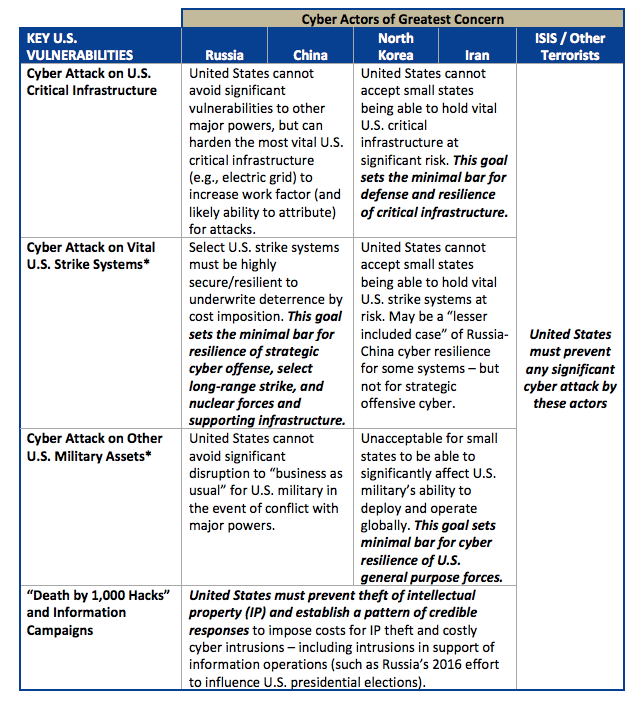
Setting the Bar for Cyber Resilience to Underwrite Cyber Deterrence (Source: DSB)
In addition to developing a “thin line” cyber-resilient second-strike capacity, the report recommends two other national lines of effort in cybersecurity.
U.S. military planning should “tailor” its deterrence posture against the full range of potential attacks that could be conducted by each category of potential adversary. “And it must do so [so as to be effective] in contexts ranging from peacetime to ‘gray zone’ [or hybrid warfare] conflicts to crisis to war … One size will not fit all.”
And the nation as a whole has to work to improve what the science board calls “foundational capabilities” like attribution of cyber attacks; cyber-resilience of critical infrastructure for the military, civilian government and private sector; and “innovative technologies that can enhance the cybersecurity of the most vital U.S. critical infrastructure.”
The task force was established in 2014. It is co-chaired by James Gosler of the Johns Hopkins University Applied Physics Laboratory and former Department of Defense cyber policy official James Miller. The membership reads like a who’s who of cyber expertise and scholarship, including Jason Healey of Columbia University, Martin Libicki of the Naval War College and former NSA Deputy Director Chris Inglis.
More Scoops

100-plus companies call for ‘global surge’ in AI-powered cyber defense
OpenAI, Anthropic, Google, Microsoft, and others say there’s a narrow “defenders’ window” to strengthen security before AI-powered attacks become more sophisticated.
AI-fueled attacks pose ‘active threat’ to water, other sectors, U.S. agencies warn

U.S., South Korean government agencies caution to be on lookout for Gunra ransomware gang
Latest Podcasts
Government
FBI officials say AI is bolstering adversaries, emphasizing need to focus on cyber basics, patching
Feds accuse China of ‘systematic’ distillation of U.S. AI models
CIA’s Michael Ellis says cyber intelligence is changing how the agency operates
The G7 tells industry to hurry up and prep for post-quantum encryption
Technology
Threats
Chinese espionage groups swarm to exploit triple-link chain of zero-days
Microsoft discloses two actively exploited zero-days among 974 vulnerabilities
Russian national extradited to US for alleged involvement in bank-account takeover scheme
Attackers exploit zero-days in consistently besieged SonicWall product
Policy
Whistleblower says USPS deploying new, ‘untested’ IT systems governing mail-in ballots
‘Watershed 250’ test program in Texas looks to private sector for water cybersecurity help
Former sexual abuse victims say Grok used their images, videos to train deepfake capabilities
Cyber threats nudge Trump to sign executive order on foreign equipment in U.S. energy infrastructure
Text extracted automatically; images, tables and formatting may be missing. Original: https://cyberscoop.com/defense-science-board-cyber-deterrence-task-force/