From 'Generation Kill' to driving digital diplomacy: Nate Fick digs into role as first U.S. cyber ambassador
Full article1,486 words · extracted from cyberscoop.com · click to collapse
Get our latest cybersecurity news first on Google.
Fick says the State Department 'has a rightful place to assert leadership' when it comes to setting American cyber policy.
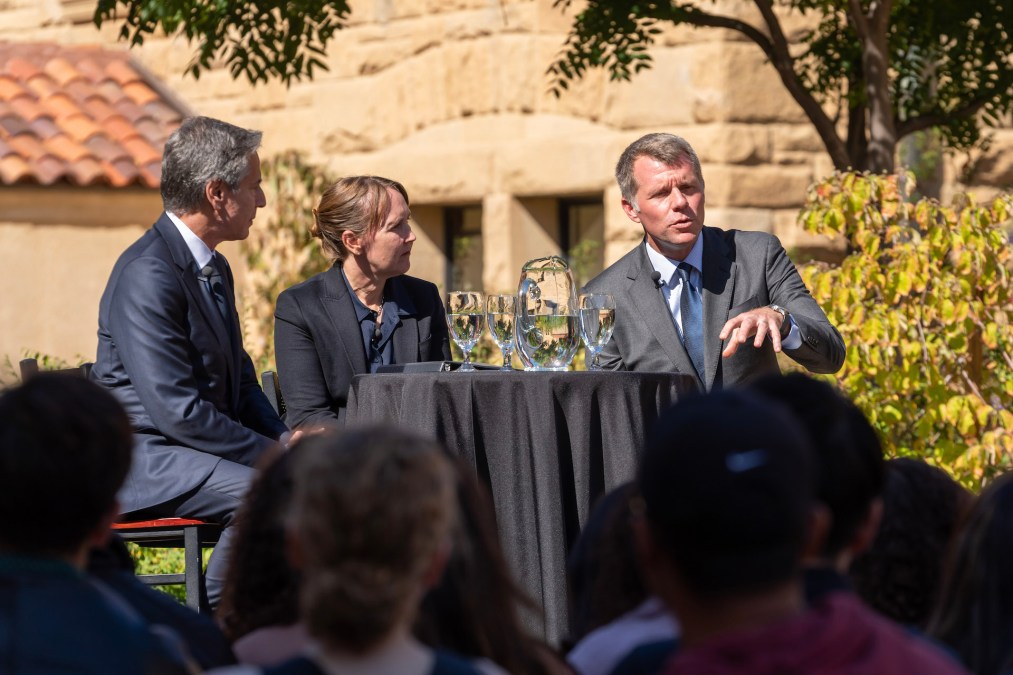
In September, Nate Fick became the State Department’s first ambassador at large for cyberspace and digital diplomacy. He’ll have a broad portfolio and will work across the government, including with the National Security Agency and the White House, on driving Washington’s foreign digital agenda. Prior to taking the role, Fick was a cybersecurity executive, venture capitalist and Marine. His experience in the Iraq war was characterized in the HBO series “Generation Kill.” He sat down this week with CyberScoop for his first extended interview since taking the office. The following has been edited and condensed for clarity.
You’ve said your key priorities include asserting State’s role in cyberspace and digital policy. How does State become a leader in something as unwieldy and amorphous as cyberspace?
There are a few fundamental propositions that undergird my thinking. The first is a personal, visceral conviction that diplomacy is and must be our tool of first resort. My formative experiences and my early career were in the Marines, living the consequences of failures of diplomacy — not at the working level, but at the senior policy maker level. Proposition two is that technology is reshaping every aspect of the world. It is infused in everything, which is really proposition number three — it’s not a vertical. It’s not like, ‘Okay, we do East Asia diplomacy here. And we do arms control diplomacy there. And we do tech diplomacy here.’ Technology represents a lateral cross-cutting substrate that informs every other aspect of American foreign policy. That’s my argument for why State has to be involved as the nation’s lead foreign affairs agency. Because it’s cross cutting, we need allies and partners around the world on all these issues. That’s why I think State has a rightful place to assert leadership in this space.
What are your goals when it comes to national security issues, given the digital threat from Russia and China?
A clear one is extending deterrence into the cyber domain more effectively than we have in the past.
Can you do that through diplomacy?
You can take meaningful steps in binding together like-minded allies, which increases the cost and consequence for malicious actors.
Last year, the US joined the Paris Call. What role do you think expanding norms in cyberspace could play in improving behavior across the globe?
Norms and standards are fundamental. We also need to be clear-eyed about a certain reality that norms are more useful in binding together our friends than they are in deterring our adversaries. Our adversaries tend not to care very much about our norms.
What can your new bureau do to reinvigorate efforts to secure a free and open internet? I’ve heard some people worry that the lack of digital freedom work in your background suggests it won’t be a priority for you.
I’m self-aware that I’m a military guy and I was a cybersecurity CEO. So, I have to prove my credibility in some areas of our portfolio. And I have tried to start doing that by meeting with leaders. I had a terrific conversation in San Francisco last week with the Filipina Nobel laureate Maria Ressa.
What did she tell you?
The power of the platform of the United States and not to underestimate the power of the megaphone that we have.
Hacktivists like the Cyber IT Army in Ukraine and Black Reward in Iran are playing a bigger role online supporting pro-Western causes. Should the State Department engage with them?
People with relatively little formal training and relatively little access to capital can wield tremendous capability. What that means is that we need to acknowledge their existence and the influence they have and account for them.
How do you see your role in terms of State’s recent enhanced role in the cyber operations’ authorization process? What should the proper balance be between State and DoD?
State has a very valid point of view that diplomacy is the tool of first resort, that our relationships with allies and partners are iterative, that they are broader than a particular operation and that operations need to be contextualized that way. At the same time, there are situations where it is also valid to say that the mission is urgent, the need is now, and we can do an enormous amount of good if we act quickly. And so, the right answer is somewhere in the middle.
What do you think industry should be doing to make the web safer and how do you plan on working with tech companies?
I bring a point of view to this job that most of the innovative ability to develop capabilities sits in the private sector. Most of the talent — not in quality, but in quantity — sits in the private sector. Most of the attack surface we care about protecting sits in the private sector. Historically, collaboration between the federal government and technology has been bumpy at best. If I can help build some bridges, I would really like to do so.
I heard a rumor that you didn’t love “Generation Kill,” the HBO miniseries based on your Marine company’s experience in Iraq.
I like “Generation Kill” a lot more in hindsight than I did at the time. And part of that is I was 25 years old, and all of a sudden you have like this huge spotlight shining on your life, like the most searing and traumatizing parts of your life. But I did spend a spectacular day with David Simon, the producer of it, in Baltimore.
The Wire is my favorite show. I’ve seen it seven times.
So, he also did “Generation Kill” and “The Wire” is my favorite show, too. I wasn’t involved in the production of “Generation Kill” at all. But when the eight episodes were complete, I went to [Simon’s] row house in Baltimore, and we sat on the couch from 8 a.m. to noon. We watched four [episodes] in a row. Then we went and got crab cakes for lunch. Then, we came back and watched another four. I literally spent the whole day on the couch with David Simon watching TV and eating crab cakes in Baltimore.
More Scoops
Plankey vows to boot China from U.S. supply chain, advocate for CISA budget
But Trump’s pick to lead CISA sidestepped questions about alleged past or future election manipulation claims.

Deterrence in cyberspace is possible — and ‘urgent’ — amid ‘alarming’ hybrid attacks, State cyber ambassador says

State Department needs more cyber policy muscle, says cyberspace ambassador nominee
Latest Podcasts
Government
FBI officials say AI is bolstering adversaries, emphasizing need to focus on cyber basics, patching
CIA’s Michael Ellis says cyber intelligence is changing how the agency operates
The G7 tells industry to hurry up and prep for post-quantum encryption
Jail time for Maine child in 764 marks turning point in federal law enforcement
Technology
Threats
Chinese espionage groups swarm to exploit triple-link chain of zero-days
Microsoft discloses two actively exploited zero-days among 974 vulnerabilities
Russian national extradited to US for alleged involvement in bank-account takeover scheme
Attackers exploit zero-days in consistently besieged SonicWall product
Policy
Whistleblower says USPS deploying new, ‘untested’ IT systems governing mail-in ballots
‘Watershed 250’ test program in Texas looks to private sector for water cybersecurity help
Former sexual abuse victims say Grok used their images, videos to train deepfake capabilities
Cyber threats nudge Trump to sign executive order on foreign equipment in U.S. energy infrastructure
Text extracted automatically; images, tables and formatting may be missing. Original: https://cyberscoop.com/nate-fick-first-cyber-ambassador/