Malicious ads on security websites
Full article319 words · extracted from securelist.com · click to collapse



Perhaps the worst possible scenario is when a bank website is hosting malicious ads: you never know what can be installed and when on your computer if you click on the ad banners.
Something similar happens with security websites hosting malicious ads. They are supposed to be for security information. The people browsing such sites trust the content to be safe, but in actual fact because of the ad banners the resources may be anything but trustworthy.
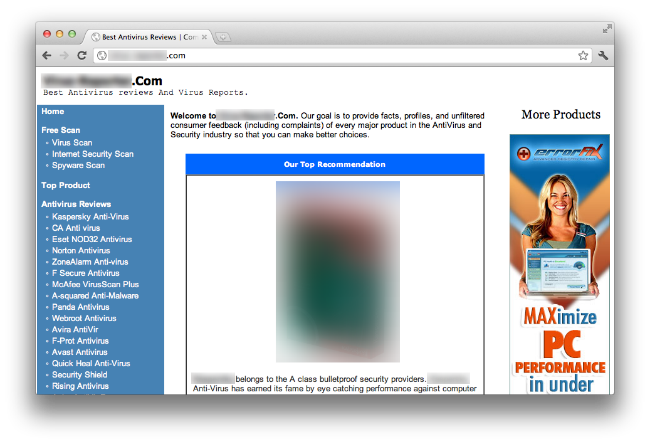
The site above was found by looking for antivirus protection and reviews. The banner to the right of the screenshot leads to a malicious app, which is basically a rogue optimizer, forcing the final user to pay for activation. So what is actually going on here? Basically, while looking for security and protection the end user may end up with a nasty infection and lose money by paying for rogue apps. The scheme used here is the same as in Fake AV attacks – “detecting” things you even don’t have in your file system and then asking for money to cure them.
If you want to check AV reviews, it’s better to visit well-known, trusted resources like
av-comparatives.org, av-test.org and virusbtn.com
Kaspersky Anti-Virus detects the threat mentioned above as Trojan-FakeAV.Win32.ErrorFix.
Latest Webinars
Reports
Kaspersky researchers have discovered new Mirage Kitten attacks using previously undocumented malware families: NodeRabbit in Node.js and PollCat in JavaScript.
Our experts discovered a new CoolClient backdoor variant with a kernel-mode rootkit driver that hides malicious processes, files, and network connections from security tools and threat analysts.
Kaspersky experts break down a new Armored Likho campaign that poses as a fundraising efforts and delivers a new Still Toolkit aimed at stealing Telegram data and eavesdropping on victims.
Kaspersky researchers reveal previously undocumented malware attributed to Mirage Kitten (UNC1549, Smoke Sandstorm, Nimbus Manticore): NightLedger backdoor, ArcBridge, and BridgeHead tunneling tools.
Text extracted automatically; images, tables and formatting may be missing. Original: https://securelist.com/malicious-ads-on-security-websites/32074/