35 Actionable Password Statistics for Businesses in 2026 | Huntress
Huntress compiles 2026 password statistics showing 94% of 19 billion leaked passwords were reused and 37% of identity threats used stolen credentials.
Huntress published a compilation of password security statistics drawing on sources including Cybernews, Verizon's 2026 DBIR, IBM, and Bitwarden. Cybernews found 19 billion exposed passwords from roughly 200 incidents between April 2024 and April 2025, with only 6% unique and 94% reused across accounts. Huntress telemetry reports 37% of identity-based threats in 2026 involved stolen or suspicious credentials, while Verizon cites credential abuse in 39% of breaches. The piece argues weak and reused passwords remain a top entry point and recommends improved password hygiene.
- Cybernews analyzed 19 billion leaked passwords from ~200 incidents; only 6% were unique.
- 94% of leaked passwords were reused or duplicated across accounts.
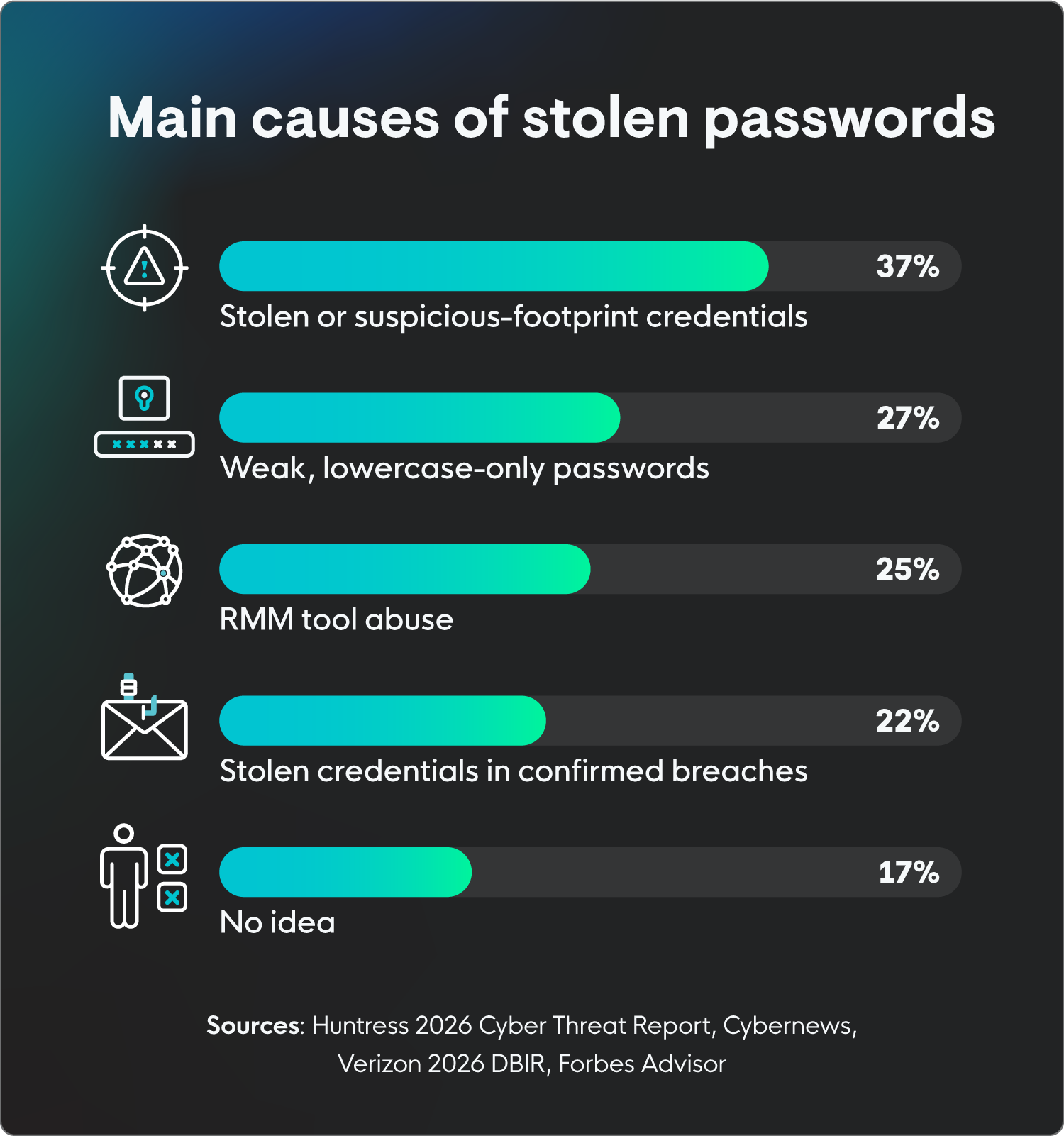
- 37% of identity-based threats in 2026 involved stolen or suspicious-footprint credentials (Huntress telemetry).
- Verizon 2026 DBIR cites credential abuse in 39% of breaches; IBM pegs average breach cost at $4.5M.
- Only 19% of leaked passwords mix uppercase, lowercase, numbers, and symbols.
Full article2,136 words · extracted from huntress.com · click to collapse
If your password is “123456”, you're in remarkably crowded company. That single string appeared 338 million times among the more than 19 billion passwords exposed in a 2024–2025 Cybernews analysis of leaked credentials.
From reusing the same login across every account to never changing it after a breach, password statistics from various data reports reveal just how uncommon good password hygiene really is.
The risk keeps climbing, as Huntress's 2026 Cyber Threat Report found that 37% of identity-based threats involved stolen or suspicious-footprint credentials, proof that a weak or reused password is often all an attacker needs to get in.
“People really underestimate how important password security is. It may seem like a given, but the more complex your password is, the more difficult your account is to access,” says Lindsey Welch, Principal Technical Community Engagement Writer at Huntress. “That doesn’t even factor in things like being sure to change your password after a breach and using different passwords, all of which improve security.”
Read about some of the most surprising (or unsurprising) password security findings, plus some tips to improve your own password hygiene.
Key password security statistics
Think of your passwords as the keys to your digital kingdom. They guard everything from personal emails and financial accounts to critical business data. While often taken for granted, the strength and security of these digital keys directly impact your safety and privacy online.
Stolen or easily guessable passwords are still some of the easiest ways in for attackers, and the numbers back that up. Here's what the data says about password risk right now and what it means for protecting your digital endpoints.
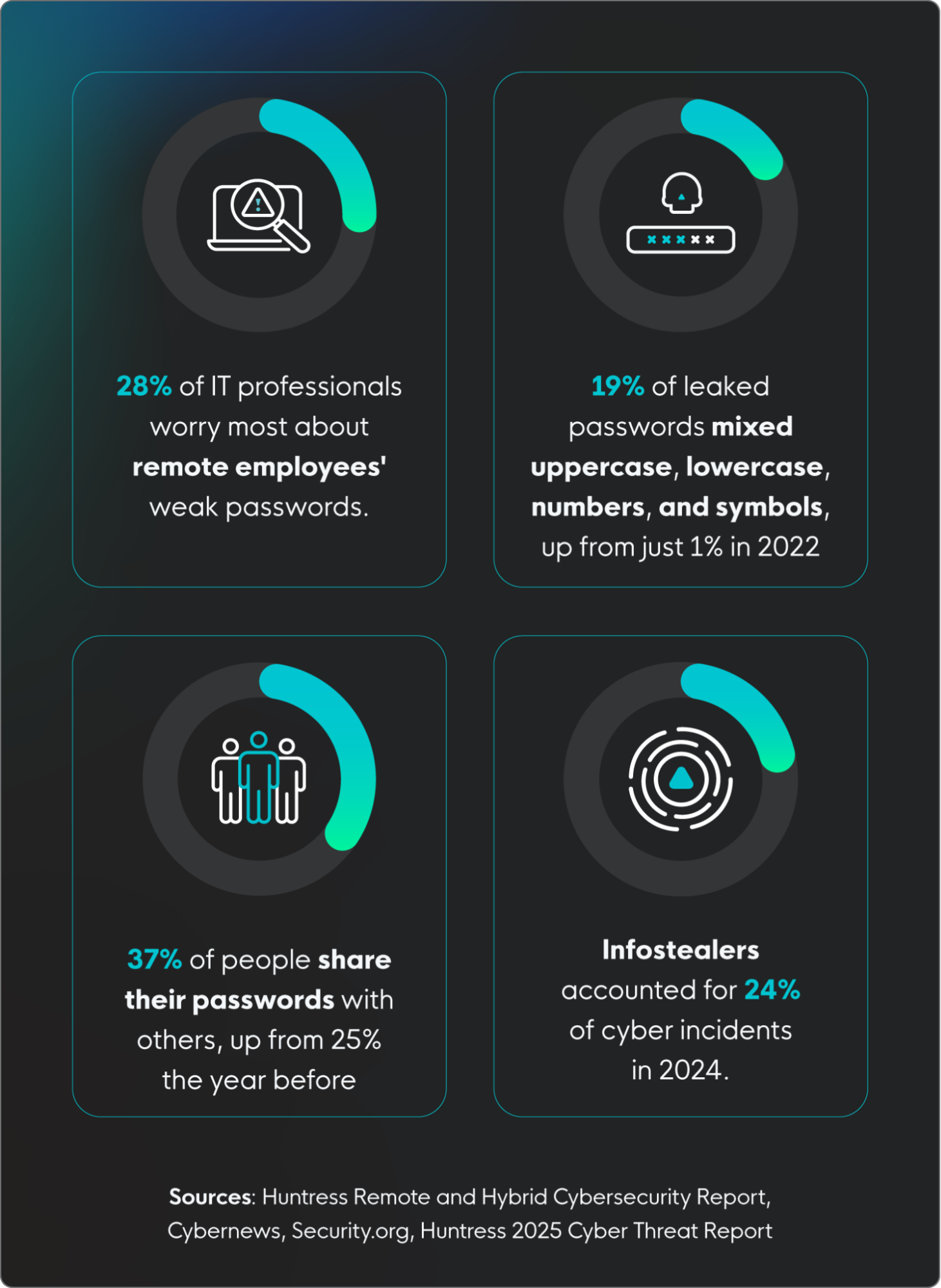
- Password security is a top concern in remote and hybrid work environments, with more than a quarter (28%) of cybersecurity professionals saying that employees using the same or weak passwords is their worst habit. (Huntress Remote and Hybrid Cybersecurity Report)
- 65% of people admit to using predictable patterns or personal information in their passwords, like simple number or letter patterns (26%), birth years or dates (22%), and family or pet names (20% each). (PasswordManager.com)
- Cybercriminals are increasingly stealing credentials using infostealers, a form of malicious software designed to gather credentials and sensitive information, showing up in 24% of cyber incidents in 2024. (Huntress 2025 Cyber Threat Report)
- Only 19% of leaked passwords that were analyzed mixed uppercase, lowercase, numbers, and symbols, up from just 1% in 2022. This means most people still favor simplicity over strength. (Cybernews)
- Password generator use nearly doubled, climbing from 15% to 27%. (Security.org)
- Many people delay changing their passwords: 49% say they don't update more often because they worry about forgetting the new one, and 40% say it's simply inconvenient. (PasswordManager.com)
- Despite these risky habits, only 5% of people rate their own passwords as very risky, and 63% say their passwords are not very risky at all, a striking overconfidence gap. (PasswordManager.com)
- 37% of people share their passwords with others, up from 25% the year before. (Security.org)
How often are passwords actually compromised? More than you'd think. From brute-force attacks to large-scale data breaches, these password breach statistics show just how exposed weak password practices leave you—and why proactive password security isn't optional.
- 37% of identity-based threats in 2026 stemmed from stolen or suspicious-footprint credential logins (per Huntress's own telemetry). (Huntress 2026 Cyber Threat Report)
- 27% of the leaked passwords analyzed consisted of only lowercase letters and digits, a structure that makes them far easier to crack. (Cybernews)
- Abuse of remote monitoring and management (RMM) tools — often the entry point in company-side breaches, jumped 277% year over year and showed up in nearly a quarter of all incidents investigated. (Huntress 2026 Cyber Threat Report)
- Credential abuse plays a role in 39% of breaches at some point in the attack chain, making it one of the most persistent threats organizations face. (Verizon 2026 Data Breach Investigations Report)
- More than 19 billion passwords (19,030,305,929) were exposed across roughly 200 incidents between April 2024 and April 2025, and only 6% of them were unique. (Cybernews)
- More than 24 billion credentials are currently exposed from data breaches and available on the dark web. (Security Magazine)
- Stolen or compromised credentials are the most common initial attack vector and among the costliest, averaging $4.5 million per breach with the longest time to identify and contain, at 327 days. (IBM Cost of a Data Breach Report)
- About 17% of people have no idea how their passwords were stolen. (Forbes Advisor)
- The most commonly stolen information in password attacks is first and last name (39%), followed by phone number (38%) and personal address (34%). (Forbes Advisor)
Password reuse statistics
While convenient, the seemingly harmless habit of reusing passwords across multiple accounts creates a dangerous domino effect. Once a single password is compromised in a breach, threat actors gain access to a potentially vast network of your online life.
According to these statistics, password reuse is surprisingly common (okay, maybe unsurprisingly):
- Gen Z reuses passwords at nearly double the rate of boomers, 72% compared to 42%, making younger users the most exposed group. (Bitwarden)
- 55% of people have abandoned an account or created a new one entirely just to avoid going through a password reset. (Bitwarden)
- 94% of the passwords in Cybernews' 19-billion-password analysis were reused or duplicated across accounts, meaning a single breach could cascade across someone's entire online footprint. (Cybernews)
Password management statistics
What is password management? It’s exactly what it sounds like: how people manage and remember their passwords. It’s a booming industry, with many different options on the market to help people remember and secure their passwords.
Here are some key facts about password management:
- Over half of Americans still rely on unsecured methods (memorization, browser autofill, or the written word) to keep track of their passwords. (Security.org)
- Among people who do use a password manager, 78% say they simply have more passwords than they can easily remember, which is why they adopted a password manager. (Security.org)
- Paper is on its way out. When it comes to password storage, 25% of people wrote passwords down on paper in 2024, down from 30% in 2023 and 32% in 2022. (Security.org)
- 34% of people save their passwords in their browser, a share that's been climbing year over year. (Security.org)
- 26% save their passwords in a note on their computer or mobile device. (Security.org)
- Password manager adoption has reached 36% of US adults, roughly 94 million people, up from 34% the year before. (Security.org)
- 27. 51% of people have their passwords memorized. (Security.org)
- Google and Apple together now control more than 55% of the password manager market. (Security.org)
Stats about password security best practices
While these password statistics may be concerning, significant security improvements are within reach. The focus should be on actionable steps and proven best practices for creating and managing strong passwords effectively.
While password policy best practices used to include changing your password frequently, that’s no longer the case. It’s better to create a strong password to begin with, store it securely, and use multifactor authentication (MFA).
Implementing these guidelines lets you take control of your digital security and significantly reduce your risk of falling victim to password-related attacks.
- About 68% of people have been forced to change a password because of a compromised credential. (Forbes Advisor)
- A secure password should be long, random, and unique. (CISA)
- A password should be at least 16 characters for optimal security, though longer is always better. (CISA)
- Passkeys are going mainstream, with 5 billion now active worldwide. (FIDO Alliance)
- 49% of people now use passkeys regularly, and 75% have enabled a passkey on at least one account. (FIDO Alliance)
- AI-powered cracking tools can guess a typical seven-character password—even one mixing letters, numbers, and symbols—in under six minutes, underscoring why length matters more than complexity tricks alone. (Home Security Heroes)
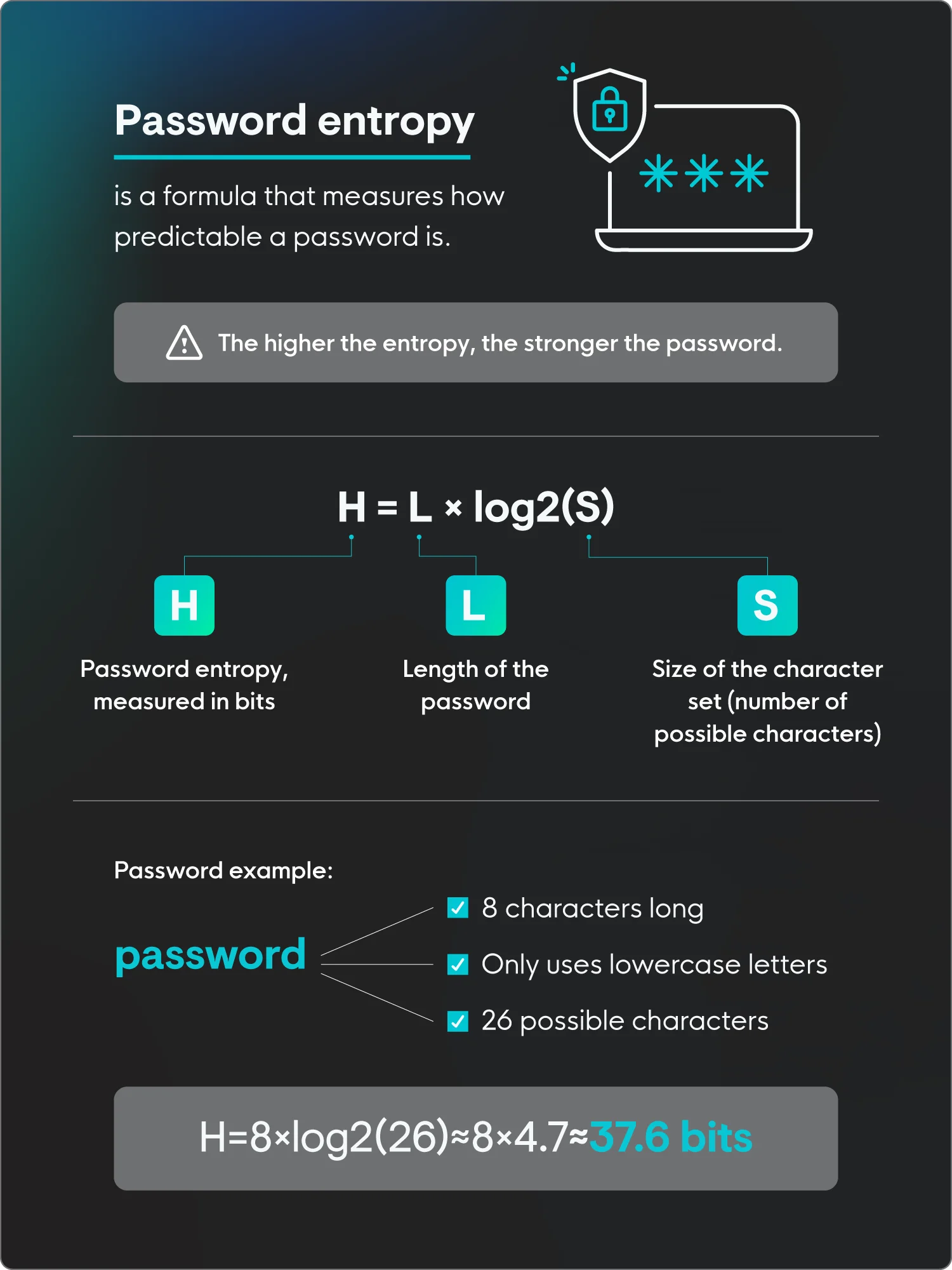
- There’s a formula for measuring password strength or password entropy, which essentially calculates how long it would take to crack a password. Again, the longer, the better. (TechTarget)
How to choose a strong password
Crafting strong passwords is your first and most crucial line of defense. Passwords should be unique, long, and a combination of letters, symbols, and numbers. It should also be something not easily guessable.
“A strong password should be long, unique, and unpredictable,” says Welch. “The moment you reuse a password or base it on information someone could find about you, you're giving attackers a head start. The goal isn't to create a password that's easy to remember; it's to create one that's difficult for anyone else to guess.”
Here are some other key password security tips:
- Make it long: Passwords should be at least 16 characters long.
- Use a mix of characters: A secure password will mix lower and uppercase letters, numbers, and random characters.
- Ensure it’s unique: Avoid using popular passwords, like 123456 or password, as those are very easily guessable.
- Don’t make it personal: Don’t choose the name of your favorite pet or your mom’s maiden name, as those are personal details that someone could easily know or find out.
- Consider using a password manager: These tools securely store and generate strong, unique passwords for all your accounts, so you only need to remember one master password.
- Enable multi-factor authentication whenever possible: MFA adds an extra layer of security by requiring a second verification method (like a code from your phone) in addition to your password.
- Pair it with single sign-on (SSO) when your organization offers it: SSO reduces the number of passwords employees have to juggle, which lowers the odds of reuse in the first place.
- Be cautious of phishing attempts: Don't click on suspicious links or enter your password on unfamiliar websites. Always verify the legitimacy of a login page.
- Keep your software up to date: Updates often include security patches that can protect against known vulnerabilities.
- Monitor your accounts for suspicious activity: If you notice anything unusual, change your password immediately and report it.
Protect your passwords (and yourself) with identity theft protection
Understanding the takeaways from password statistics is a crucial step toward stronger security online. Simple changes, like retiring reused login credentials and moving credentials into a password manager, help block attackers.
If you want to see how your own compare, start with the most common passwords and make sure none of yours are on the list. But individual habits only go so far. We understand what threats like credential theft and unauthorized access mean for your business, and we're here to help.
Huntress Managed Identity Threat Detection and Response (ITDR) protects identities across your organization 24/7, while Huntress Security Awareness Training turns your team into a stronger first line of defense. Because the strongest password policy still needs people who know how to follow it.
FAQ
What Huntress product or service promotes password safety and best practices?
Huntress Security Awareness Training (SAT) turns password best practices into habits your team actually keeps up with, through ongoing, real-world training rather than a one-time policy memo. Pairing SAT with Managed ITDR, which monitors identities across your organization 24/7, covers both the education and detection sides of password security.
What is the best way to protect your passwords?
The strongest approach layers habits and tools: creating long, unique passwords, storing them in a reputable password manager, and enabling MFA wherever you can. Because people are the most targeted layer, ongoing education matters too. Huntress Security Awareness Training can help build those habits organization-wide.
What is the 8-4 rule for passwords?
The 8-4 rule is a classic guideline: Use at least 8 characters and include all 4 character types: uppercase letters, lowercase letters, numbers, and symbols. It's a reasonable floor, though current guidance from CISA pushes for 16 characters or more.
What's a good password?
A good password is long (16+ characters), random, and unique to a single account, mixing uppercase and lowercase letters, numbers, and symbols (and containing nothing a stranger could guess or look up, like a pet's name or a birth year).
How many passwords does the average person have?
The number peaked at nearly 170 passwords per person in 2024, when business accounts were tracked separately, finding an average of 87 that year. Since then, the personal account number has dropped for the first time, to about 120.
What is the most commonly hacked password?
The most common password that password hackers targeted in 2026 is “123456”.
How many passwords are hacked every day?
A University of Maryland study famously clocked an attack on internet-connected computers roughly every 39 seconds, or about 2,244 a day.
Text extracted automatically; images, tables and formatting may be missing. Original: https://www.huntress.com/blog/password-statistics