“I want your clothes, shoes, and motorbike”
Full article426 words · extracted from securelist.com · click to collapse



It’s a classic type of network fraud: you receive a letter asking you to send the login and password for your e-mail/online wallet/gaming account/etc. If you fail to comply, the phoney “support service” that sent the message threatens to limit or even block your access to the service.
Today our spam traps detected a letter like this in which the fraudsters were trying to swindle users out of out their activation codes for…Kaspersky Lab products! However, that’s not all – they also wanted to know the recipient’s residential address, mobile phone number and credit card number. They only stopped short of asking for the house keys.
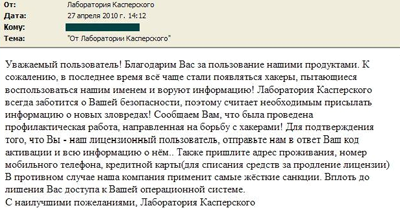
“Dear User! Thank you for choosing our products. Unfortunately, recently more and more hackers have tried to use our name to steal information! Kaspersky Lab always cares about your security therefore we believe it is necessary to inform you about new malware! Please be informed that we have carried out preventive measures aimed at combating hackers! To confirm that you are using our licensed product please send us your full activation code information. Please also send your residence address, mobile phone number, credit card number (in order to pay for a license extension). Otherwise, our company will have to impose severe sanctions, including blocking access to your operating system.
Best regards, Kaspersky Lab.”
Hopefully, our users are not naïve enough to fall for such a primitive scam. There’s no need to explain that Kaspersky Lab would never send out letters like this, especially such threatening messages. It’s nothing more than a crude attempt to obtain some confidential data from some unsuspecting user.
To be fair, the letter does contain a number of true statements. For instance, it states that hackers make use of our name, which they do. And the authors state that Kaspersky Lab cares about the security of its users. That’s also true.
Latest Webinars
Reports
Kaspersky researchers have discovered new Mirage Kitten attacks using previously undocumented malware families: NodeRabbit in Node.js and PollCat in JavaScript.
Our experts discovered a new CoolClient backdoor variant with a kernel-mode rootkit driver that hides malicious processes, files, and network connections from security tools and threat analysts.
Kaspersky experts break down a new Armored Likho campaign that poses as a fundraising efforts and delivers a new Still Toolkit aimed at stealing Telegram data and eavesdropping on victims.
Kaspersky researchers reveal previously undocumented malware attributed to Mirage Kitten (UNC1549, Smoke Sandstorm, Nimbus Manticore): NightLedger backdoor, ArcBridge, and BridgeHead tunneling tools.
Text extracted automatically; images, tables and formatting may be missing. Original: https://securelist.com/i-want-your-clothes-shoes-and-motorbike/29605/