Akuity gives AI agents operational context to safely ship software
Akuity launches Agentic Control Plane and MCP Server to govern AI agent actions inside production software delivery pipelines.
Akuity introduced an Agentic Control Plane and MCP Server that lets AI agents such as Claude, Codex, and Cursor access deployment and cluster context under existing identity, permission, and audit controls. MLB reported the product identified over 100 degraded applications within hours. Akuity positions it against open-source MCP servers granting raw access with no identity inheritance or policy layer.
- Agent requests authenticate as the connecting user with inherited permissions
- Policy layer can block sensitive production actions and adds agent-aware audit
- MLB reported 100+ degraded applications identified within hours
- Unrestricted open-source MCP servers expand attack surface per Akuity
Full article699 words · extracted from helpnetsecurity.com · click to collapse
Akuity has introduced its Agentic Control Plane and MCP Server. Akuity’s Agentic Control Plane lets AI agents accelerate software delivery by giving them the operational context and permissions to act, all governed by the same controls Akuity already enforces across the pipeline. That governance is what gives engineering leadership the confidence to let agents into production, with real control over what agents can touch.
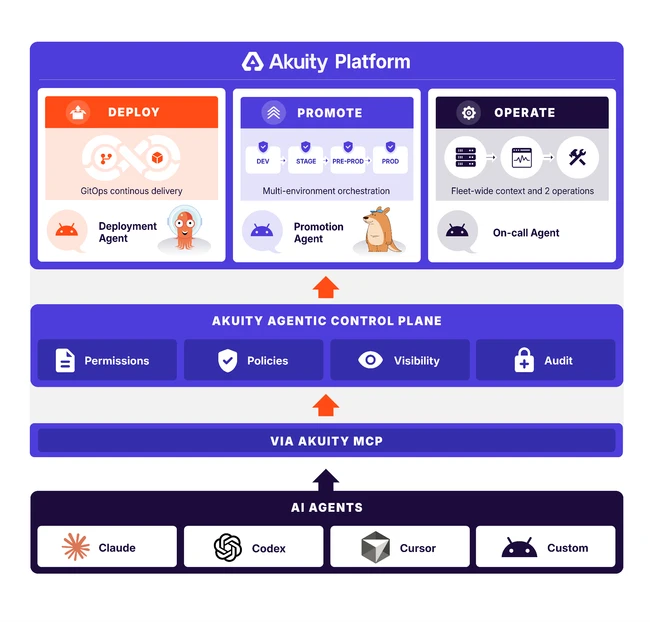
Agentic engineering is driving teams to write more code than ever but shipping it safely has become the bottleneck. Agents are operating inside production environments, sanctioned or not, often with limited access to the data they would need to make a real impact. Many also connect through open-source MCP servers that grant raw access with no identity inheritance, no policy layer and no agent-aware audit trail, expanding the attack surface with every new connection.
“Within hours of enabling Akuity’s Agentic Control Plane, it identified more than one hundred degraded applications, and in under ten minutes, it flagged one project as the source of a systemic issue, traced it to the root cause and had a fix ready to go. That’s exactly the workflow we wanted: identify the problem, tell us if it’s systemic and hand us the fix. This is already bringing value to the team, and we are looking to expand its adoption,” said Michael Goodness, Principal DevOps Engineer, MLB.
“AI agents have moved past writing code to operating how infrastructure changes get delivered and promoted to production, whether we’ve built the guardrails for it or not. The winners in this next phase won’t be whoever adopts AI fastest, it’ll be whoever gives their agents a safe, reliable path to do that work. That’s what Akuity’s Agentic Control Plane is for,” said Hong Wang, CEO of Akuity.
Akuity’s Agentic Control Plane is different from point solutions that have added guardrails or generic AI gateways that broker access to them: it runs the software delivery pipeline itself, capturing the deployment history, cluster health and change lineage that these other solutions don’t have access to. That operational data is what lets agents move beyond writing code to actually shipping it.
Akuity MCP Server allows AI agents, in-house or third-party such as Claude, Codex or Cursor, to access the Akuity Platform, from cluster health down to the exact commit behind every deployment. Every request they make routes through the Agentic Control Plane which authenticates it as the specific user who connected the agent.
Akuity’s Agentic Control Plane features include:
- Full operational context, not just application data. Point solutions and generic AI gateways give agents visibility into the deployment pipeline but nothing beneath it. Akuity’s context extends to the infrastructure it runs on, cluster health and change lineage across the entire fleet so an agent can troubleshoot real incidents, not just the release it just shipped.
- Guardrails engineering leadership can trust. Every agent action runs through the same identity, permissions and audit trail. A policy layer restricts what agents can touch, including sensitive production actions a team may not want to delegate even when the underlying user has access.
- One connection, no new liabilities. A single connection authenticates once and carries the user’s existing permissions across every instance and cluster it manages. There are no separate credentials to provision or rotate and no new endpoint for security to worry about.
With Akuity’s Agentic Control Plane, customers can:
- Gain visibility without the overhead. Users can ask a single question and get an answer across every cluster instead of checking each one separately.
- Stand up new services in hours, not weeks. Users can start from an empty repo and ask their agent to bootstrap the entire delivery setup for a new service, environments, promotion rules and all and ship it the same afternoon.
- Promote a release without leaving the chat. Users can ask their agent to check a release’s promotion history and eligibility then promote it to the next environment. Existing approval rules still apply whether a person or an agent made the request.
- Agent-to-agent troubleshooting. Users can ask their agent to troubleshoot a struggling instance. Their agent connects directly to Akuity’s On-Call Agent, pulling in logs and recent changes to diagnose the issue and recommend a fix.
Text extracted automatically; images, tables and formatting may be missing. Original: https://www.helpnetsecurity.com/2026/09/15/akuity-agentic-control-plane/