Army must empower next generation to succeed in cyber, senior official says
Full article622 words · extracted from cyberscoop.com · click to collapse
Get our latest cybersecurity news first on Google.
To quickly develop the Army's cyber capabilities requires that leadership consider unique options while also adjusting for a different culture brought in by recruits who are inherently digitally savvy, according to Col. Chris Wade, director of the Army's Task Force Cyber Strong.
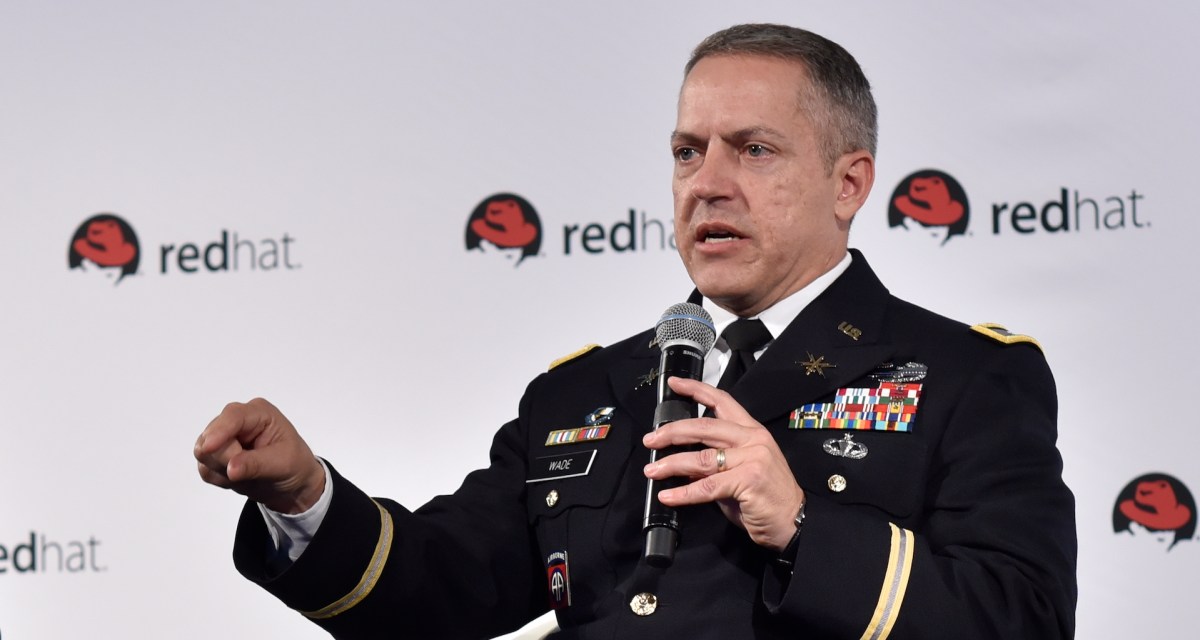
For the armed forces to succeed in cyberspace, the military must avoid “groupthink” by exploring new approaches and empowering junior service members, a senior U.S. Army official says.
To quickly develop the Army’s cyber capabilities requires that leadership consider unique options while also adjusting for a different culture brought in by recruits who are inherently digitally savvy, according to Col. Chris Wade, director of the Army’s Task Force Cyber Strong. The program is designed to quickly develop and improve the military’s ability to defend against and launch cyberattacks.
“What we want to avoid in the Army is that ‘groupthink,'” Wade said Thursday at the Red Hat Government Symposium presented by FedScoop. “That’s challenging for us as leaders … we got to embrace what’s going on .. giving power to the lowest levels so that guys can think through problems and rapidly react.”
Wade, who serves in the Army’s Office of the Deputy Chief of Staff, said the Hack the Pentagon program served as one example of the force’s new and experimental mindset when it comes to finding solutions to complex cybersecurity challenges. The bug bounty program, which was conducted by U.S. cybersecurity firm HackerOne, served to inform the Army about existing software vulnerabilities evident in some unclassified systems.
“We think the biggest aspect in terms of our soldiers is they can only do what we do when they’re in this uniform for the most part,” Wade said about the Army’s role in government-back cyber operations. “The satisfaction that they can combat and face our enemies on daily basis is … a unique and rewarding experience.”
Fiscal 2018, which began Oct. 1, represents a year for “delivery,” described Wade.
The Army’s cyber branch has only existed for two years and just recently completed the training of 40 Cyber Mission Force teams. This means that the force is finally fully capable of launch operations at scale, internationally.
“I think it’s just amazing where we are at today and if you watch this year, the year of delivery, where we are going to implement some of these teams I think it’s going to be incredible,” Wade said.
Latest Podcasts
Government
FBI officials say AI is bolstering adversaries, emphasizing need to focus on cyber basics, patching
Feds accuse China of ‘systematic’ distillation of U.S. AI models
CIA’s Michael Ellis says cyber intelligence is changing how the agency operates
The G7 tells industry to hurry up and prep for post-quantum encryption
Technology
Threats
Microsoft discloses two actively exploited zero-days among 974 vulnerabilities
Russian national extradited to US for alleged involvement in bank-account takeover scheme
Attackers exploit zero-days in consistently besieged SonicWall product
Jail time for Maine child in 764 marks turning point in federal law enforcement
Policy
Whistleblower says USPS deploying new, ‘untested’ IT systems governing mail-in ballots
‘Watershed 250’ test program in Texas looks to private sector for water cybersecurity help
Former sexual abuse victims say Grok used their images, videos to train deepfake capabilities
Cyber threats nudge Trump to sign executive order on foreign equipment in U.S. energy infrastructure
Text extracted automatically; images, tables and formatting may be missing. Original: https://cyberscoop.com/army-must-empower-next-generation-succeed-cyber-senior-official-says/