Microsoft: Attackers Exploiting ‘ZeroLogon’ Windows Flaw
Vulnerabilities mentionedAll →
| CVE | Vulnerability | CVSS | EPSS | Flags | Affected | Exposure | Published |
|---|---|---|---|---|---|---|---|
| CVE-2020-1472 | Unauthenticated Privilege Escalation (Zerologon) in Microsoft Netlogon Domain Controllers CVE-2020-1472, widely known as "Zerologon," is an elevation-of-privilege flaw in how the Netlogon secure channel is established over the Netlogon Remote Protocol (MS-NRPC) on Microsoft domain controllers. An unauthenticated attacker with network reachability to a domain controller sends specially crafted Netlogon messages to establish a vulnerable secure channel and then runs a specially crafted application on the network to obtain domain administrator access. Successful exploitation yields domain administrator privileges, effectively full compromise of the Active Directory environment, and the flaw is known to be used in ransomware operations. Any organization running affected Windows Server versions (2008 through 20H2) as domain controllers is exposed, along with environments using Netlogon implementations from Samba and distributions or products from Fedora, openSUSE, Canonical (Ubuntu), Debian, Synology, and Oracle. Exploitation is highly active: a public Zerologon PoC/exploit is available, the flaw is on CISA's Known Exploited Vulnerabilities catalog (added 2021-11-03, with known ransomware use), and EPSS estimates a 99.4% probability of exploitation within 30 days. Do: Apply the vendor updates on all domain controllers and other affected systems immediately, following Microsoft's two-phase Netlogon secure channel guidance (the enforcement phase of the phased rollout began in Q1 2021). Audit Netlogon secure-channel connections and event logs for clients still using vulnerable connections before enabling full enforcement, and install updated packages for Samba and other Netlogon implementations from Fedora, openSUSE, Ubuntu, Debian, Synology, and Oracle. Given known ransomware use, prioritize patching any domain controller reachable from user networks, VPNs, or the internet. | 5.5 | 99% | KEV ransomware PoC |
| massmillions of domain controllers worldwide (essentially every Active Directory domain), with hundreds of thousands of domain controllers/RPC endpoints… |
Full article391 words · extracted from krebsonsecurity.com · click to collapse
Microsoft warned on Wednesday that malicious hackers are exploiting a particularly dangerous flaw in Windows Server systems that could be used to give attackers the keys to the kingdom inside a vulnerable corporate network. Microsoft’s warning comes just days after the U.S. Department of Homeland Security issued an emergency directive instructing all federal agencies to patch the vulnerability by Sept. 21 at the latest.
DHS’s Cybersecurity and Infrastructure Agency (CISA) said in the directive that it expected imminent exploitation of the flaw — CVE-2020-1472 and dubbed “ZeroLogon” — because exploit code which can be used to take advantage of it was circulating online.
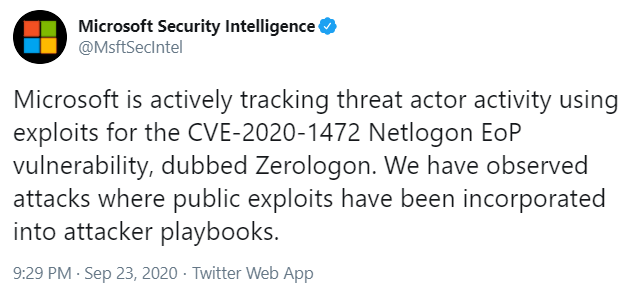
Last night, Microsoft’s Security Intelligence unit tweeted that the company is “tracking threat actor activity using exploits for the CVE-2020-1472 Netlogon vulnerability.”
“We have observed attacks where public exploits have been incorporated into attacker playbooks,” Microsoft said. “We strongly recommend customers to immediately apply security updates.”
Microsoft released a patch for the vulnerability in August, but it is not uncommon for businesses to delay deploying updates for days or weeks while testing to ensure the fixes do not interfere with or disrupt specific applications and software.
CVE-2020-1472 earned Microsoft’s most-dire “critical” severity rating, meaning attackers can exploit it with little or no help from users. The flaw is present in most supported versions of Windows Server, from Server 2008 through Server 2019.
The vulnerability could let an unauthenticated attacker gain administrative access to a Windows domain controller and run an application of their choosing. A domain controller is a server that responds to security authentication requests in a Windows environment, and a compromised domain controller can give attackers the keys to the kingdom inside a corporate network.
Scott Caveza, research engineering manager at security firm Tenable, said several samples of malicious .NET executables with the filename ‘SharpZeroLogon.exe’ have been uploaded to VirusTotal, a service owned by Google that scans suspicious files against dozens of antivirus products.
“Given the flaw is easily exploitable and would allow an attacker to completely take over a Windows domain, it should come as no surprise that we’re seeing attacks in the wild,” Caveza said. “Administrators should prioritize patching this flaw as soon as possible. Based on the rapid speed of exploitation already, we anticipate this flaw will be a popular choice amongst attackers and integrated into malicious campaigns.”
Text extracted automatically; images, tables and formatting may be missing. Original: https://krebsonsecurity.com/2020/09/microsoft-attackers-exploiting-zerologon-windows-flaw/