Three bills governing AI in elections pass Senate committee
Full article852 words · extracted from cyberscoop.com · click to collapse
Get our latest cybersecurity news first on Google.
The bills are aimed at protecting election integrity from the misuse of generative artificial intelligence.
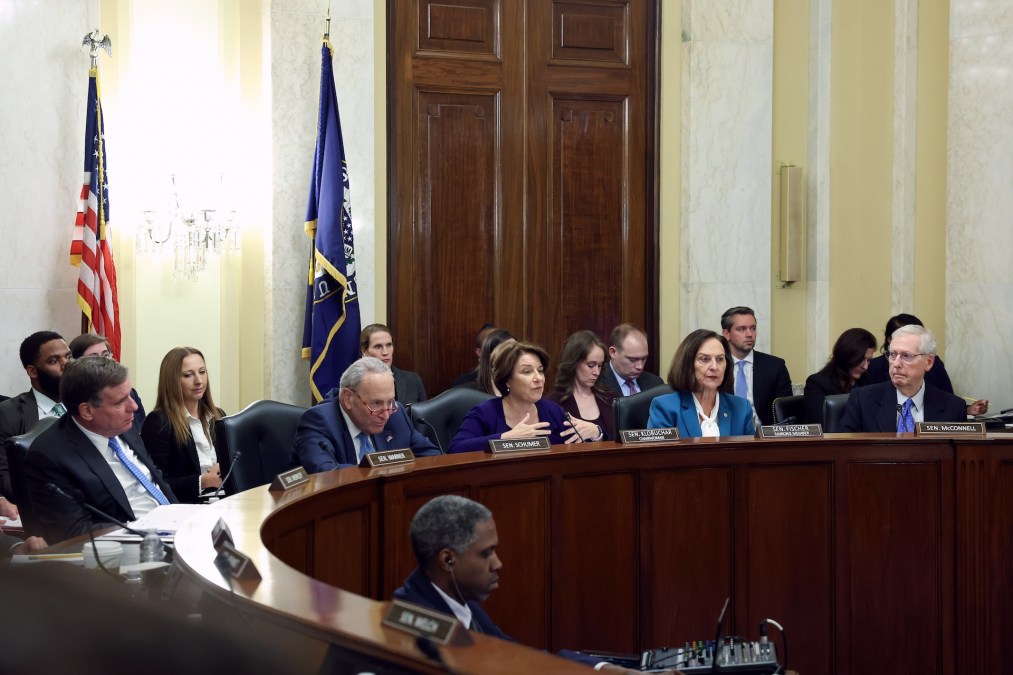
A trio of bills focused on limiting deepfakes and other forms of fake generative artificial intelligence content in elections is on the way to the Senate for a final vote after passing through a markup Wednesday with the chamber’s Committee on Rules and Administration.
The bills head to the Senate just as election season ramps up, leaving many security experts, researchers, and members of Congress alarmed at the potential for scaled disinformation campaigns that are only made possible by generative AI. Tech giants and AI developers promised to take the threat to the integrity of elections seriously through a voluntary pledge, but to close observers, those declarations lack the actions to match.
The Protect Elections from Deceptive AI Act, from Chairwoman Amy Klobuchar, D-Minn., bans “materially deceptive” AI-generated content of federal candidates to influence elections. The bill also allows federal candidates for office to have content taken down and pursue damages in federal court, with exceptions for news organizations, parody, and satire.
Klobuchar warned about the threat that generative AI poses to election integrity, pointing to fake robocalls imitating President Joe Biden in New Hampshire that told voters to skip the Democratic primary, as well as photos of former President Donald Trump hugging Anthony Fauci, the former chief medical adviser to the president, shared by Ron DeSantis’s presidential campaign.
“We cannot have our democracy undermined by ads, by videos, by robocalls when you literally don’t know whether it’s the candidate you love or the candidate you dislike,” Klobuchar said, pointing to multiple states that are moving toward labeling or outright bans for generative AI use in elections.
Ranking member Deb Fischer, R-Neb., opposed the Protect Elections from Deceptive AI Act, saying the bill sends a signal of federalizing elections, a charge Klobuchar answered by noting that “we do not preempt the state laws.” Fischer pointed to terms in the legislation such as “materially deceptive,” which she said would create “uncertainty about what speech is regulated.” She added that people who would be impacted by regulations around AI would be those who use the tech “to create political speech, not tech companies.”
“They sweep in previously unregulated speech that goes beyond deepfakes,” Fischer said.
The AI Transparency in Elections Act, meanwhile, co-sponsored by Klobuchar and Sen. Lisa Murkowski, R-Alaska, would disclose political advertisements that have AI-generated images, with criteria set by the Election Assistance Commission.
Only one bill had broad bipartisan support: the Preparing Election Administrators for AI Act, which requires the EAC to work with the National Institute of Standards and Technology to report to Congress how AI is used in elections, as well as guidelines for state and local election offices. A House companion bill was introduced on Monday.
More Scoops
AI is getting better at election facts, but voters shouldn’t rely on it
AI chatbots are avoiding some of the obvious errors that plagued earlier models, but they still fall short giving voters the full picture compared to state and…
House intel bill includes provisions on state and local threat intelligence, election security, AI
Warner bill would create federally vetted list for secure, trustworthy AI agents
Latest Podcasts
Government
Technology
Threats
Chinese espionage groups swarm to exploit triple-link chain of zero-days
Microsoft discloses two actively exploited zero-days among 974 vulnerabilities
Russian national extradited to US for alleged involvement in bank-account takeover scheme
Attackers exploit zero-days in consistently besieged SonicWall product
Policy
Whistleblower says USPS deploying new, ‘untested’ IT systems governing mail-in ballots
‘Watershed 250’ test program in Texas looks to private sector for water cybersecurity help
Former sexual abuse victims say Grok used their images, videos to train deepfake capabilities
Cyber threats nudge Trump to sign executive order on foreign equipment in U.S. energy infrastructure
Text extracted automatically; images, tables and formatting may be missing. Original: https://cyberscoop.com/klobuchar-ai-election-bill-senate-markup/