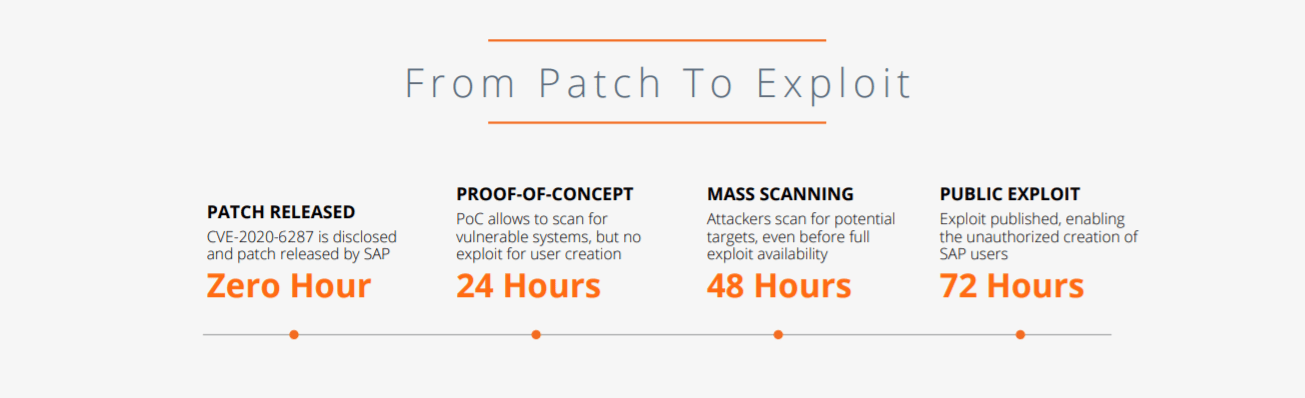
SAP systems are targeted within 72 hours after updates are released
Vulnerabilities mentionedAll →
| CVE | Vulnerability | CVSS | EPSS | Flags | Affected | Exposure | Published |
|---|---|---|---|---|---|---|---|
| CVE-2010-5326 | Unauthenticated Remote Code Execution in SAP NetWeaver Invoker Servlet The Invoker Servlet in SAP NetWeaver Application Server (AS) Java does not require authentication, which allows unauthenticated attackers to trigger remote code execution on the server. The flaw is triggered by sending a crafted HTTP or HTTPS request to the exposed Invoker Servlet on an affected NetWeaver AS Java system, with no credentials required. Successful exploitation gives an attacker the ability to run arbitrary code on the SAP application server, typically at the privileges of the application service, exposing business data and enabling further attacks into the environment. Any organization running SAP NetWeaver with the Java application server stack — particularly instances reachable from the internet or untrusted networks — is affected. Exploitation is confirmed in the wild: CISA added this vulnerability to its Known Exploited Vulnerabilities catalog on 2021-11-03 (ransomware use unknown), EPSS estimates a 17.4% probability of exploitation within 30 days (97th percentile), and no public proof-of-concept code is known. Do: Inventory all SAP NetWeaver AS Java instances and prioritize internet-exposed ones for remediation, applying SAP's updates per vendor instructions as required by the CISA KEV entry. Until patched, require authentication for or restrict access to the Invoker Servlet and limit HTTP/HTTPS access to the AS Java ports to trusted networks, then verify the fix is in place. | — | 17% | KEV |
| largetens of thousands of internet-exposed SAP NetWeaver AS Java systems (10k–100k order of magnitude) | |
| CVE-2016-3976 | Directory Traversal File-Read Flaw in SAP NetWeaver Application Server (Java) SAP NetWeaver Application Server (Java) contains a directory traversal vulnerability (CWE-22) in its CrashFileDownloadServlet. A remote attacker sends a request to the servlet with a dot-dot-backslash (..\) traversal sequence in the fileName parameter, causing the server to step outside the intended directory and return the contents of arbitrary files. Successful exploitation lets the attacker read sensitive files on the host, such as configuration or credential material, which can support further compromise; no code execution is involved. Any organization running SAP NetWeaver Application Server Java, typically large enterprises with SAP landscapes, is affected. The flaw was added to CISA's Known Exploited Vulnerabilities catalog on 2021-11-03, confirming exploitation in the wild, and EPSS assigns a 46.6% probability of exploitation in the next 30 days (99th percentile). Do: Apply SAP security updates for NetWeaver AS Java per vendor instructions, as required by CISA's KEV listing. Until patched, restrict network access to the CrashFileDownloadServlet endpoint from untrusted networks and review web logs for requests using dot-dot-backslash (..\) sequences in the fileName parameter. Prioritize internet-facing SAP Java instances, since exploitation is confirmed and the EPSS score indicates high near-term exploitation probability. | 7.5 | 47% | KEV PoC ×3 |
| largetens of thousands of SAP NetWeaver AS Java installations worldwide, with thousands plausibly internet-exposed (estimate) | |
| CVE-2016-9563 | Authenticated XXE in SAP NetWeaver Application Server Java (BPM component) CVE-2016-9563 is an XML External Entity (XXE) injection flaw (CWE-611) in SAP NetWeaver Application Server for Java, located in the BC-BMT-BPM-DSK (Business Process Management) component. A remote attacker holding valid authenticated credentials submits crafted XML containing external entity references, which the server's XML parser resolves. Successful exploitation allows the attacker to read local files from the server and potentially trigger server-side requests (SSRF), enabling disclosure of sensitive configuration or credential material that can support further compromise. Any organization running SAP NetWeaver AS Java with the BPM component is affected, with exposure determined by whether such systems are reachable and by the privileges an attacker can obtain. The flaw is listed in CISA's Known Exploited Vulnerabilities catalog (added 2021-11-03), confirming exploitation in the wild, though no public proof-of-concept is known and ransomware use is undetermined. Do: Apply the SAP security note/patch addressing CVE-2016-9563 to SAP NetWeaver AS Java per vendor instructions, as required by the CISA KEV listing. Verify whether your AS Java estate includes the BPM (BC-BMT-BPM-DSK) component and whether those instances are internet-reachable, and review authentication on affected services. As interim mitigation, restrict and monitor authenticated access to the affected component and watch logs for XML parser activity indicative of XXE (unexpected external entity resolution or outbound connections from the application server). | 6.5 | 24% | KEV |
| largeOrder of tens of thousands of SAP NetWeaver AS Java installations plausibly affected; exact exposed-instance count unknown | |
| CVE-2018-2380 | Path Traversal in SAP Customer Relationship Management (CRM) CVE-2018-2380 is a path traversal flaw (CWE-22) in SAP Customer Relationship Management (CRM) caused by insufficient validation of path information supplied by users. An attacker triggers it by submitting crafted path input to the vulnerable CRM functionality, allowing requests to reach files or directories outside the intended scope. Successful exploitation can enable unauthorized access to or manipulation of files on the SAP CRM server, potentially supporting further compromise; CISA notes known ransomware use. Any organization running SAP CRM is potentially affected, with risk concentrated in deployments where the application is reachable by untrusted users. The flaw is listed in CISA's Known Exploited Vulnerabilities catalog (added 2021-11-03), and EPSS assigns a high 28.9% probability of exploitation within 30 days (98th percentile), though no public proof-of-concept is known. Do: Apply SAP's security updates per vendor instructions as required by CISA, and identify all SAP CRM instances in your environment, prioritizing any that are internet-facing. Because ransomware use is known, verify the integrity of affected SAP servers and restrict network access to them from untrusted networks. Check with SAP's advisory for the specific affected releases, since the provided data does not enumerate version ranges. | 6.6 | 29% | KEV ransomware PoC ×2 |
| large≈10,000–100,000 enterprise installations worldwide (order-of-magnitude estimate) | |
| CVE-2020-6207 | Unauthenticated RCE in SAP Solution Manager 7.2 (CWE-306) CVE-2020-6207 is a missing authentication check (CWE-306) in the User Experience Monitoring service of SAP Solution Manager 7.2, allowing an unauthenticated remote attacker to interact with the service over the network. The flaw is triggered simply by connecting to the unauthenticated service, and CVSS v3.1 scores it 9.8 Critical with network vector, low complexity, and no privileges or user interaction required. A successful attacker achieves remote command execution on the Solution Manager host and complete compromise of every SMDAgent connected to it, with public reporting noting the exploit yields root-level access. Any organization running SAP Solution Manager 7.2 — deployed across the majority of large SAP enterprise landscapes — is affected, particularly where the monitoring service is reachable from untrusted networks. Exploitation is confirmed in the wild: the flaw is in CISA KEV (added 2021-11-03), a fully functional public exploit exists, scanning activity against SAP systems has been reported, and EPSS assigns a 98.3% probability of exploitation within 30 days (100th percentile). Do: Apply SAP's patch for this vulnerability (SAP Security Note 2914509) per vendor instructions, as required by the CISA KEV catalog, and ensure all connected SMDAgents are updated with the Solution Manager. Until patched, restrict or block external access to the Solution Manager monitoring service from untrusted networks, since active scanning of SAP systems has been observed. Check whether your instance exposes the affected service to the internet and hunt for signs of compromise on the SolMan host and connected SMDAgents. | 9.8 | 98% | KEV PoC ×2 |
| moderate≈2,000–5,000 internet-exposed instances (out of tens of thousands of total SolMan deployments worldwide) | |
| CVE-2020-6287 | Missing Authentication (RECON) in SAP NetWeaver AS Java LM Configuration Wizard CVE-2020-6287 is a missing authentication check (CWE-306) in the LM Configuration Wizard component of SAP NetWeaver Application Server Java versions 7.30, 7.31, 7.40 and 7.50. An unauthenticated remote attacker can reach the configuration interface over the network and execute critical configuration tasks without any credentials. This allows the attacker to create administrative users and take full control of the SAP Java system, compromising its confidentiality, integrity and availability. Any organization running SAP NetWeaver AS Java on the affected versions is exposed, especially instances where the LM Configuration Wizard is reachable from untrusted networks. Exploitation is confirmed in the wild: the flaw was added to CISA's Known Exploited Vulnerabilities catalog on 2021-11-03, carries a 94.7% EPSS probability of exploitation within 30 days, and news reports describe mission-critical SAP applications under active attack. Do: Apply SAP's security updates for NetWeaver AS Java 7.30, 7.31, 7.40 and 7.50 per the vendor's instructions (patches were released in July 2020), prioritizing internet-facing systems given the CISA KEV listing. As an interim mitigation, restrict network access to or disable the LM Configuration Wizard on affected systems. Also audit the system for unexpected or newly created administrative users and review access logs for unauthenticated configuration requests. | 10.0 | 95% | KEV |
| largetens of thousands of installations, with thousands directly internet-exposed |
Full article639 words · extracted from securityaffairs.com · click to collapse

On-premises SAP systems are targeted by threat actors within 72 hours after security patches are released, security SAP security firm Onapsis warns.
According to a joint study published by Onapsis and SAP, on-premises SAP systems are targeted by threat actors within 72 hours after security patches are released.
Threat actors perform reverse-engineering of the SAP patches to create their own code to exploit recently addressed vulnerabilities and use them to target SAP installs.
SAP and Onapsis have worked with Cybersecurity and Infrastructure Security Agency (CISA) and German cybersecurity agency BSI to warn SAP customers to install security updates once they became available and assess their on-premises installs.
“The window for defenders is significantly smaller than previously thought, with examples of SAP vulnerabilities being weaponized in less than 72 hours since the release of patches, and new unprotected SAP applications provisioned in cloud (IaaS) environments being discovered and compromised in less than three hours” reads the report published by Onapsis.
“Observed exploitation could lead in many cases to full control of the unsecured SAP application, bypassing common security and compliance controls, and enabling attackers to steal sensitive information, perform financial fraud or disrupt mission-critical business processes by deploying ransomware or stopping operations. These threats may also have regulatory compliance implications for organizations that have not properly secured their SAP applications processing
regulated data”
Threat actors conduct sophisticated attacks aimed at mission-critical SAP applications directly targeting sensitive data
and critical processes. Attackers attempted to accessing SAP systems to modify configurations and users and exfiltrate sensitive business information
According to the report, new unsecured SAP applications deployed in cloud (IaaS) environments are targeted by cyber attacks in less than three hours.
Furthermore, attackers used proof-of-concept code to attack SAP systems, but also brute-force attacks to take over high-privileged SAP user accounts. The goal of these attacks was to take full control of an SAP deployment in order to modify configurations and user accounts to exfiltrate business information.
Sophisticated attackers show a deep knowledge of the SAP architecture, they use to chain multiple vulnerabilities to target specific SAP applications to maximize the efficiency of the intrusions, in many cases experts observed the use of private exploits.
“It is important to note that while most of the observed threat activity is related to the use of publicly-available exploits released following SAP patches, Onapsis researchers have detected indicators of custom/private exploits not available in the public domain,” continues the report.
Onapsis set up honeypots to study the attacks against SAP installs and determined that the following vulnerabilities are being actively scanned for and exploited:
• CVE-2010-5326
• CVE-2018-2380
• CVE-2016-3976
• CVE-2016-9563
• CVE-2020-6287
• CVE-2020-6207
Below the list of recommendations provided by SAP and Onapsis in their report:
- Immediately perform a compromise assessment on SAP applications that are still exposed to the vulnerabilities mentioned herein, or that have not been promptly secured upon the release of the relevant SAP security patches—internet-facing SAP applications should be prioritized
- Immediately assess all applications in the SAP environment for risk, and immediately apply the relevant SAP security patches and secure configurations
- Immediately assess SAP applications for the existence of misconfigured and/or unauthorized highprivilege users and perform a compromise assessment on at-risk applications
- If assessed SAP applications are currently exposed and mitigations cannot be applied in a timely manner, compensating controls should be deployed and activity monitored to detect any potential threat activity until such mitigations are implemented.
“Furthermore, risk, cybersecurity and SAP leaders should implement a specific mission-critical application protection program as part of their overall cybersecurity and compliance strategy to protect these applications effectively and comprehensively.” concludes the report.
If you want to receive the weekly Security Affairs Newsletter for free subscribe here.
Follow me on Twitter: @securityaffairs and Facebook
| [adrotate banner=”9″] | [adrotate banner=”12″] |
(SecurityAffairs – hacking, SAP systems)
[adrotate banner=”5″]
[adrotate banner=”13″]
Text extracted automatically; images, tables and formatting may be missing. Original: https://securityaffairs.com/116431/reports/sap-systems-under-attacks.html