Health care industry is king of the malicious insider threat
Full article688 words · extracted from cyberscoop.com · click to collapse
Get our latest cybersecurity news first on Google.
The health care sector's IT suffered from malicious insider attacks at a rate far higher than any other major industry in 2016.
The health care sector’s IT suffered from malicious insider attacks at a rate far higher than any other major industry in 2016, according to new research from IBM.
The numbers further cement long held fears among health care technologists that highly valuable records, which sell on the black market for far-higher prices than stolen credit card information, are vulnerable in a sector that many professionals say does not do enough for security beyond minimum compliance requirements. About 25 percent of attacks on health care sector IT were malicious insider incidents, well above the rates in industries such as financial services (5 percent), manufacturing (4 percent) and retail (2 percent), the report said.
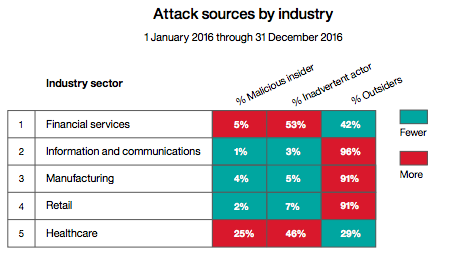
The industry also had a high rate of incidents by “inadvertent actors,” meaning an attack came from inside the system but without the knowledge of the compromised machine’s user. A typical example would be a machine infected by malware that isn’t activated until later and initially looks like an insider attack.
Those incidents accounted for about 46 percent of health care sector attacks, the report said. Only financial services had a higher rate, at 53 percent.
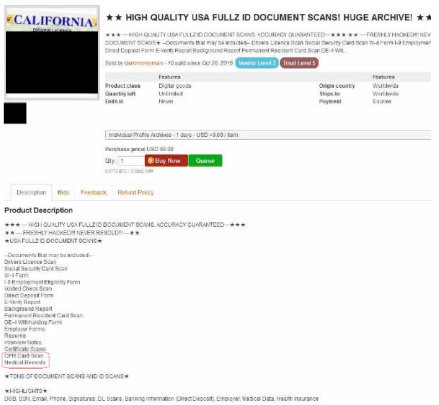
Medical records, in combination with other records, for sale on the dark net market AlphaBay
As electronic records increasingly replace paper based records in established and emerging health care markets, the digitization comes with potential risks both within organizations and “through indirect compromise such as third-party [electronic health record] vendor breaches,” according to IBM Security research.
One noteworthy example of a malicious insider successfully attacking the health care sector occurred in April 2016, when the personal information of 200,000 children leaked from Chinese hospitals due to the combined efforts of outside hackers and cooperative insiders. Local media reported the data was quickly sold after being stolen.
Researchers showed that health care was the only major industry in which insider threats actually outnumbered outsider attacks, a stark contrast to most industries that see a relatively tiny threat from the inside.
The finance industry, which can hold similarly valuable mountains of personal data, was both the most-attacked industry of 2016 according to IBM as well as the only other major industry that saw a majority of threats coming from inside the organization. In finance, however, the lion’s share of the insider threat is inadvertent.
“The fact that the insider attacks targeting the financial services and healthcare were largely the result of inadvertent actors may be due these industries having a greater susceptibility to phishing attacks,” the researchers write. “Organizations in these sectors should focus on educating employees about phishing and how to avoid becoming a victim, use a variety of approaches—video, webinars, in-person instruction—and require training at intervals to make the risk clear.”
You can read the full IBM X-Force Threat Intelligence Index report below:
https://www.documentcloud.org/documents/3527813-IBM-XForce-Index-2017-FINAL.html
Latest Podcasts
Government
FBI officials say AI is bolstering adversaries, emphasizing need to focus on cyber basics, patching
Feds accuse China of ‘systematic’ distillation of U.S. AI models
CIA’s Michael Ellis says cyber intelligence is changing how the agency operates
Jail time for Maine child in 764 marks turning point in federal law enforcement
Technology
Threats
Chinese espionage groups swarm to exploit triple-link chain of zero-days
Microsoft discloses two actively exploited zero-days among 974 vulnerabilities
Russian national extradited to US for alleged involvement in bank-account takeover scheme
Attackers exploit zero-days in consistently besieged SonicWall product
Policy
Whistleblower says USPS deploying new, ‘untested’ IT systems governing mail-in ballots
‘Watershed 250’ test program in Texas looks to private sector for water cybersecurity help
Former sexual abuse victims say Grok used their images, videos to train deepfake capabilities
Cyber threats nudge Trump to sign executive order on foreign equipment in U.S. energy infrastructure
Text extracted automatically; images, tables and formatting may be missing. Original: https://cyberscoop.com/health-care-industry-king-malicious-insider-threat/