Hidden Details about the last Skype Spread Malware
Full article411 words · extracted from securelist.com · click to collapse



Many things have been told already about the latest Skype malware spread via instant messages. However I just wanted to add something not mentioned yet. The first thing is about when the attack was launched first. According to Google Short URL service it first surfaced on Oct 6th:
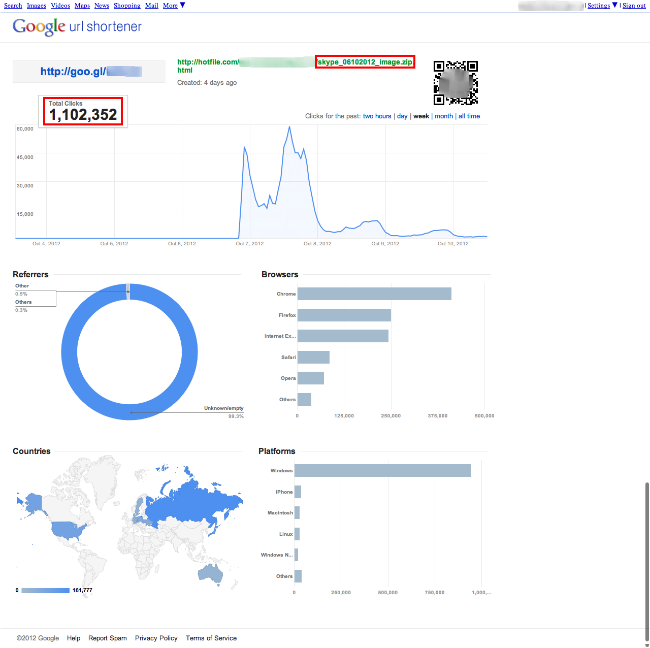
To be exact it happened at 8:00 PM Ecuadorian time (7:00 PM ET). In just 2 hours the number of clicks grew up to 484,111 clicks. I’d say most of the people who clicked got infected since the initial Virus Total (https://www.virustotal.com/) detection for the malware was only from 2 of the 44 AV engines. The actual detection now is 27/43 engines and the actual number of clicks is more than 1 million!
Despite the fact that the original Hotfile malicious URL is already dead, people are still clicking on it. It means the malicious campaign is maintaining a low level of activity and where most of the victims are in Russia. It’s a controversial situation because one of the payloads is the stealing of credit card information from one of the Ecuadorian banks!
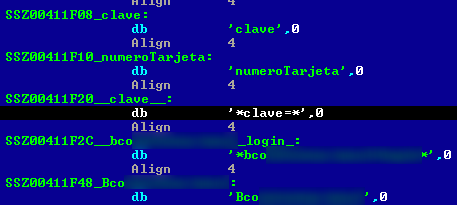
The malware “speaks” many languages, so when I obtained a sample it was spreading between Venezuelan users saying “¿es ésta tu foto de perfil nuevo?” (Translation: Is this your new profile picture?) It speaks at least; Spanish, Portuguese, English and Latvian languages and additionally steals user account information from: .iknowthatgirl, YouPorn, Brazzers, Webnames, Dotster, Enom, 1and1, Moniker, Namecheap, Godaddy, Alertpay, Netflix, Thepiratebay, Torrentleech, Vip-file, Sms4file, Letitbit, Whatcd, eBay, Twitter, Facebook, Yahoo, PayPal and many other services.
The Trojan has an autorun functionality to spread via USB devices. It’s able to spread via MSN Messenger too and all locally saved Skype passwords on the same infected machine by switching automatically between available accounts.
Kaspersky detects this threat as Trojan.Win32.Bublik.jdb
Latest Webinars
Reports
Kaspersky researchers have discovered new Mirage Kitten attacks using previously undocumented malware families: NodeRabbit in Node.js and PollCat in JavaScript.
Our experts discovered a new CoolClient backdoor variant with a kernel-mode rootkit driver that hides malicious processes, files, and network connections from security tools and threat analysts.
Kaspersky experts break down a new Armored Likho campaign that poses as a fundraising efforts and delivers a new Still Toolkit aimed at stealing Telegram data and eavesdropping on victims.
Kaspersky researchers reveal previously undocumented malware attributed to Mirage Kitten (UNC1549, Smoke Sandstorm, Nimbus Manticore): NightLedger backdoor, ArcBridge, and BridgeHead tunneling tools.
Text extracted automatically; images, tables and formatting may be missing. Original: https://securelist.com/hidden-details-about-the-last-skype-spread-malware/57771/