The endless hunt: Looking for patterns in malware data
Full article708 words · extracted from cyberscoop.com · click to collapse
Get our latest cybersecurity news first on Google.
A Comodo dataset is allowing researchers to examine more than 97 million malware incidents — and experts tell CyberScoop it's "just scratching the surface."
“No research is ever really finished,” observes Kenneth Geers, senior research scientist for Comodo.
He’s talking about the second massive set of data he’s crunched in two weeks: The Comodo Threat Labs Q2 2017 report.
It was only a week ago that Geers released Comodo’s Q1 data — the first time the company sought to leverage the huge amounts of information about malware attacks gathered by the 90 million installs of its software across the world.
This time around, the dataset is four times as large — more than 97 million malware incidents — and Geers told CyberScoop the analysis he’s been able to do on it so far is “just scratching the surface.”
“I’m going to be working all week,” he said, preparing for a presentation at DEF CON Saturday.
In Q1, he demonstrated that “different malware types map against [national] GDP per capita.” The more advanced types of malware, like backdoors, make up a greater proportion of the attacks in wealthier countries. For worms, the least sophisticated kind of malware, Geers explained, “It’s the opposite, the highest ratio is in the most impoverished nations.”
The Q2 data bear out one conclusion he drew from the first set: Russia’s IT networks are riddled with malware.
“Russia and South Africa suffered the highest volume of computer worms,” the Q2 report reads. “Frankly, this situation should be urgently addressed within Russian and South African IT security communities. Given the nature of worms, what this means is that many networks in these countries do not have nearly enough licensed, patched and professionally managed hardware and software. Part of this problem, of course, is non-cyber and may take years to rectify.”
This time around, Geers wants to map malware incidence longitudinally — across time as well as space.
“I’m sure we will find clusters of malware activities around [significant] geo-political events … like elections,” he said.
For instance, the data show several spikes in malware activity in the U.S. — the largest in the week of May 8. “I will look into that,” he said.
The other correspondence he wants to check: What happened to malware incident levels in France during the run-up to the election.
In a previous analysis of malware in the middle east he conducted, he said, “For each one of the major spikes [in malware occurrence] there is a geopolitical event that corresponds.”
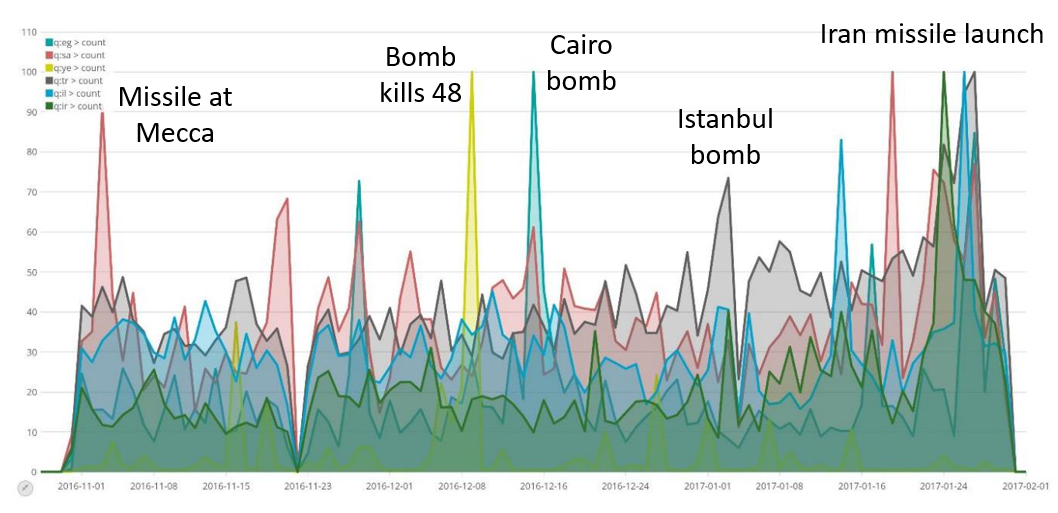
Longitudinal analysis of Middle Eastern malware incidents (Source: Comodo)
For each of those events, “There’s going to be local and international intelligence agencies running [cyber-espionage] collection operations,” in addition to cybercriminals attempting to exploit major news stories with phishing campaigns, Geers said, explaining why the spikes shadow political and other kinds of crisis.
“I don’t want to over dramatize the numbers,” he added, “But I firmly believe there are thousands of cyber-espionage operations being run every day — you can see them in the data.”
Latest Podcasts
Government
FBI officials say AI is bolstering adversaries, emphasizing need to focus on cyber basics, patching
Feds accuse China of ‘systematic’ distillation of U.S. AI models
CIA’s Michael Ellis says cyber intelligence is changing how the agency operates
Jail time for Maine child in 764 marks turning point in federal law enforcement
Technology
Threats
Chinese espionage groups swarm to exploit triple-link chain of zero-days
Microsoft discloses two actively exploited zero-days among 974 vulnerabilities
Russian national extradited to US for alleged involvement in bank-account takeover scheme
Attackers exploit zero-days in consistently besieged SonicWall product
Policy
Whistleblower says USPS deploying new, ‘untested’ IT systems governing mail-in ballots
‘Watershed 250’ test program in Texas looks to private sector for water cybersecurity help
Former sexual abuse victims say Grok used their images, videos to train deepfake capabilities
Cyber threats nudge Trump to sign executive order on foreign equipment in U.S. energy infrastructure
Text extracted automatically; images, tables and formatting may be missing. Original: https://cyberscoop.com/comodo-q2-2017-report-kenneth-geers-def-con/