South Korean ‘Whois Team’ attacks
Full article347 words · extracted from securelist.com · click to collapse



Earlier today, reports of a number of cyberattacks against various South Korean targets hit the news.
The attackers, going by the handle ?Whois Team¦ left a number of messages during the defacements:
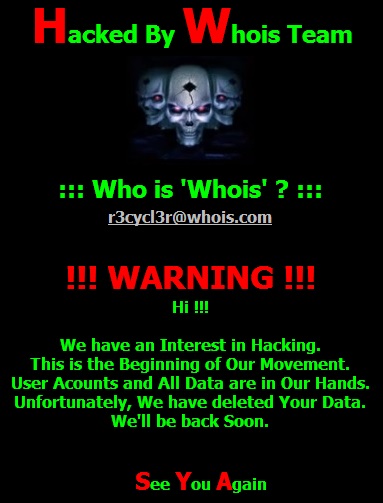
The code used for defacement, posted by an anonymous user to the ?pygments.org¦ forum (see http://pygments.org/demo/68313/) indicates several e-mails used by the attackers:
arrFadeTitles[0] = “[email protected]”;
arrFadeTitles[1] = “[email protected]”;
arrFadeTitles[2] = “[email protected]”;
arrFadeTitles[3] = “[email protected]”;
arrFadeTitles[4] = “[email protected]”;
arrFadeTitles[5] = “[email protected]”;
The screenshots from victim-s computers indicate the at ?Wiper¦ type of malware was also used. We have previously written about two other ?Wiper¦-style malwares: Iranian Wiper and Shamoon.
So, is this an isolated incident or part of a bigger cyberwar campaign? Honestly speaking, we don-t know. If a nation state is NOT behind these attacks, then it’s just cyber-terrorism; cyberwar requires a nation state to be behind the attacks.
In general, if the attacks target critical infrastructure, they can be considered cyber-terrorism. According to the definition of critical infrastructure, banks can be considered as such, therefore, this counts as a cyberterrorism attack.
Previous incidents like Stuxnet and Wiper were part of an ongoing cyberwar campaign that went for years, although in a more stealthy fashion.
Obviously, the attacks were designed to be ‘loud’ – the victims are broadcasting companies and banks. This makes us think we are not dealing with a serious, determined adversary but script kiddies or hacktivists looking for quick fame.
Latest Webinars
Reports
Kaspersky researchers have discovered new Mirage Kitten attacks using previously undocumented malware families: NodeRabbit in Node.js and PollCat in JavaScript.
Our experts discovered a new CoolClient backdoor variant with a kernel-mode rootkit driver that hides malicious processes, files, and network connections from security tools and threat analysts.
Kaspersky experts break down a new Armored Likho campaign that poses as a fundraising efforts and delivers a new Still Toolkit aimed at stealing Telegram data and eavesdropping on victims.
Kaspersky researchers reveal previously undocumented malware attributed to Mirage Kitten (UNC1549, Smoke Sandstorm, Nimbus Manticore): NightLedger backdoor, ArcBridge, and BridgeHead tunneling tools.
Text extracted automatically; images, tables and formatting may be missing. Original: https://securelist.com/south-korean-whois-team-attacks/65106/