Coker tells Senate committee that he’d follow ONCD’s current path if confirmed to top cyber position
Full article1,133 words · extracted from cyberscoop.com · click to collapse
Get our latest cybersecurity news first on Google.
Former NSA executive director says that as national cyber director, he would “continue the good work ONCD has done with its partners.”
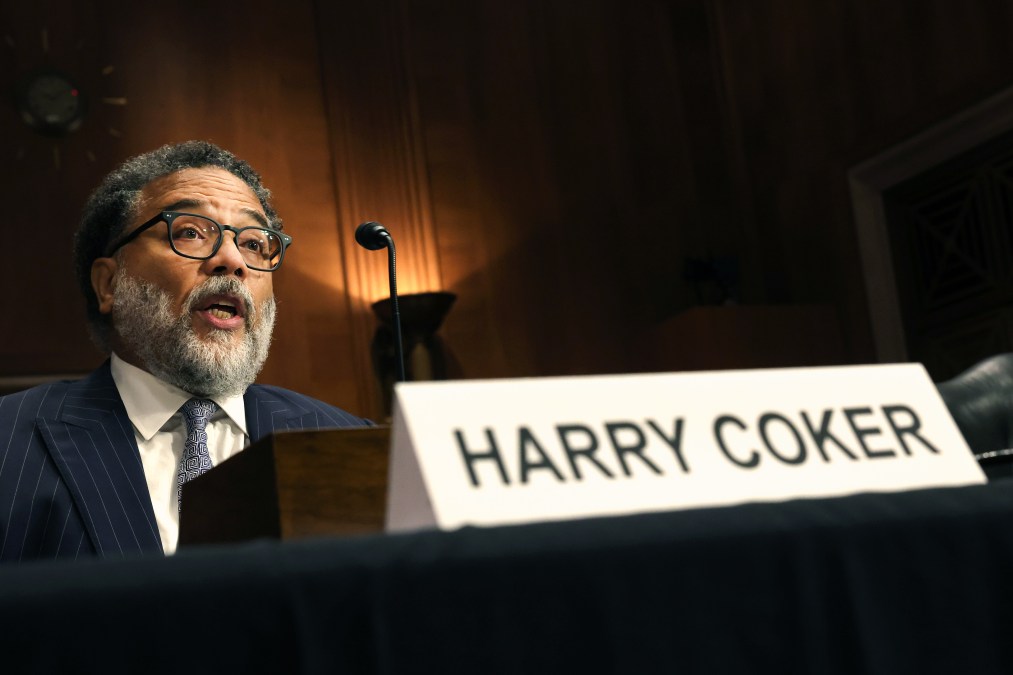
Former National Security Agency Executive Director Harry Coker told members of the Senate Homeland Security and Governmental Affairs Committee that if he’s confirmed as the next national cyber director, he’d largely continue along the same path as his predecessors.
Coker, who also spent 17 years at the Central Intelligence Agency and had made few public appearances before Thursday’s hearing, expressed appreciation for previous Office of the National Cyber Director work, including the National Cybersecurity Strategy, the subsequent implementation plan and the National Cyber Workforce and Education Strategy.
“If confirmed, I would frankly continue the good work that ONCD has done with its partners,” Coker said. He noted in his opening statement he’s “seen the need for stronger partnerships and collaboration between the public and private sectors” and that collaboration would be “the north star” under his leadership.
The congressionally mandated Cyberspace Solarium Commission initially urged the creation of a national cyber director, and the office was made into law through the 2020 National Defense Authorization Act during the Trump administration.
The creation of the office was aimed at creating a position to lead national coordination for U.S. cyber policy, or as Sen. Angus King, I-Maine, put it, “one throat to choke.”
ONCD has pushed out major whole-of-government efforts to reshape foundational aspects of U.S. cyber policy through the release of those strategies. Coker, if confirmed, would take on the implementation of those strategies.
Kemba Walden, who took on the acting director role following the departure of former National Cyber Director Chris Inglis a few weeks before the issuing of the National Cybersecurity Strategy, was the favored permanent pick of many lawmakers and experts. But the White House did not consider Walden because of personal debts, the Washington Post reported, an argument that drew harsh outcry as an unreasonable concern given her record and the fact that having debt is normal among those not born into a higher economic class.
Coker, meanwhile, praised both Inglis and Walden for their work. Asked how he planned to tackle the nation’s cyber workforce issues, Coker said he would follow their lead with a strategy that tackles the “whole of nation” issue “head on.” “It gets the right involvement with the private sector but also with another key partner, the state, local, tribal and territorial governments,” he said.
Coker also noted that addressing any workforce issues has to move beyond targeting only students interested in science, technology, engineering and math.
“We need to change the way we look at vacancy notices [and] job questionnaires. In cyber, it should not be a requirement for everyone to have a four-year degree,” Coker said. “You can get that cyber education without going through a four-year college.”
On the matter of defending critical infrastructure, Coker highlighted the need to “rebalance responsibility” to more capable defenders called out in the National Cybersecurity Strategy, pointing specifically to sectors that have little resources to defend themselves against cyberattacks, such as hospitals.
“That major shift would take some of that responsibility, in this case, away from hospitals and shift it up to those that are more capable,” he said. “For example, our partners across the federal government have specific threat information that they would share [with the] hospital and other entities if it’s credible and timely.”
Coker continued: “Part of ONCD’s responsibilities, as I see it, is to make sure that those that are less capable are more aware of the threats and capabilities that they can take advantage of.”
When asked by Sen. Richard Blumenthal, D-Conn., about how he views ONCD’s role in the 2024 election, Coker said that his “concern is that state and local governments need all the support that they need to be able to execute their respective elections in a safe and accurate and confident way.”
“The role that ONCD and frankly [the] federal government, by and large, would have would be a supporting role to the state, local, tribal and territorial governments with regards to how they run their elections,” Coker said. “If confirmed, from an ONCD perspective, I would ensure that those [governmental bodies] are aware of the resources that are available to them.”
More Scoops

‘Watershed 250’ test program in Texas looks to private sector for water cybersecurity help
The six-month program will be overseen by the Office of the National Cyber Director and Texas Cyber Command to “find out what works.”

Where’s the Trump administration line on AI regulation?

Open-source security is posing challenges governments can’t easily solve
Latest Podcasts
Government
FBI officials say AI is bolstering adversaries, emphasizing need to focus on cyber basics, patching
Feds accuse China of ‘systematic’ distillation of U.S. AI models
CIA’s Michael Ellis says cyber intelligence is changing how the agency operates
The G7 tells industry to hurry up and prep for post-quantum encryption
Technology
Threats
Chinese espionage groups swarm to exploit triple-link chain of zero-days
Microsoft discloses two actively exploited zero-days among 974 vulnerabilities
Russian national extradited to US for alleged involvement in bank-account takeover scheme
Attackers exploit zero-days in consistently besieged SonicWall product
Policy
Whistleblower says USPS deploying new, ‘untested’ IT systems governing mail-in ballots
Former sexual abuse victims say Grok used their images, videos to train deepfake capabilities
Cyber threats nudge Trump to sign executive order on foreign equipment in U.S. energy infrastructure
Election official says Tina Peters would be consultant, won’t have access to election systems
Text extracted automatically; images, tables and formatting may be missing. Original: https://cyberscoop.com/national-cyber-director-hearing-harry-coker/