Hundreds of registered data brokers ignore user requests around personal data
Full article990 words · extracted from cyberscoop.com · click to collapse
Get our latest cybersecurity news first on Google.
Researchers in California contacted data brokers in their state to exercise their rights under the California Privacy Protection Act. Many didn’t reply, while others threw up barriers.
Listen to this article
0:00
Learn more.

There are few laws at the state or federal level to constrain data brokerage, the process by which companies collect and sell bulk data on people they’ve never met or done business with.
States at the forefront of regulating the industry, like California, currently require hundreds of companies to register with the government and provide consumers with the means to opt out of collection or request deletion of their data.
Now, a study from the University of California, Irvine shows that many registered brokers may be ignoring these requirements, and experts tell CyberScoop that state regulators should strengthen their enforcement of current privacy laws.
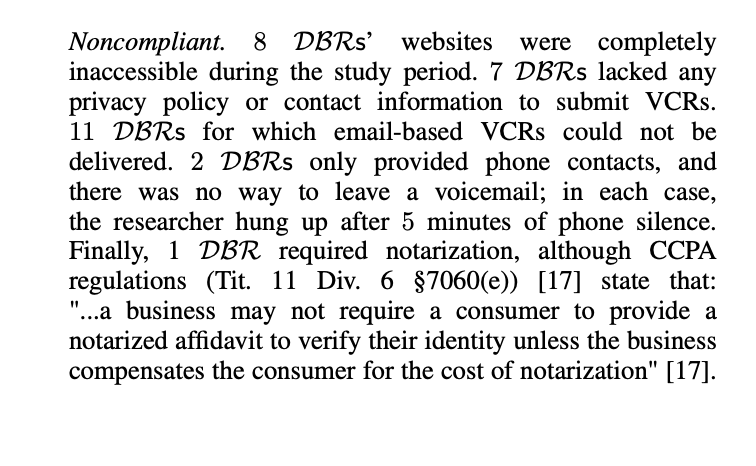
In the study, researchers exercised their rights under the California Consumer Privacy Act by contacting all registered data brokers and requesting details about the data the companies had collected on them. Of the 543 companies contacted, 40% failed to respond in any way, showing “rampant non-compliance” among the registered brokers.
“Our findings reveal rampant non-compliance and lack of standardization of the data access request process,” wrote authors Elina van Kempen, Isita Bagayatkar, Pavel Frolikov, Chloe Georgiou and Gene Tsudik. “These issues highlight an urgent need for stronger enforcement, clearer guidelines, and standardized, periodic compliance checks to enhance consumers’ privacy protections and improve data broker accountability.”
In addition to brokers that didn’t respond, those that did often created numerous hurdles for people trying to access their data. There was no standard process for submitting such requests: some companies required a phone call, others an email, and others asked users to fill out an online form.
The study measured six types of friction in these requests: individual burden, identity verification challenges, response time, response quality, the data collected, and the privacy issues related to the requests.
One key finding was that inconsistent identity procedures across brokers are confusing and “taxing” to the average consumer, forcing them to navigate a patchwork of different requirements.
Many brokers that collect and sell personal data require strict identity verification for consumer data requests, which helps prevent unauthorized access.
On the other hand, the study’s authors say this creates an “unintended privacy paradox” for consumers looking to limit the exposure of their personal data by engaging with brokers directly, as they must often provide additional forms of personal and personally identifiable information along the way.
“Paradoxically, this means that exercising one’s privacy rights under CCPA introduces new privacy risks,” the authors wrote.
The study, which focused solely on companies registered as data brokers in California, may actually understate the problem, as other research has shown that many data brokers don’t carry their disclosures across state lines.
Justin Sherman, a privacy expert and scholar-in-residence at the Electronic Privacy Information Center, told CyberScoop that many brokers seem to hold an odd commitment to privacy principles in one particular instance: verifying the identity of people who object to having a third-party company collect and use their personal information.
“It is beyond irony that there are data brokers who will sell to basically anybody and … yet when someone is saying, ‘I don’t consent to you having collected my data behind my back,’ everything is all of a sudden, ‘how are we going to verify?’ and ‘how are we going to do ‘Know Your Customer’” rules, Sherman said. “It’s talking out of both sides of your mouth. They know that if you create some friction, then people are less likely to cancel.”
Additionally, Sherman noted that for opt-out rights to be effective, “the consumer has to be able to easily exercise them.” A process that forces them to personally contact hundreds of different companies without a standardized process for doing so, he argued, is a recipe for frustration and dark patterns.
He added “there’s no gray area” about how registered brokers are obligated to handle such requests.
“I think the law is very clear. The law says: accept the requests and respond, or reject the requests and respond with the exception you’re setting,” Sherman said, something hundreds of registered brokers failed to do, according to the study.
The California Privacy Protection Agency did not respond to questions from CyberScoop about the UC Irvine study or its own research on data broker noncompliance under the CCPA.
Latest Podcasts
Government
FBI officials say AI is bolstering adversaries, emphasizing need to focus on cyber basics, patching
Feds accuse China of ‘systematic’ distillation of U.S. AI models
CIA’s Michael Ellis says cyber intelligence is changing how the agency operates
The G7 tells industry to hurry up and prep for post-quantum encryption
Technology
Threats
Chinese espionage groups swarm to exploit triple-link chain of zero-days
Microsoft discloses two actively exploited zero-days among 974 vulnerabilities
Russian national extradited to US for alleged involvement in bank-account takeover scheme
Attackers exploit zero-days in consistently besieged SonicWall product
Policy
Whistleblower says USPS deploying new, ‘untested’ IT systems governing mail-in ballots
‘Watershed 250’ test program in Texas looks to private sector for water cybersecurity help
Former sexual abuse victims say Grok used their images, videos to train deepfake capabilities
Cyber threats nudge Trump to sign executive order on foreign equipment in U.S. energy infrastructure
Text extracted automatically; images, tables and formatting may be missing. Original: https://cyberscoop.com/data-brokers-california-ccpa-non-compliance-privacy/