Microsoft fixes record 964 flaws, including 2 exploited zero-days
Microsoft's September Patch Tuesday fixes a record 964 CVEs, including two actively exploited Windows privilege-escalation zero-days, CVE-2026-81963 and CVE-2026-85880.
Microsoft's September 2026 Patch Tuesday addresses 964 customer-patchable CVEs (104 Critical, 860 Important), the largest release on record, out of 974 total listed. Two actively exploited zero-days are fixed: CVE-2026-81963, a link-following elevation-of-privilege flaw in the Windows Update Stack, and CVE-2026-85880, a Windows ALPC heap overflow enabling AppContainer sandbox escape, both with CVSS 7.8. Both zero-days were exploited before a patch was available and grant SYSTEM-level access after an initial foothold. The release also includes high-severity RCE fixes for Windows DNS Server, Remote Desktop Services, Exchange Server, SharePoint, and SQL Server.
- Record 964 customer-patchable CVEs: 104 Critical, 860 Important; 974 total including cloud-only fixes.
- CVE-2026-81963: link-following elevation-of-privilege in Windows Update Stack, actively exploited, CVSS 7.8.
- CVE-2026-85880: Windows ALPC heap overflow lets AppContainer code escape sandbox to SYSTEM, actively exploited.
- High-severity RCE fixes cover Windows DNS Server, RDS, Exchange, SharePoint, SQL Server, and Office.
- Neither zero-day provides remote access alone; both aid post-compromise privilege escalation.
Vulnerabilities mentionedAll →
| CVE | Vulnerability | CVSS | EPSS | Flags | Affected | Exposure | Published |
|---|---|---|---|---|---|---|---|
| CVE-2026-81963 +1 in the same advisory: …85880 | Local Privilege Escalation via Link Following in Windows Update Stack CVE-2026-81963 is a link-following flaw (CWE-59, improper link resolution before file access) in the Microsoft Windows Update Stack, in which the component fails to correctly resolve file links before opening them. A local attacker with low privileges can plant or manipulate a link (symlink/junction) that the privileged update stack follows during operation, redirecting its file access to an attacker-controlled target. The result is local privilege escalation — CVSS 3.1 rates this 7.8 (high) with high confidentiality, integrity, and availability impact — allowing an authorized local user or malware already on the machine to gain elevated rights. Affected products are Windows 11 23H2, 24H2, 25H2, and 26H1 and Windows Server 2025; any unpatched system on those versions is exposed to any local account holder. The flaw was fixed in Microsoft's record September 2026 Patch Tuesday (974 CVEs), was added to CISA's KEV on 2026-09-08 as one of two Windows zero-days reported as exploited in the wild, and has no known public PoC or confirmed ransomware use. Do: Immediately deploy the September 2026 Patch Tuesday cumulative updates to every Windows 11 23H2/24H2/25H2/26H1 and Windows Server 2025 host; as a KEV entry under BOD 26-04, prioritize internet-exposed and high-value assets, apply vendor mitigations (or discontinue use) where patching is delayed, and follow CISA's forensics triage requirements if compromise is suspected. Verify deployment via patch telemetry and review which local accounts can trigger update-stack activity on shared or multi-user systems. | 7.8 | <1% | KEV |
| masswell over 1,000,000 |
Full article654 words · extracted from malwarebytes.com · click to collapse
Microsoft’s September 2026 Patch Tuesday addresses 964 CVEs, including 104 rated Critical and 860 rated Important, making it the company’s largest Patch Tuesday release on record.
Microsoft lists 974 CVEs in its full September security release. However, 10 of those affect cloud services or involve fixes that Microsoft applies itself, leaving 964 vulnerabilities that customers need to patch.
The release includes fixes for two actively exploited Windows zero-days. Both are local elevation-of-privilege vulnerabilities that could allow an attacker who already has access to a device to gain SYSTEM privileges. Neither provides remote access by itself, but SYSTEM-level access is valuable to malware operators after they gain an initial foothold through phishing, stolen credentials, or another method.
How to apply patches and check if you’re protected
These updates fix security problems and help keep your Windows PC protected. Here’s how to make sure you’re up to date:
- Click the Start button, then open Settings.
- Select Windows Update (usually at the bottom of the menu on the left).
- Click Check for updates. Windows will search for the latest security updates. If you’ve enabled Get the latest updates as soon as they’re available under More options, you may be prompted to restart immediately to complete the update. Otherwise, continue to the next step.
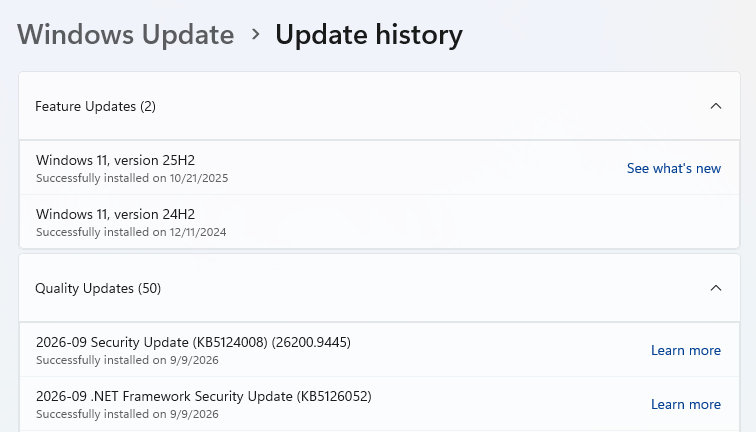
- If updates are available, they’ll start downloading automatically. When they’re ready, click Install or Restart now if prompted. Your computer may need a restart to finish the update.
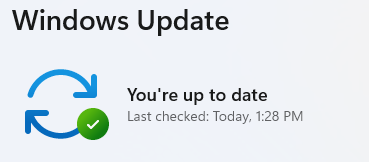
- After restarting, go back to Windows Update and check again. If it says You’re up to date, you’re all set.
Technical details
The unusually large batch also includes high-severity remote-code-execution vulnerabilities in Windows DNS Server and Remote Desktop Services, as well as fixes affecting Exchange Server, SharePoint, SQL Server, Office, and core Windows components.
Let’s take a closer look at the two zero-day vulnerabilities. Microsoft classifies a vulnerability as a zero-day if it was publicly disclosed or actively exploited before an official fix became available.
The first is a Windows Update Stack elevation-of-privilege (EoP) vulnerability with a CVSS score of 7.8 out of 10, tracked as CVE-2026-81963. The description says:
“Improper link resolution before file access (‘link following’) in Windows Update Stack allows an authorized attacker to elevate privileges locally.”
This means Windows can be persuaded to open or modify the wrong file because it follows a shortcut-like pointer without properly checking where that pointer leads. Microsoft says attackers exploited the bug before a patch was available.
The second zero-day, tracked as CVE-2026-85880, also has a CVSS score of 7.8 out of 10. Microsoft describes it as:
“heap-based buffer overflow in Windows ALPC allows an authorized attacker to elevate privileges locally.”
Microsoft says an attacker who can execute code in a low-privilege AppContainer could exploit the vulnerability locally to escape the sandbox and elevate their privileges on the affected system. No additional user interaction is required.
Windows ALPC is an internal messaging system in the Windows operating system that allows different programs on the same computer to communicate with each other quickly.
A buffer overflow occurs when an area of memory within a software application reaches its boundary and data spills into an adjacent memory region. The heap is a region of memory used for dynamic memory allocation.
These are not the kinds of bugs a typical victim triggers merely by opening a malicious document or visiting a website. But local privilege escalation is a critical part of many attack chains: After malware runs with limited rights, a SYSTEM-level exploit can help an intruder disable defenses, access protected data, establish persistence, or move through a network.
From reporting threats to removing them.
Cybersecurity risks should never spread beyond a headline. Keep threats off your devices by downloading Malwarebytes today.
About the author
Was a Microsoft MVP in consumer security for 12 years running. Can speak four languages. Smells of rich mahogany and leather-bound books.
Text extracted automatically; images, tables and formatting may be missing. Original: https://www.malwarebytes.com/blog/news/2026/09/microsoft-fixes-record-964-flaws-including-2-exploited-zero-days